
含结晶外加剂的快凝砂浆的孔隙率及SA-PA改性效果
Porosity of a Fast-Setting Mortar with Crystallization Admixture and Effect of a SA-PA Modification.
作者信息
Cotini Oscar, Di Maggio Rosa, Tonelli Daniel, Nascimben Roger, Ataollahi Narges
机构信息
Department of Civil, Environmental and Mechanical Engineering, University of Trento, 38123 Trento, Italy.
出版信息
Materials (Basel). 2022 Feb 18;15(4):1542. doi: 10.3390/ma15041542.
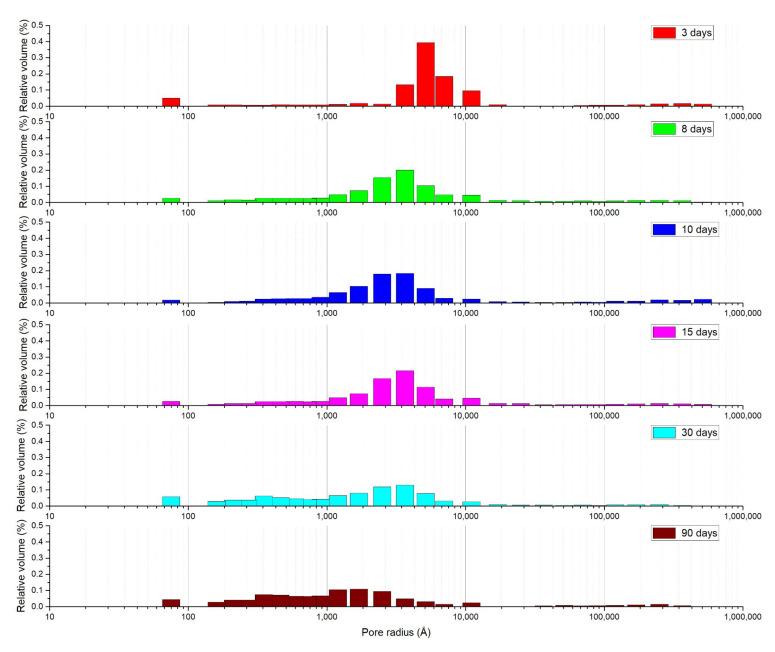
Air permeability measurements according to the Hagen-Poiseuille equation, Scanning Electron Microscopy (SEM) and mercury intrusion porosimetry (MIP) tests were conducted on samples of cementitious mortar at different curing times to study the correlation between the increased crystallization and their microstructure. The mortar samples were prepared with a commercial fast-setting premix containing calcium silicates and quartz. The average permeability coefficient (K) was 2.96 × 10 m after 3 days and decreased to 3.07 × 10 m after about one month. The continuous C-S-H nucleation in the capillary pores of the cement mortar changes their shape and improves the mortar's impermeability. The SEM images showed the development of crystals that refine the pore size distribution of the cement paste, with more of the smallest pores, and fewer of the largest, as demonstrated by the MIP measurements. Adding a superabsorbent polyacrylate (SA-PA) in the amount of 0.5% wt of dry powder, without adding any extra water, makes a mortar less fluid but not faster-setting. Twenty-four hours after mixing and casting, it is still plastic and, with time, the pore size distribution differs from that of standard mortar. Over time in air, permeability remains high, but in water it could be low due to swelling of SA-PA residues.
根据哈根 - 泊肃叶方程进行透气率测量,对不同养护时间的水泥砂浆样品进行扫描电子显微镜(SEM)和压汞孔隙率测定(MIP)试验,以研究结晶增加与其微观结构之间的相关性。砂浆样品采用含有硅酸钙和石英的商用速凝预混料制备。3天后平均渗透系数(K)为2.96×10米,约一个月后降至3.07×10米。水泥砂浆毛细管孔隙中连续的C - S - H成核改变了它们的形状并提高了砂浆的抗渗性。SEM图像显示晶体的生长细化了水泥浆体的孔径分布,如MIP测量所示,最小孔径的孔隙更多,最大孔径的孔隙更少。添加0.5%重量的干粉状高吸水性聚丙烯酸酯(SA - PA),不添加任何额外的水,会使砂浆流动性降低但不会加快凝结速度。搅拌和浇筑24小时后,它仍然呈塑性,随着时间推移,其孔径分布与标准砂浆不同。在空气中放置一段时间后,渗透率仍然很高,但由于SA - PA残留物的膨胀,在水中渗透率可能较低。



 Zotero 插件