Kralj Thomas, Nuske Madison, Hofferek Vinzenz, Sani Marc-Antoine, Lee Tzong-Hsien, Separovic Frances, Aguilar Marie-Isabel, Reid Gavin E
School of Chemistry, Bio21 Molecular Science and Biotechnology Institute, The University of Melbourne, Melbourne, VIC 3010, Australia.
Department of Biochemistry and Molecular Biology, Monash University, Clayton, VIC 3800, Australia.
Metabolites. 2022 Feb 11;12(2):171. doi: 10.3390/metabo12020171.
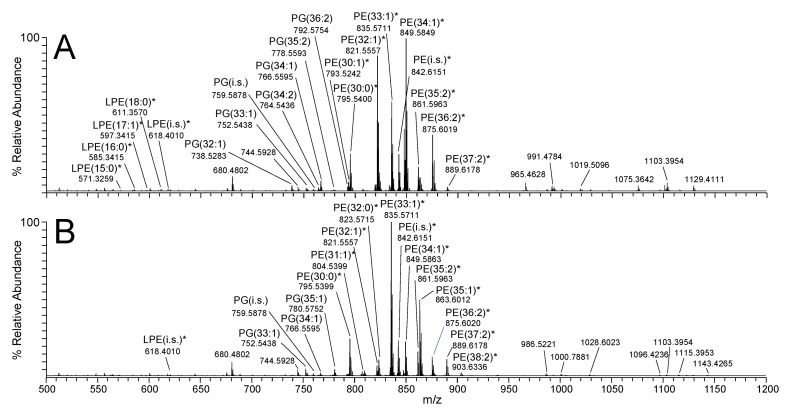
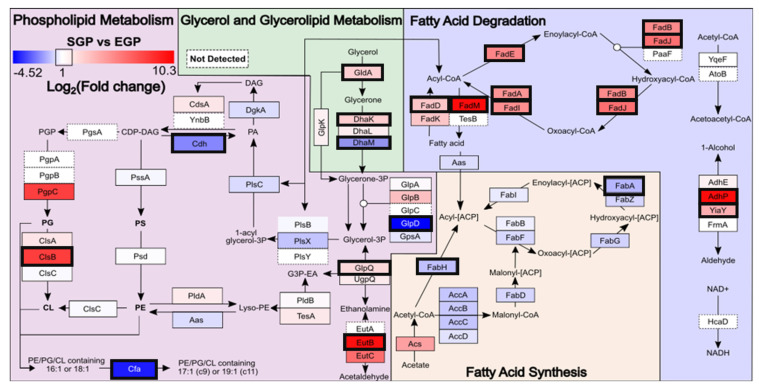
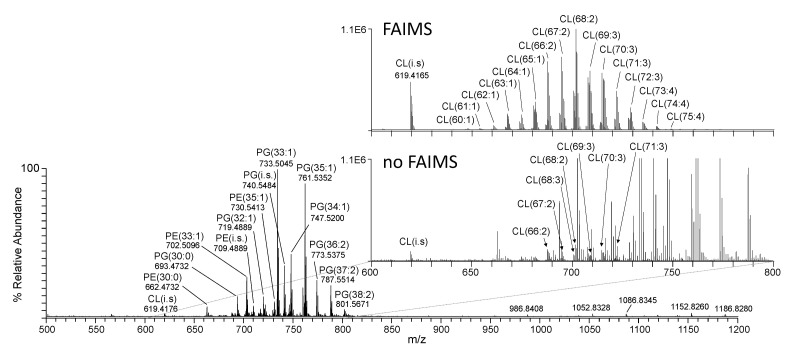
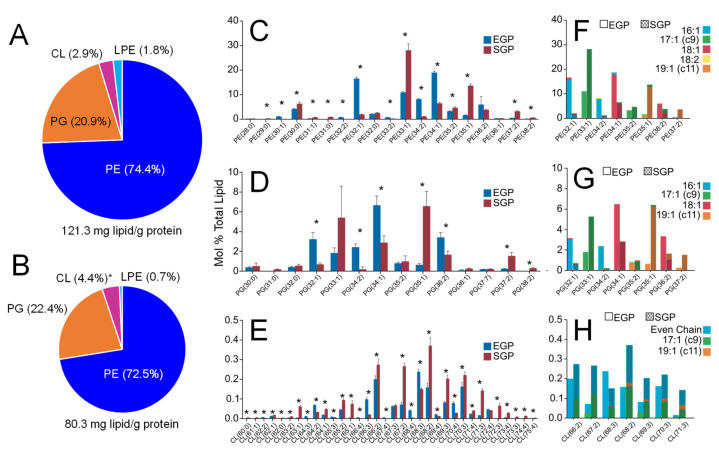
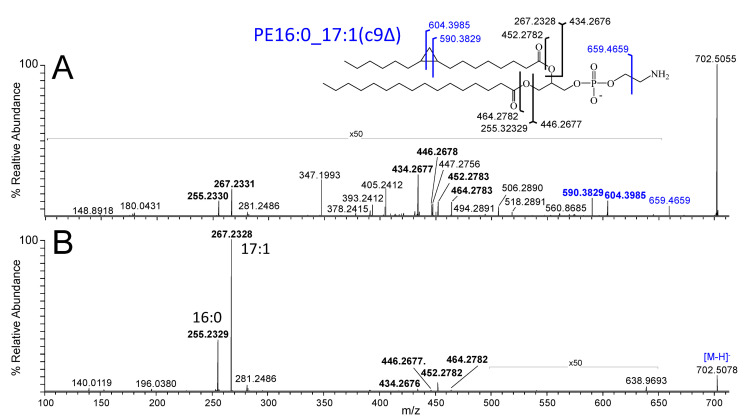
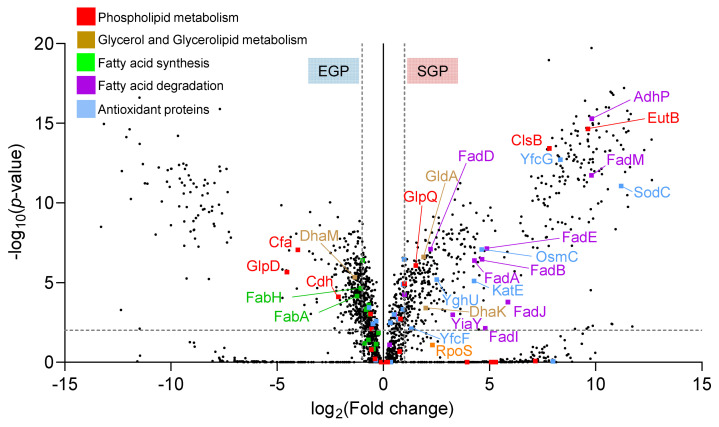
As an adaptive survival response to exogenous stress, bacteria undergo dynamic remodelling of their lipid metabolism pathways to alter the composition of their cellular membranes. Here, using as a well characterised model system, we report the development and application of a 'multi-omics' strategy for comprehensive quantitative analysis of the temporal changes in the lipidome and proteome profiles that occur under exponential growth phase versus stationary growth phase conditions i.e., nutrient depletion stress. Lipidome analysis performed using 'shotgun' direct infusion-based ultra-high resolution accurate mass spectrometry revealed a quantitative decrease in total lipid content under stationary growth phase conditions, along with a significant increase in the mol% composition of total cardiolipin, and an increase in 'odd-numbered' acyl-chain length containing glycerophospholipids. The inclusion of field asymmetry ion mobility spectrometry was shown to enable the enrichment and improved depth of coverage of low-abundance cardiolipins, while ultraviolet photodissociation-tandem mass spectrometry facilitated more complete lipid structural characterisation compared with conventional collision-induced dissociation, including unambiguous assignment of the odd-numbered acyl-chains as containing cyclopropyl modifications. Proteome analysis using data-dependent acquisition nano-liquid chromatography mass spectrometry and tandem mass spectrometry analysis identified 83% of the predicted lipid metabolism enzymes, which enabled the temporal dependence associated with the expression of key enzymes responsible for the observed adaptive lipid metabolism to be determined, including those involved in phospholipid metabolism (e.g., ClsB and Cfa), fatty acid synthesis (e.g., FabH) and degradation (e.g., FadA/B,D,E,I,J and M), and proteins involved in the oxidative stress response resulting from the generation of reactive oxygen species during β-oxidation or lipid degradation.
作为对外源应激的一种适应性生存反应,细菌会对其脂质代谢途径进行动态重塑,以改变细胞膜的组成。在此,我们以一个特征明确的模型系统为研究对象,报告了一种“多组学”策略的开发与应用,用于全面定量分析在指数生长期与稳定生长期条件下(即营养耗尽应激)脂质组和蛋白质组谱随时间的变化。使用基于“鸟枪法”直接进样的超高分辨率精确质量质谱进行脂质组分析,结果显示在稳定生长期条件下总脂质含量定量减少,同时总心磷脂的摩尔百分比组成显著增加,且含奇数碳酰基链长度的甘油磷脂增加。结果表明,采用场不对称离子淌度质谱能够富集并提高低丰度心磷脂的覆盖深度,而与传统的碰撞诱导解离相比,紫外光解离串联质谱有助于更完整地表征脂质结构,包括明确将奇数碳酰基链确定为含有环丙基修饰。使用数据依赖采集的纳升液相色谱质谱和串联质谱分析进行蛋白质组分析,鉴定出了预测的脂质代谢酶中的83%,这使得能够确定与观察到的适应性脂质代谢相关的关键酶表达的时间依赖性,包括参与磷脂代谢的酶(如ClsB和Cfa)、脂肪酸合成酶(如FabH)和降解酶(如FadA/B、D、E、I、J和M),以及参与β氧化或脂质降解过程中活性氧生成所导致的氧化应激反应的蛋白质。