Boyer Pierre H, Barthel Cathy, Mohseni-Zadeh Mahsa, Talagrand-Reboul Emilie, Frickert Mathieu, Jaulhac Benoit, Boulanger Nathalie
UR7290: Virulence Bactérienne Précoce: Groupe Borrelia, Institut de Bactériologie, FMTS, University of Strasbourg, 67000 Strasbourg, France.
Hôpitaux Civils de Colmar, Service de Maladies Infectieuses, 39 Avenue de la Liberté, 68000 Colmar, France.
Microorganisms. 2022 Jan 23;10(2):245. doi: 10.3390/microorganisms10020245.
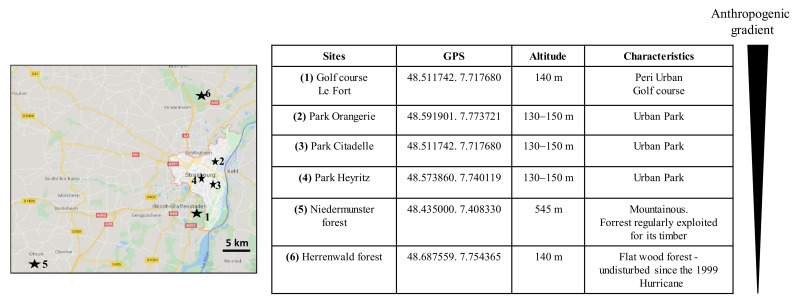
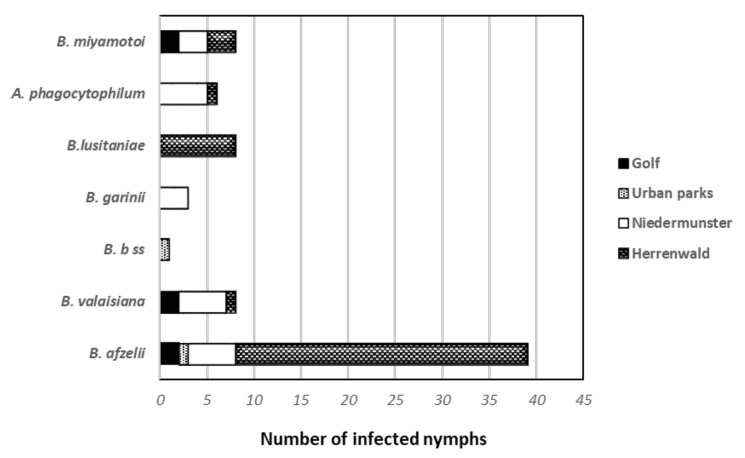
Ticks and tick-borne diseases have spread over the last decades. In parallel, the incidence in humans, accidental hosts for most of these zoonotic diseases, has increased. This epidemiological intensification can be associated with anthropogenic alterations of forest ecosystems and animal biodiversity, but also with socioeconomic changes. Their proliferation is largely due to human-induced effects on the factors that favor the circulation of these infectious agents. We selected different types of anthropogenic environments in Alsace, a region endemic for tick-borne diseases in France, to better understand the impact of human interventions on tick populations and tick-borne disease incidence. Ticks were collected in one golf course, three urban parks, one mid-mountain forest, and one alluvial forest that is currently part of a protected natural area. was found primarily in humid vegetation, which is favorable for tick survival, such as grounds populated with trees and covered with leaf litter. We also observed that reforestation and high animal biodiversity in a protected area such as the alluvial forest led to a greater number of ticks, including both and , as well as to a higher prevalence of pathogens such as sensu lato, , , and .
蜱虫及蜱传疾病在过去几十年中不断蔓延。与此同时,作为这些人畜共患病大多数的偶然宿主,人类感染病例有所增加。这种流行病学上的加剧可能与森林生态系统和动物生物多样性的人为改变有关,也与社会经济变化有关。它们的扩散很大程度上归因于人类对有利于这些传染源传播的因素所产生的影响。我们在法国蜱传疾病的一个流行地区阿尔萨斯选择了不同类型的人为环境,以更好地了解人类干预对蜱虫种群和蜱传疾病发病率的影响。蜱虫采集于一个高尔夫球场、三个城市公园、一个中山森林和一个目前属于受保护自然区域一部分的冲积森林。主要在潮湿植被中发现蜱虫,潮湿植被有利于蜱虫生存,比如树木繁茂且覆盖着落叶层的地面。我们还观察到,在冲积森林这样的保护区进行重新造林和拥有较高的动物生物多样性会导致蜱虫数量增加,包括硬蜱属和璃眼蜱属,以及诸如狭义伯氏疏螺旋体、嗜吞噬细胞无形体、巴贝斯虫属和泰勒立克次体等病原体的更高流行率。