Alviz-Gazitua Pablo, Durán Roberto E, Millacura Felipe A, Cárdenas Franco, Rojas Luis A, Seeger Michael
Laboratorio de Microbiología Molecular y Biotecnología Ambiental, Departamento de Química & Centro de Biotecnología, Universidad Técnica Federico Santa María, Avenida España 1680, Valparaíso 2390123, Chile.
Departamento de Ciencias Biológicas y Biodiversidad, Universidad de los Lagos, Osorno 5311890, Chile.
Microorganisms. 2022 Feb 21;10(2):484. doi: 10.3390/microorganisms10020484.
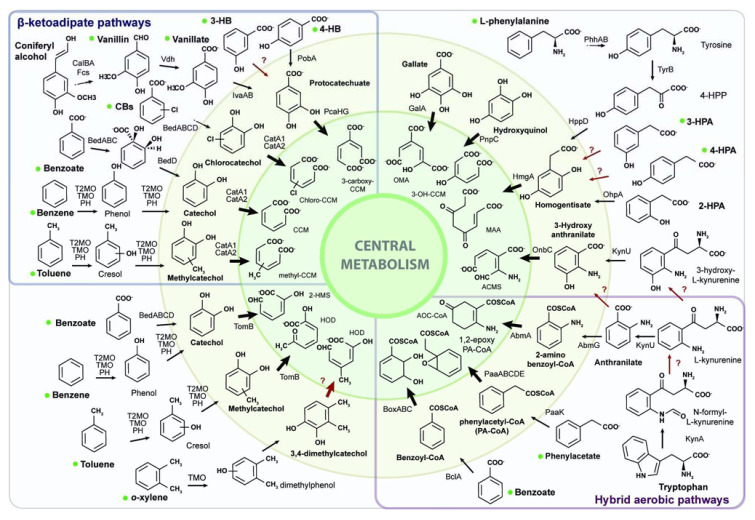
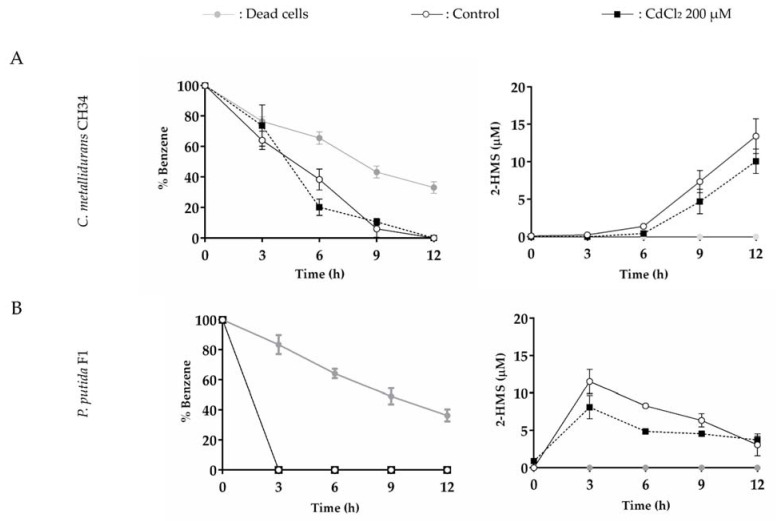
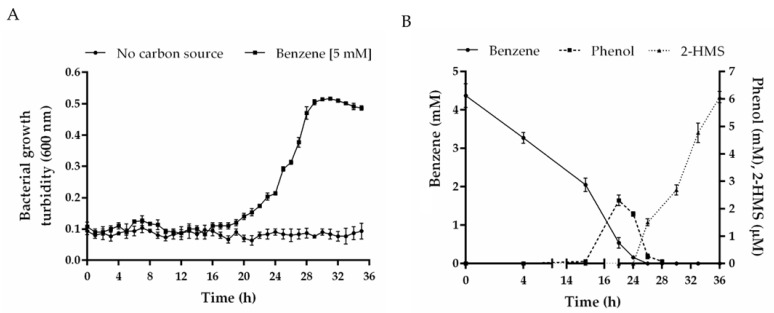
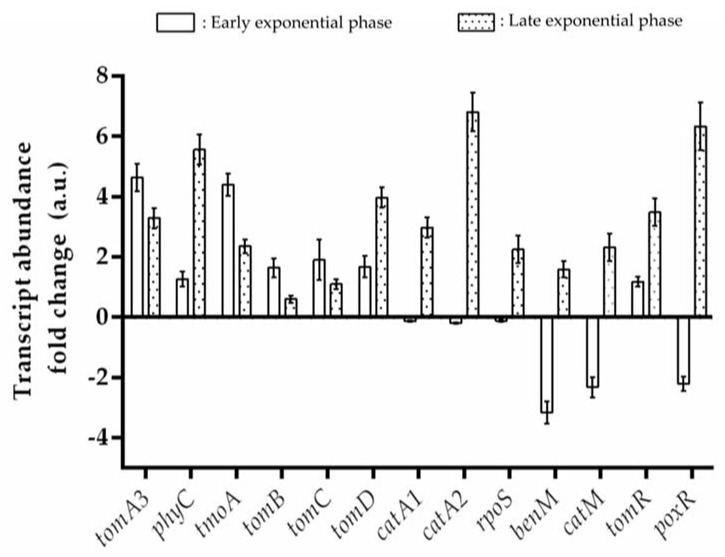
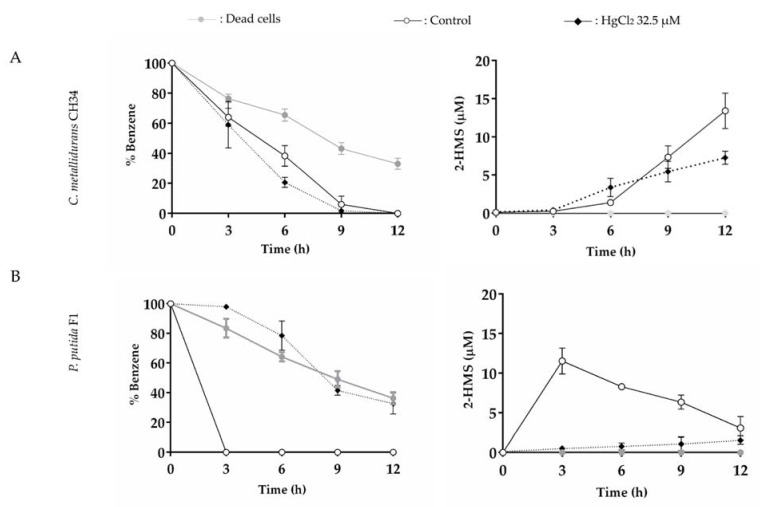
Heavy metal co-contamination in crude oil-polluted environments may inhibit microbial bioremediation of hydrocarbons. The model heavy metal-resistant bacterium CH34 possesses cadmium and mercury resistance, as well as genes related to the catabolism of hazardous BTEX aromatic hydrocarbons. The aims of this study were to analyze the aromatic catabolic potential of CH34 and to determine the functionality of the predicted benzene catabolic pathway and the influence of cadmium and mercury on benzene degradation. Three chromosome-encoded bacterial multicomponent monooxygenases (BMMs) are involved in benzene catabolic pathways. Growth assessment, intermediates identification, and gene expression analysis indicate the functionality of the benzene catabolic pathway. Strain CH34 degraded benzene via phenol and 2-hydroxymuconic semialdehyde. Transcriptional analyses revealed a transition from the expression of catechol 2,3-dioxygenase () in the early exponential phase to catechol 1,2-dioxygenase ( and ) in the late exponential phase. The minimum inhibitory concentration to Hg (II) and Cd (II) was significantly lower in the presence of benzene, demonstrating the effect of co-contamination on bacterial growth. Notably, this study showed that CH34 degraded benzene in the presence of Hg (II) or Cd (II).
原油污染环境中的重金属共污染可能会抑制碳氢化合物的微生物生物修复。模式重金属抗性细菌CH34具有镉和汞抗性,以及与有害BTEX芳香烃分解代谢相关的基因。本研究的目的是分析CH34的芳香族分解代谢潜力,确定预测的苯分解代谢途径的功能以及镉和汞对苯降解的影响。三种染色体编码的细菌多组分单加氧酶(BMMs)参与苯分解代谢途径。生长评估、中间产物鉴定和基因表达分析表明了苯分解代谢途径的功能。菌株CH34通过苯酚和2-羟基粘康酸半醛降解苯。转录分析显示,在指数生长前期儿茶酚2,3-双加氧酶()表达,而在指数生长后期儿茶酚1,2-双加氧酶(和)表达,呈现出一种转变。在有苯存在的情况下,对Hg(II)和Cd(II)的最低抑菌浓度显著降低,表明共污染对细菌生长的影响。值得注意的是,本研究表明CH34在Hg(II)或Cd(II)存在的情况下能够降解苯。