Dipartimento di Farmacia e Biotecnologie (FABIT), Università di Bologna, I-40126 Bologna, Italy.
Dipartimento di Scienze Biomediche e Neuromotorie (DIBINEM), Università di Bologna, I-40100 Bologna, Italy.
Molecules. 2022 Feb 16;27(4):1341. doi: 10.3390/molecules27041341.
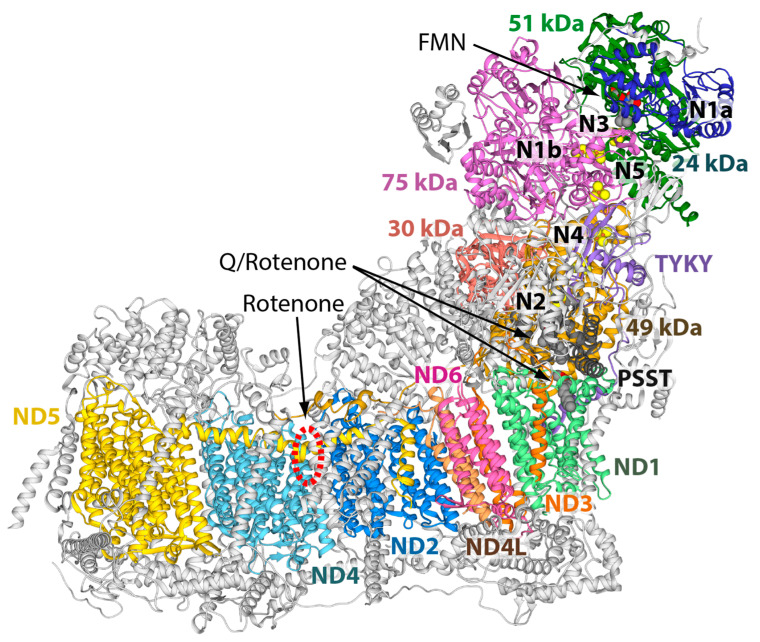
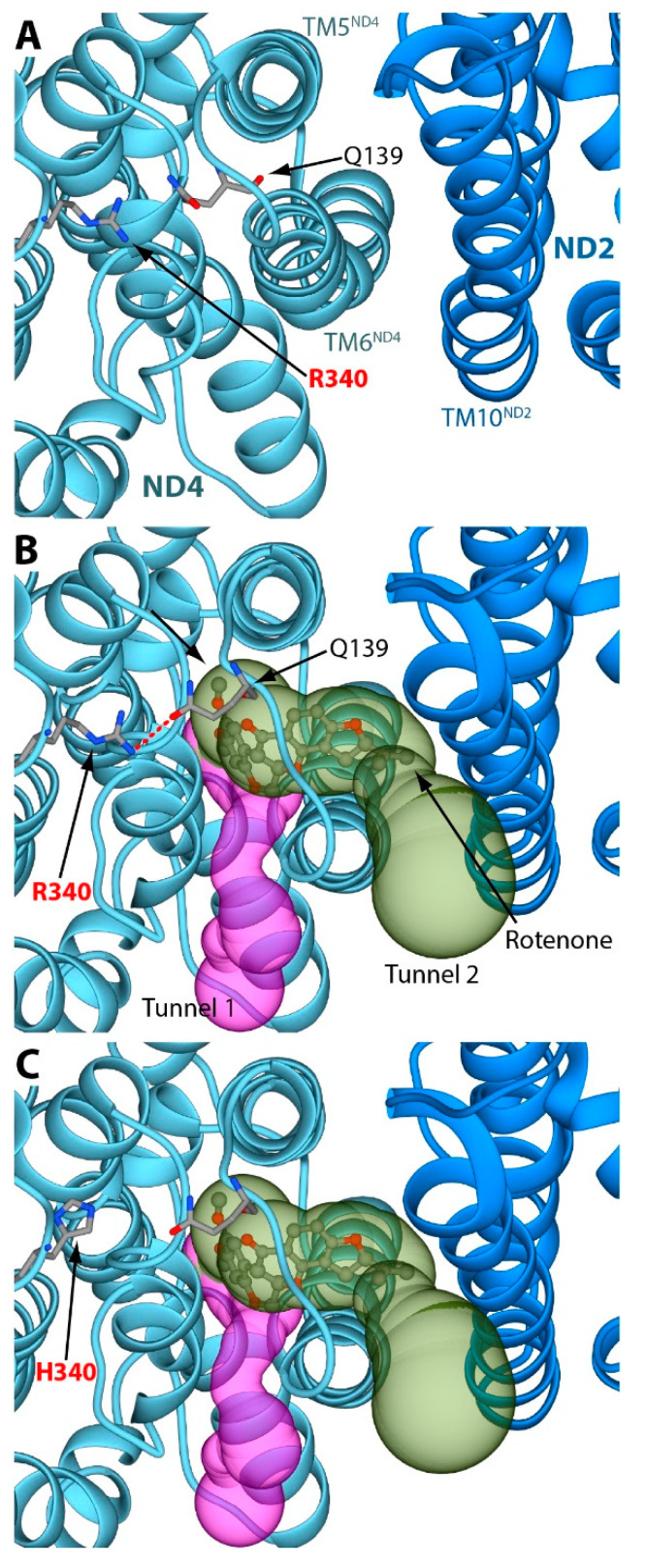
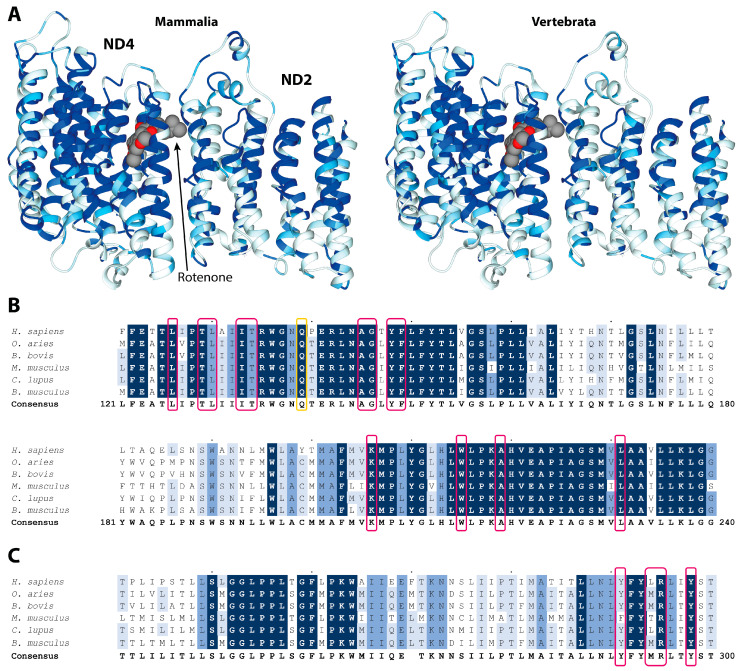
The finding that the most common mitochondrial DNA mutation m.11778G>A/ (p.R340H) associated with Leber's hereditary optic neuropathy (LHON) induces rotenone resistance has produced a long-standing debate, because it contrasts structural evidence showing that the ND4 subunit is far away from the quinone-reaction site in complex I, where rotenone acts. However, recent cryo-electron microscopy data revealed that rotenone also binds to the ND4 subunit. We investigated the possible structural modifications induced by the LHON mutation and found that its amino acid replacement would disrupt a possible hydrogen bond between native R340 and Q139 in ND4, thereby destabilizing rotenone binding. Our analysis thus explains rotenone resistance in LHON patients as a biochemical signature of its pathogenic effect on complex I.
研究发现,与莱伯遗传性视神经病变(LHON)相关的最常见线粒体 DNA 突变 m.11778G>A/(p.R340H) 会诱导对鱼藤酮的抗性,这引发了长期的争论,因为这与结构证据相矛盾,结构证据表明 ND4 亚基远离复合体 I 中的醌反应位点,而鱼藤酮在此处发挥作用。然而,最近的冷冻电子显微镜数据显示,鱼藤酮也与 ND4 亚基结合。我们研究了 LHON 突变可能引起的结构修饰,并发现其氨基酸替换会破坏 ND4 中天然 R340 和 Q139 之间可能的氢键,从而使鱼藤酮结合不稳定。因此,我们的分析将 LHON 患者对鱼藤酮的抗性解释为其对复合体 I 产生致病性影响的生化特征。