A. A. Martinos Center for Biomedical Imaging, Massachusetts General Hospital, Boston, MA, USA.
Department of Radiology, Stanford University, Stanford, CA, USA.
Sci Rep. 2022 Feb 24;12(1):3155. doi: 10.1038/s41598-022-07092-9.
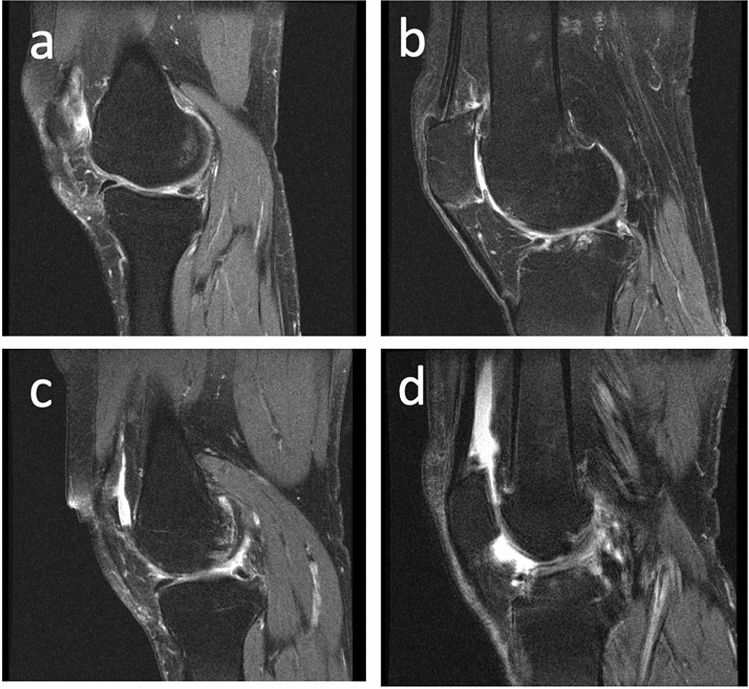
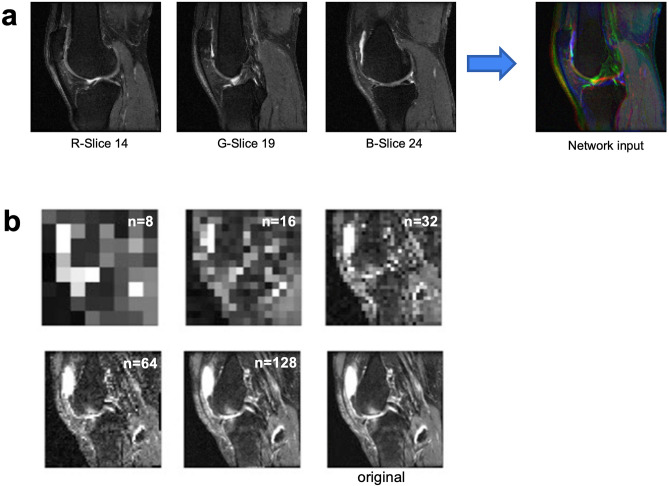
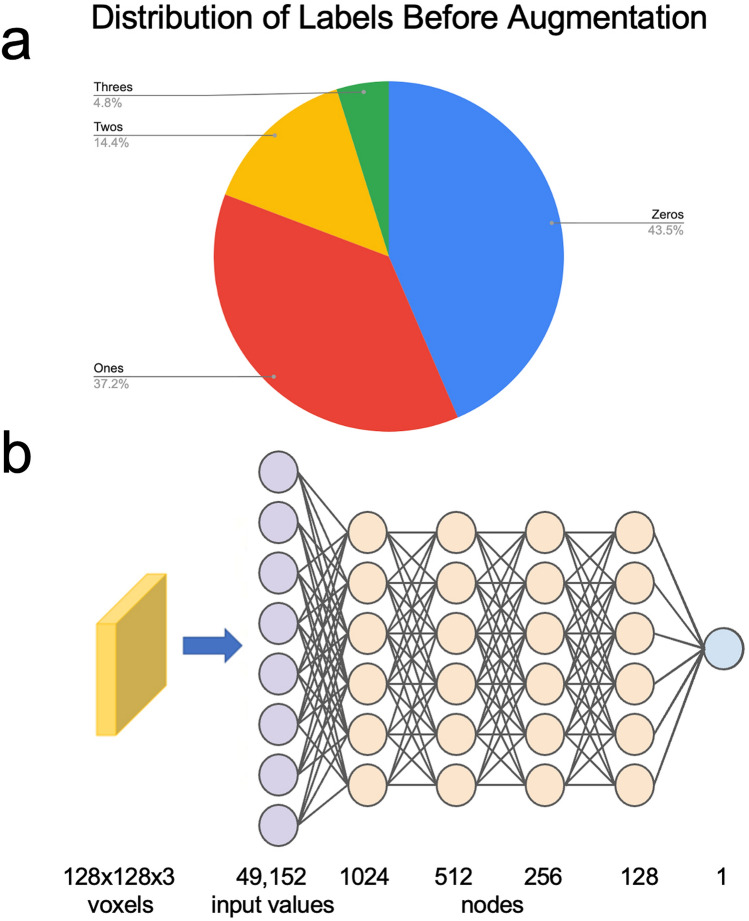
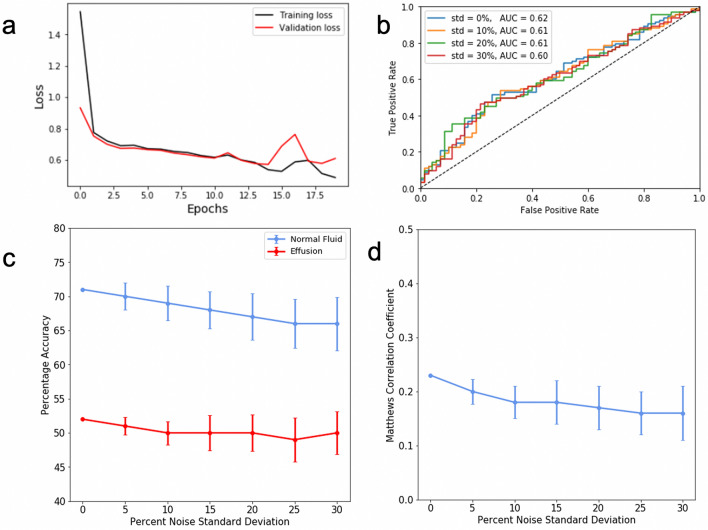
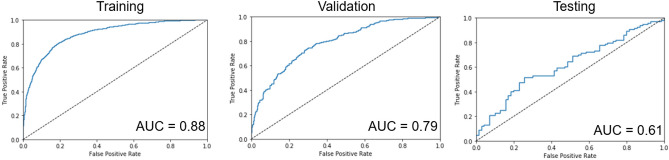
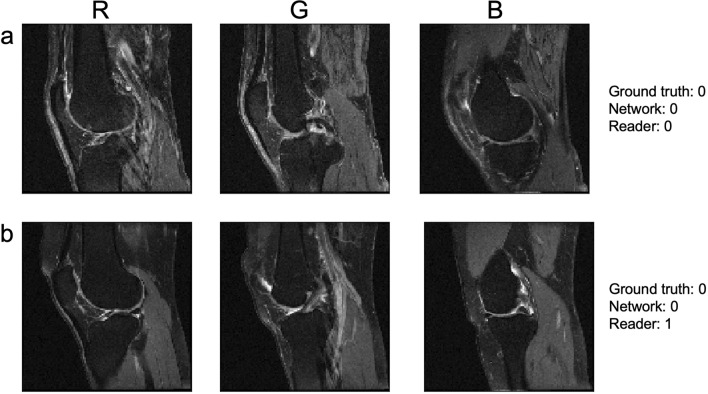
Knee effusion is a common comorbidity in osteoarthritis. To quantify the amount of effusion, semi quantitative assessment scales have been developed that classify fluid levels on an integer scale from 0 to 3. In this work, we investigated the use of a neural network (NN) that used MRI Osteoarthritis Knee Scores effusion-synovitis (MOAKS-ES) values to distinguish physiologic fluid levels from higher fluid levels in MR images of the knee. We evaluate its effectiveness on low-resolution images to examine its potential in low-field, low-cost MRI. We created a dense NN (dNN) for detecting effusion, defined as a nonzero MOAKS-ES score, from MRI scans. Both the training and performance evaluation of the network were conducted using public radiological data from the Osteoarthritis Initiative (OAI). The model was trained using sagittal turbo-spin-echo (TSE) MR images from 1628 knees. The accuracy was compared to VGG16, a commonly used convolutional classification network. Robustness of the dNN was assessed by adding zero-mean Gaussian noise to the test images with a standard deviation of 5-30% of the maximum test data intensity. Also, inference was performed on a test data set of 163 knees, which includes a smaller test set of 36 knees that was also assessed by a musculoskeletal radiologist and the performance of the dNN and the radiologist compared. For the larger test data set, the dNN performed with an average accuracy of 62%. In addition, the network proved robust to noise, classifying the noisy images with minimal degradation to accuracy. When given MRI scans with 5% Gaussian noise, the network performed similarly, with an average accuracy of 61%. For the smaller 36-knee test data set, assessed both by the dNN and by a radiologist, the network performed better than the radiologist on average. Classifying knee effusion from low-resolution images with a similar accuracy as a human radiologist using neural networks is feasible, suggesting automatic assessment of images from low-cost, low-field scanners as a potentially useful assessment tool.
膝关节积液是骨关节炎的一种常见合并症。为了定量评估积液量,已经开发出半定量评估量表,将液体水平按整数从 0 到 3 进行分类。在这项工作中,我们研究了使用神经网络 (NN) 的方法,该方法使用 MRI 骨关节炎膝关节评分积液-滑膜炎 (MOAKS-ES) 值来区分膝关节 MRI 图像中生理水平的积液与更高水平的积液。我们评估了它在低分辨率图像上的有效性,以检查其在低场、低成本 MRI 中的潜在应用。我们创建了一个用于检测积液的密集神经网络 (dNN),定义为 MOAKS-ES 评分非零。网络的训练和性能评估均使用来自骨关节炎倡议 (OAI) 的公共放射学数据进行。该模型使用来自 1628 个膝关节的矢状面涡轮自旋回波 (TSE) MR 图像进行训练。将准确性与常用的卷积分类网络 VGG16 进行了比较。通过向测试图像添加均值为零的高斯噪声,并将标准差设置为最大测试数据强度的 5-30%,评估 dNN 的稳健性。此外,还对包括由肌肉骨骼放射科医生评估的 36 个膝关节较小测试集的 163 个膝关节测试数据集进行了推断,并比较了 dNN 和放射科医生的性能。对于较大的测试数据集,dNN 的平均准确率为 62%。此外,该网络对噪声具有很强的鲁棒性,对图像进行分类时,其准确性几乎没有降低。当给 5%高斯噪声的 MRI 扫描时,网络的性能相似,平均准确率为 61%。对于较小的 36 个膝关节测试数据集,由 dNN 和放射科医生评估,网络的性能平均优于放射科医生。使用神经网络以与人类放射科医生相似的准确度从低分辨率图像中分类膝关节积液是可行的,这表明使用低成本、低场扫描仪的图像自动评估可能是一种有用的评估工具。