Chen Liang, Ding Xiao-Hang, Fan Kang-Jun, Gao Ming-Xin, Yu Wen-Yuan, Liu Hong-Li, Yu Yang
Department of Cardiac Surgery, Beijing Anzhen Hospital, Capital Medical University, Beijing, 100029, People's Republic of China.
Diabetes Metab Syndr Obes. 2022 Feb 16;15:439-450. doi: 10.2147/DMSO.S343374. eCollection 2022.
Data on the relationship between the triglyceride glucose (TyG) index and prognosis after off-pump coronary artery bypass grafting (OPCABG) are limited. This retrospective observational cohort study evaluated the association of the TyG index with prognosis in patients with diabetes mellitus who underwent OPCABG.
The TyG index was calculated using the following equation: TyG index = ln (fasting triglyceride level [mg/dL] × fasting glucose level [mg/dL]/2). The primary outcomes included the occurrence of major adverse cardiovascular and cerebrovascular events (MACCEs), which were defined as all-cause death, nonfatal myocardial infarction, nonfatal stroke and symptomatic graft failure. The association between the TyG index and MACCEs was assessed by Cox proportional hazards regression analysis.
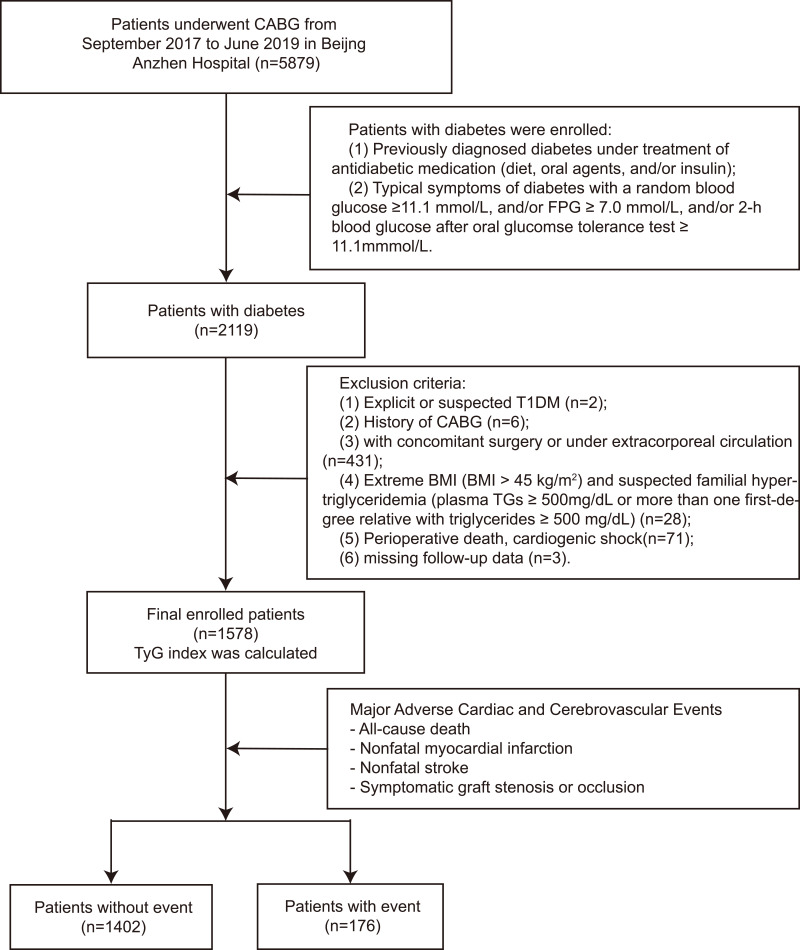
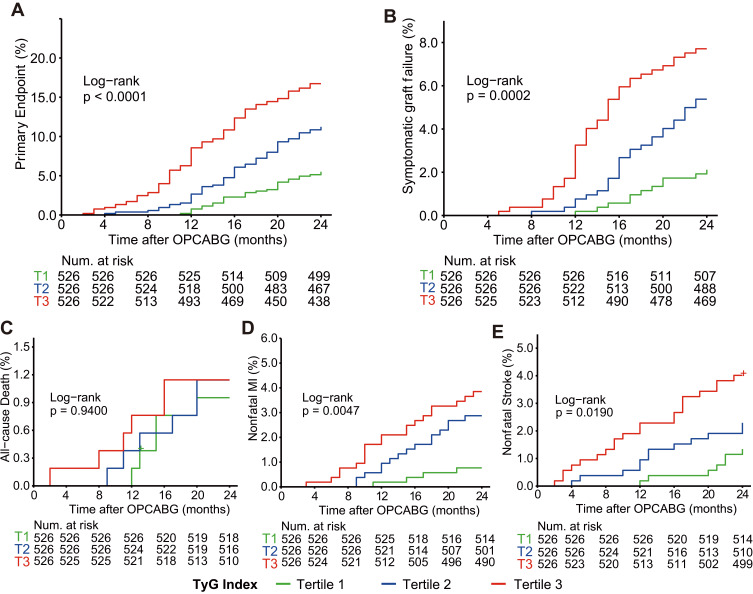
A total of 1578 patients with diabetes who underwent OPCABG (mean age, 62.9 ± 8.0 years; men, 72.7%) were enrolled in this study. Over the follow-up of 2 years, 176 patients (11.2%) had at least 1 primary endpoint event. The follow-up incidence of the primary endpoint rose with increasing TyG index tertiles. The multivariate Cox proportional hazards regression analysis adjusted for multiple confounders revealed a hazard ratio for the primary endpoint of 2.133 (95% CI 1.347-3.377; P for trend = 0.001) when the highest and lowest TyG index tertiles were compared.
The TyG index was significantly and positively associated with MACCEs, suggesting that the TyG index may be a valuable predictor of adverse cardiovascular and cerebrovascular outcomes after OPCABG in patients with T2DM.
关于非体外循环冠状动脉旁路移植术(OPCABG)后甘油三酯葡萄糖(TyG)指数与预后关系的数据有限。这项回顾性观察性队列研究评估了TyG指数与接受OPCABG的糖尿病患者预后的相关性。
TyG指数通过以下公式计算:TyG指数=ln(空腹甘油三酯水平[mg/dL]×空腹血糖水平[mg/dL]/2)。主要结局包括主要不良心血管和脑血管事件(MACCEs),定义为全因死亡、非致命性心肌梗死、非致命性中风和有症状的移植失败。通过Cox比例风险回归分析评估TyG指数与MACCEs之间的关联。
本研究共纳入1578例接受OPCABG的糖尿病患者(平均年龄62.9±8.0岁;男性占72.7%)。在2年的随访中,176例患者(11.2%)发生了至少1次主要终点事件。主要终点的随访发生率随TyG指数三分位数的增加而升高。在对多个混杂因素进行调整的多变量Cox比例风险回归分析中,当比较最高和最低TyG指数三分位数时,主要终点的风险比为2.133(95%CI 1.347 - 3.377;趋势P值=0.001)。
TyG指数与MACCEs显著正相关,提示TyG指数可能是2型糖尿病患者OPCABG后不良心血管和脑血管结局的有价值预测指标。