Lin Wen-Yu, Yang Ching-Lan, Huang Wei-Ping, Tseng Po-Chang, Kuo Hsien-Wen
Institute of Environmental and Occupational Health Sciences, National Yang Ming Chiao Tung University, Taipei, Taiwan.
Taiwan's Environmental Protection Agency, Taipei, Taiwan.
J Pain Res. 2022 Feb 15;15:455-463. doi: 10.2147/JPR.S345552. eCollection 2022.
Despite repetitive activities and the frequency of high workload for municipal solid waste (MSW) collectors, the risks of work-related stress on upper extremity pain are inconclusive. The objective of this study is to assess the moderation and mediation effect of effort-reward imbalance (ERI) and over-commitment (OC) on upper back and hand/wrist disorders in MSW collectors.
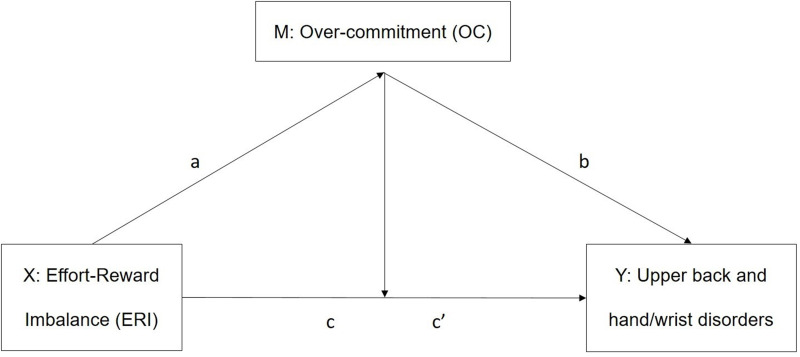
A cross-sectional study was conducted with MSW collectors from two cities in Taiwan. Each participant was asked to anonymously fill out a structured questionnaire. Work-related stress, including ERI and OC, was assessed by a Chinese version of the Job Content Questionnaire (C-JCL). Upper back and hand/wrist disorders were assessed using the Nordic musculoskeletal questionnaire. Multivariate analysis was used to assess moderation and mediation effect of OC and ERI on upper extremity pain.
The moderation effect of ERI and OC on upper back and hand/wrist disorders in MSW collectors was found. Disorders were higher in the group with both ERI ≥1 and high OC (OR (odds ratio) = 3.25 and OR = 3.00) than in the group with ERI ≥1 and low OC (OR = 2.66 and OR = 1.87) and in the ERI <1 and high OC group (OR = 2.27 and OR = 1.26). Synergy indexes were 0.77 and 1.77, respectively. Using multivariate analysis after adjusting for covariates, the mediation effect of OC was significant for the association between ERI and upper back and hand/wrist pains. The indirect effects of OC for upper back and hand/wrist pains accounted for 35% and 42%, respectively, and OC appears to mediate the relationship between ERI and upper back and hand/wrist disorders in MSW collectors.
Work-related stress measured ERI and OC may play a role in moderating and mediating effects on upper extremity pain. Encouraging provisions of work modification and stress management is needed to mitigate the occurrence of upper extremities pain in MSW collectors.
尽管城市固体废物(MSW)收集者的工作活动重复性高且工作量大,但工作相关压力对上肢疼痛的风险尚无定论。本研究的目的是评估努力-回报失衡(ERI)和过度投入(OC)对MSW收集者上背部和手/腕部疾病的调节和中介作用。
对来自台湾两个城市的MSW收集者进行了一项横断面研究。要求每位参与者匿名填写一份结构化问卷。使用中文版工作内容问卷(C-JCL)评估包括ERI和OC在内的工作相关压力。使用北欧肌肉骨骼问卷评估上背部和手/腕部疾病。采用多变量分析评估OC和ERI对上肢疼痛的调节和中介作用。
发现ERI和OC对MSW收集者上背部和手/腕部疾病有调节作用。ERI≥1且OC高的组(优势比(OR)=3.25和OR = 3.00)的疾病发生率高于ERI≥1且OC低的组(OR = 2.66和OR = 1.87)以及ERI<1且OC高的组(OR = 2.27和OR = 1.26)。协同指数分别为0.77和1.77。在调整协变量后进行多变量分析,OC对ERI与上背部和手/腕部疼痛之间的关联具有显著的中介作用。OC对上背部和手/腕部疼痛的间接效应分别占35%和42%,OC似乎介导了MSW收集者中ERI与上背部和手/腕部疾病之间的关系。
以ERI和OC衡量的工作相关压力可能在上肢疼痛的调节和中介作用中发挥作用。需要鼓励采取工作调整和压力管理措施,以减轻MSW收集者上肢疼痛的发生。