Occupational Medicine Department, Far Eastern Memorial Hospital, Taipei, Taiwan.
Institute of Environmental and Occupational Health Sciences, National Yang Ming Chiao Tung University, 155, Sec.2, Linong Street, 112, Taipei, Taiwan.
BMC Musculoskelet Disord. 2022 Aug 10;23(1):762. doi: 10.1186/s12891-022-05721-y.
Since the policy of "keeping trash off of the ground" in Taiwan, long-term exposure to repetitive motion in waste collection process results in high risk of upper extremity musculoskeletal disorders (UEMDs). Thus, we assessed the moderation and mediation effects of job-related stress and job support on work-related UEMDs among municipal waste collectors.
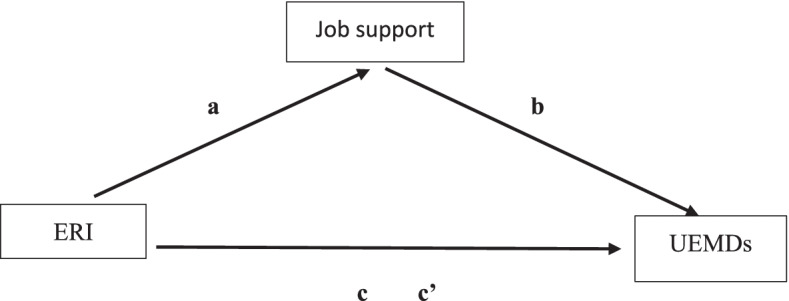
A cross-sectional study was conducted in two cities located at northern Taiwan during 2018-2019. 626 municipal waste collectors voluntarily participated and anonymously filled out a structured questionnaire. The moderation and mediation effects of effort-reward imbalance (ERI) and social support on UEMDs were analyzed by Haye's Process Macro Model.
Prevalence of UEMDs in municipal waste collectors were 43.4% for neck, 56.0% for shoulder, 24.1% for upper back, and 33.1% for hand/wrist. There was high prevalence of shoulder (72.2%), neck (48%), and upper back (30%) in female workers compared to male, most significantly in shoulders. In univariate and multivariate analysis, high ERI and low job support were significantly associated with ORs of 3.11 (95% CI:1.58-6.13) for elbow, 2.79 (95% CI:1.39-5.56) for shoulder, 3.39 (95% CI:1.64-7.00) for upper back and 3.83 (95% CI:1.98-7.41) for hand/wrist. Prevalent UEMDs were positively associated with high ERI in municipal waste collectors but negatively with job support. The moderation effects of ERI and job support on UEMDs, of which the measured synergy index exceeded one, were 18.24 for shoulder, 3.32 for elbow, and 2.45 for hand/wrist, but mediation effects were not significant.
This study found municipal waste collectors with work-related upper extremity disorders were significantly associated with work-related psychological risk factors. Therefore, waste collection cannot only to be improved by semi-automatic and automatic processes but immediate intervention programs for the reduction of psychological risk factors is needed promptly.
自台湾实行“垃圾不落地”政策以来,垃圾收集过程中长时间反复动作导致上肢肌肉骨骼疾病(UEMD)的风险很高。因此,我们评估了工作相关压力和工作支持对市政垃圾收集员工作相关 UEMD 的调节和中介作用。
2018 年至 2019 年,在台湾北部的两个城市进行了一项横断面研究。626 名市政垃圾收集员自愿参与并匿名填写了一份结构化问卷。通过 Haye 的 Process Macro Model 分析了努力-回报失衡(ERI)和社会支持对 UEMD 的调节和中介作用。
市政垃圾收集员 UEMD 的患病率分别为颈部 43.4%、肩部 56.0%、上背部 24.1%和手部/手腕 33.1%。女性工人的肩部(72.2%)、颈部(48%)和上背部(30%)的患病率明显高于男性,肩部最为明显。在单变量和多变量分析中,高 ERI 和低工作支持与肘部的 OR 分别为 3.11(95%CI:1.58-6.13)、肩部的 2.79(95%CI:1.39-5.56)、上背部的 3.39(95%CI:1.64-7.00)和手部/手腕的 3.83(95%CI:1.98-7.41)显著相关。市政垃圾收集员中,普遍存在的 UEMD 与高 ERI 呈正相关,与工作支持呈负相关。ERI 和工作支持对 UEMD 的调节作用(其中测量的协同指数超过 1)分别为肩部 18.24、肘部 3.32 和手部/手腕 2.45,但中介作用不显著。
本研究发现,与工作相关的上肢疾病与工作相关的心理危险因素显著相关。因此,不仅要通过半自动和自动过程来改进垃圾收集,还需要立即实施干预计划,以降低心理危险因素。