Ruan Guo-Tian, Xie Hai-Lun, Zhu Li-Chen, Ge Yi-Zhong, Yan Lin, Liao Cun, Gong Yi-Zhen, Shi Han-Ping
Department of Gastrointestinal Surgery/Department of Clinical Nutrition, Beijing Shijitan Hospital, Capital Medical University, Beijing, China.
Beijing International Science and Technology Cooperation Base for Cancer Metabolism and Nutrition, Beijing, China.
Front Genet. 2022 Feb 8;13:762514. doi: 10.3389/fgene.2022.762514. eCollection 2022.
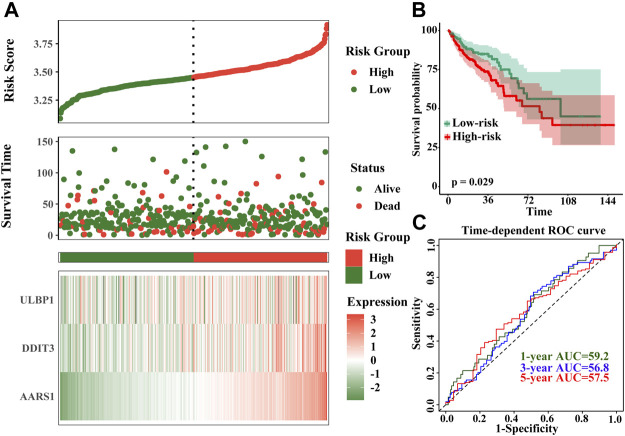
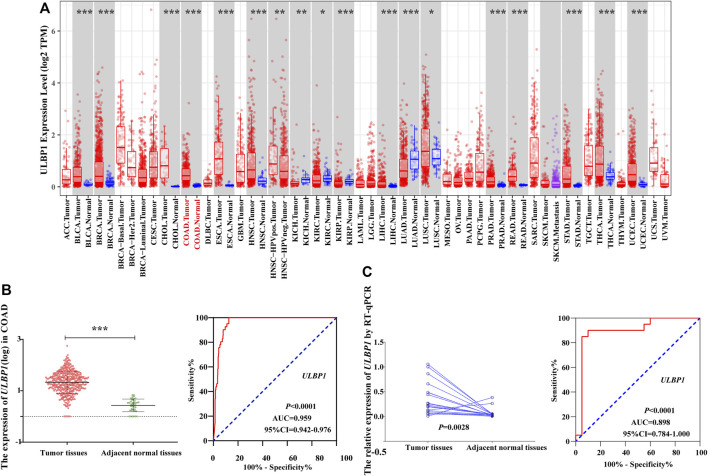
Colon adenocarcinoma (COAD) is still the main cause of cancer deaths worldwide. Although immunotherapy has made progress in recent years, there is still a need to improve diagnosis, prognosis, and treatment tools. UL-16 binding protein 1 (ULBP1) is a ligand that activates the receptor natural killer cell group 2 receptor D (NKG2D) and plays an important immunomodulatory role. We aimed to investigate the clinical significance of in COAD. We obtained the relevant data from The Cancer Genome Atlas (TCGA). A total of 438 patients with COAD were included in this study, with a mean age of 67.1 ± 13.03 years old, of which 234 (53.42%) were male. The diagnostic value of COAD tumor tissues and adjacent tissues was analyzed by ROC curve. Univariate and multivariate survival analysis investigated the prognostic value of gene, and Gene Set Enrichment Analysis (GSEA) curve was performed to analyze the biological process and enriched enrichment pathway of in COAD. Combination survival analysis investigated the combined prognostic effect of prognostic genes. gene had a high diagnostic value in COAD [AUC (TCGA) = 0.959; AUC (Guangxi) = 0.898]. Up-regulated gene of patients with COAD predicted a worse prognosis compared to those patients with down-regulated gene (Adjusted HR = 1.544, 95% CI = 1.020-2.337, = 0.040). The GSEA showed that was involved in the apoptotic pathway and biological process of T cell mediated cytotoxicity, regulation of natural killer cell activation, and T cell mediated immunity of COAD. The combination survival analysis showed that the combination of high expression of , , and would increase the 2.2-fold death risk of COAD when compared with those of low expression genes. The immune-related gene had diagnostic and prognostic value in COAD. The combination of , , and genes could improve the prognostic prediction performance in COAD.
结肠腺癌(COAD)仍是全球癌症死亡的主要原因。尽管近年来免疫疗法取得了进展,但仍需要改进诊断、预后和治疗工具。UL-16结合蛋白1(ULBP1)是一种激活受体自然杀伤细胞组2受体D(NKG2D)的配体,发挥重要的免疫调节作用。我们旨在研究其在COAD中的临床意义。我们从癌症基因组图谱(TCGA)获取相关数据。本研究共纳入438例COAD患者,平均年龄为67.1±13.03岁,其中234例(53.42%)为男性。通过ROC曲线分析COAD肿瘤组织和癌旁组织的诊断价值。单因素和多因素生存分析研究该基因的预后价值,并进行基因集富集分析(GSEA)曲线以分析其在COAD中的生物学过程和富集途径。联合生存分析研究预后基因的联合预后效应。该基因在COAD中具有较高的诊断价值[AUC(TCGA)=0.959;AUC(广西)=0.898]。与该基因下调的患者相比,COAD患者该基因上调预示预后更差(调整后HR=1.544,95%CI=1.020-2.337,P=0.040)。GSEA显示其参与COAD的凋亡途径以及T细胞介导的细胞毒性、自然杀伤细胞激活调节和T细胞介导的免疫生物学过程。联合生存分析表明,与低表达基因相比,该基因、某基因和另一基因高表达联合将使COAD的死亡风险增加2.2倍。免疫相关的该基因在COAD中具有诊断和预后价值。该基因、某基因和另一基因联合可提高COAD的预后预测性能。