Cai Mingyue, Chen Na
Provincial Hospital Affiliated to Shandong First Medical University, Department of Hematology, Jinan, China.
School of Medicine, Shandong University, Jinan, China.
Front Oncol. 2022 Feb 8;12:817069. doi: 10.3389/fonc.2022.817069. eCollection 2022.
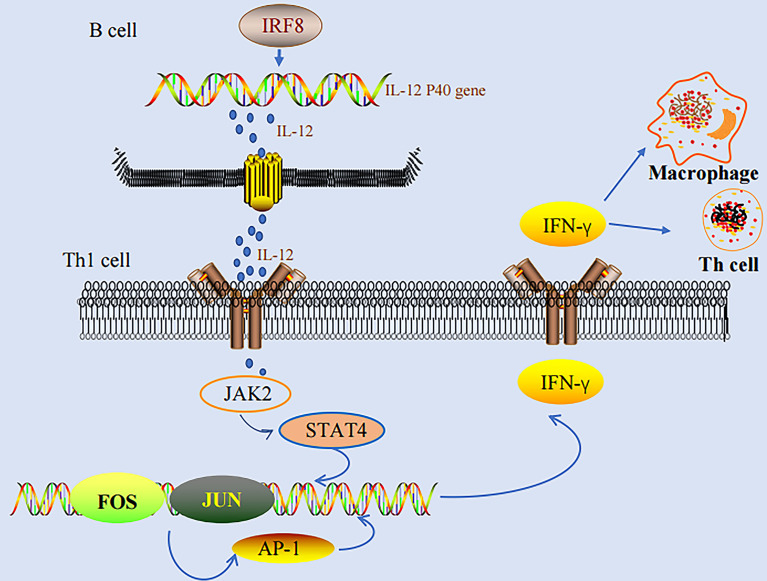
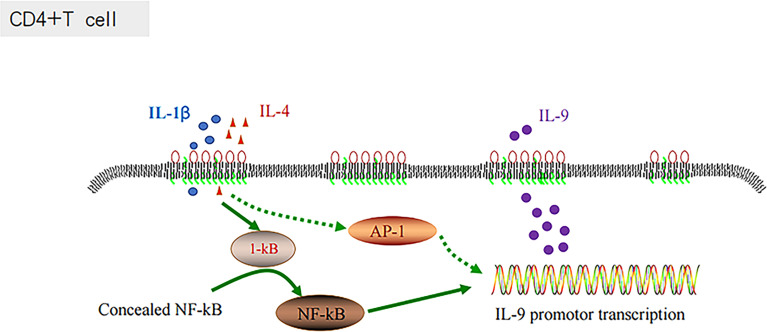
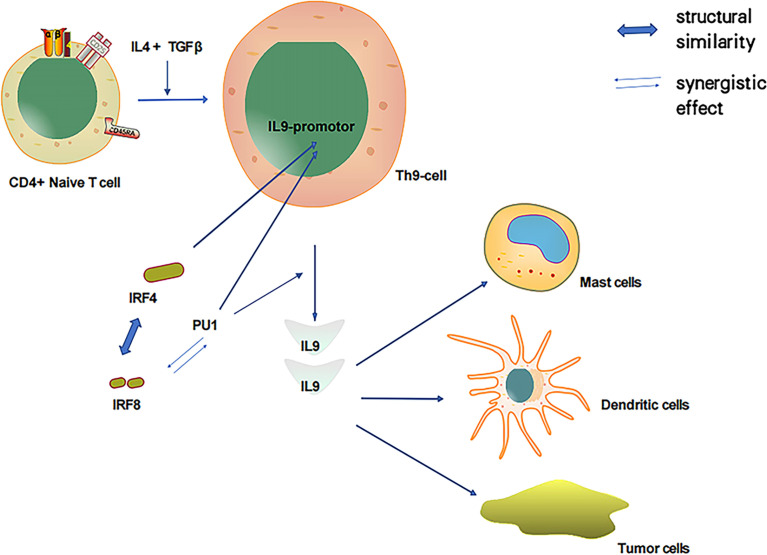
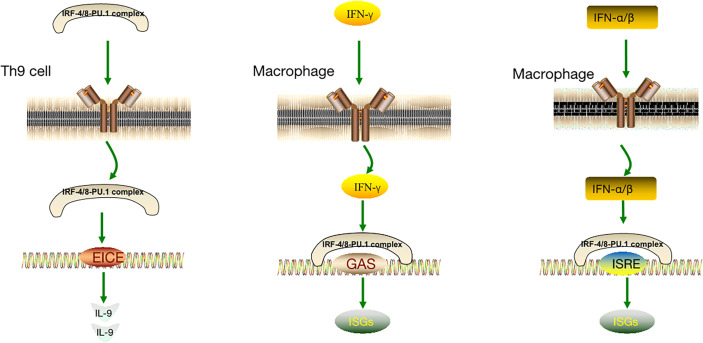
Interferon regulatory factor 8 (IRF-8) is a transcription suppressor that functions through associations with other transcription factors, contributing to the growth and differentiation of bone marrow cells and the activation of macrophages. IRF-8 expression profoundly affects pathogenic processes ranging from infections to blood diseases. Interleukin-9 (IL-9) is a multipotent cytokine that acts on a variety of immune cells by binding to the IL-9 receptor (IL-9R) and is involved in a variety of diseases such as cancer, autoimmune diseases, and other pathogen-mediated immune regulatory diseases. Studies have shown that IL-9 levels are significantly increased in the serum of patients with diffuse large B-cell lymphoma (DLBCL), and IL-9 levels are correlated with the DLBCL prognostic index. The activator protein-1 (AP-1) complex is a dimeric transcription factor that plays a critical role in cellular proliferation, apoptosis, angiogenesis, oncogene-induced transformation, and invasion by controlling basic and induced transcription of several genes containing the AP-1 locus. The AP-1 complex is involved in many cancers, including hematological tumors. In this report, we systematically review the precise roles of IL-9, IRF-8, and AP-1 in tumor development, particularly with regard to DLBCL. Finally, the recent progress in IRF-8 and IL-9 research is presented; the possible relationship among IRF-8, IL-9, and AP-1 family members is analyzed; and future research prospects are discussed.
干扰素调节因子8(IRF-8)是一种转录抑制因子,通过与其他转录因子结合发挥作用,有助于骨髓细胞的生长和分化以及巨噬细胞的激活。IRF-8的表达深刻影响从感染到血液疾病等一系列致病过程。白细胞介素-9(IL-9)是一种多效细胞因子,通过与IL-9受体(IL-9R)结合作用于多种免疫细胞,并参与多种疾病,如癌症、自身免疫性疾病和其他病原体介导的免疫调节疾病。研究表明,弥漫性大B细胞淋巴瘤(DLBCL)患者血清中IL-9水平显著升高,且IL-9水平与DLBCL预后指数相关。激活蛋白-1(AP-1)复合物是一种二聚体转录因子,通过控制含有AP-1位点的几个基因的基础转录和诱导转录,在细胞增殖、凋亡、血管生成、癌基因诱导的转化和侵袭中起关键作用。AP-1复合物参与包括血液系统肿瘤在内的多种癌症。在本报告中,我们系统地综述了IL-9、IRF-8和AP-1在肿瘤发生发展中的精确作用,特别是在DLBCL方面。最后,介绍了IRF-8和IL-9研究的最新进展;分析了IRF-8、IL-9和AP-1家族成员之间可能的关系;并讨论了未来的研究前景。