Bao Di, Yu Yun, Xiong Wei, Wang Ya-Xin, Liang Yi, Li Lu, Liu Bin, Jin Xu
Department of Anesthesiology, Beijing Tiantan Hospital, Capital Medical University, Beijing 100070, China.
World J Clin Cases. 2022 Feb 6;10(4):1242-1254. doi: 10.12998/wjcc.v10.i4.1242.
Paediatric supraglottic airway devices (SGAs) are widely used in routine anaesthesia and serve as primary or back-up devices for difficult airway management. The inflatable Ambu laryngeal masks and non-inflatable i-gel are two improvements of SGAs based on classic laryngeal masks. The clinical performance and safety of these two devices in paediatric patients are still unclear and warrant further investigation.
To perform a systematic review and meta-analysis on the clinical performance and safety of Ambu laryngeal masks and i-gel in anaesthetised paediatric patients.
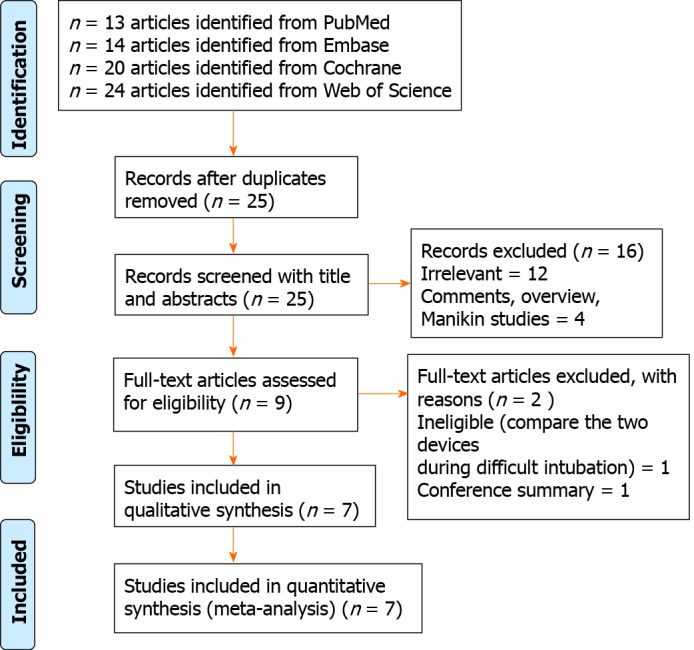
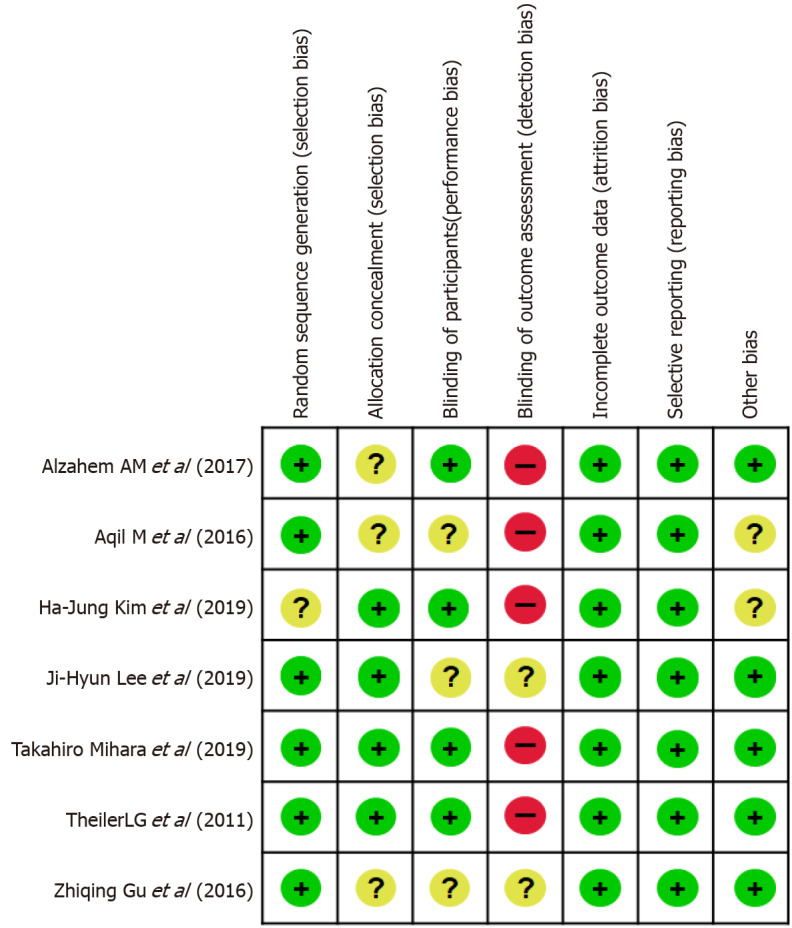
MEDLINE, Embase, Web of Science and Cochrane Central Register of Controlled Trials were searched from inception dates to April 2020. We identified published randomised controlled trials (RCTs) in which the intervention involved the use of Ambu laryngeal masks and i-gel in anaesthetised paediatric patients (age < 18 years). We assessed the oropharyngeal leak pressure (OLP) as the primary outcome. The secondary outcomes were insertion time, success rate of insertion on the first attempt, and incidence of adverse events.
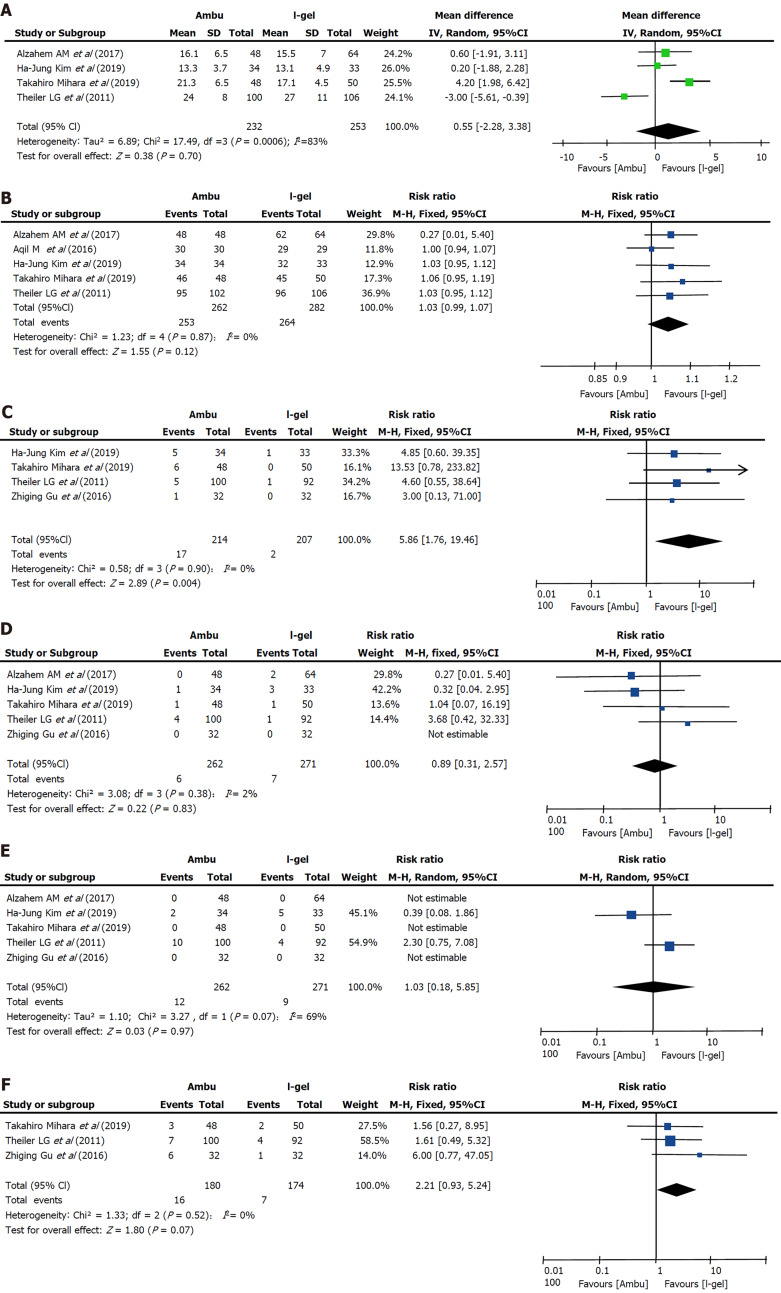
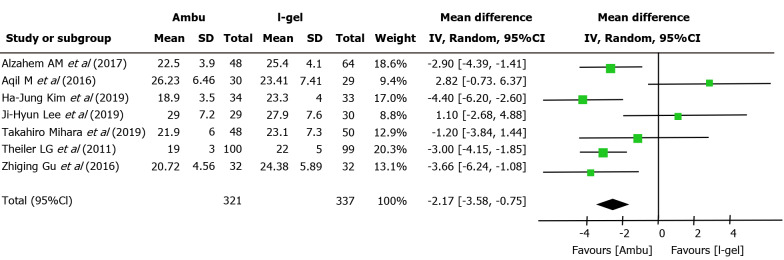
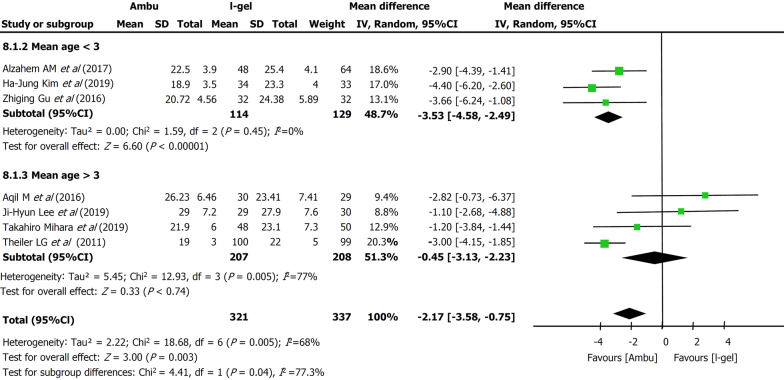
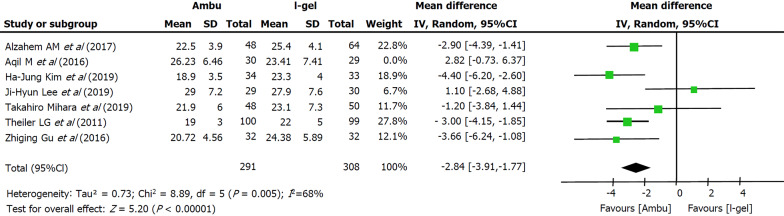
After searching for all relevant trials published up to April 2020, data from seven RCTs with a total of 667 paediatric patients (323 and 344 participants in the i-gel and Ambu groups, respectively) were evaluated. The mean OLP in anaesthetised paediatric patients was lower in the Ambu group [21.82 cmHO for Ambu 23.98 cmHO for i-gel, = 0.003, 95% confidence interval (CI): -3.58 to -0.75, = 68%, Mantel-Haenszel random model]. We did not find any clear evidence of differences between the devices in terms of insertion time, success rate of insertion, and incidence of adverse events except for blood staining (risk ratio 5.86, 95%CI: 1.76 to 19.46, = 0.004, = 0, fixed-effect model).
The i-gel airway may provide a better seal and is therefore probably more suitable than the Ambu laryngeal mask airway in anaesthetised paediatric patients. However, the evidence is insufficient to allow making firm conclusions or to guide clinical practice, owing to the small number of relevant published studies.
儿科声门上气道装置(SGA)在常规麻醉中广泛使用,并且作为困难气道管理的主要或备用装置。可充气的阿姆布喉罩和不可充气的i-gel是基于经典喉罩的SGA的两项改进。这两种装置在儿科患者中的临床表现和安全性仍不明确,需要进一步研究。
对阿姆布喉罩和i-gel在麻醉儿科患者中的临床表现和安全性进行系统评价和荟萃分析。
检索MEDLINE、Embase、科学网和Cochrane对照试验中央注册库,检索时间从建库至2020年4月。我们纳入已发表的随机对照试验(RCT),其中干预措施涉及在麻醉儿科患者(年龄<18岁)中使用阿姆布喉罩和i-gel。我们将口咽漏气压(OLP)作为主要结局指标。次要结局指标为插入时间、首次插入成功率和不良事件发生率。
检索截至2020年4月发表的所有相关试验后,评估了7项RCT的数据,共667例儿科患者(i-gel组和阿姆布组分别有323例和344例参与者)。阿姆布组麻醉儿科患者的平均OLP较低[i-gel组为23.98cmH₂O,阿姆布组为21.82cmH₂O,P = 0.003,95%置信区间(CI):-3.58至-0.75,I² = 68%,Mantel-Haenszel随机模型]。除血染外,我们未发现两种装置在插入时间、插入成功率和不良事件发生率方面存在任何明显差异(风险比5.86,95%CI:1.76至19.46,P = 0.004,I² = 0,固定效应模型)。
i-gel气道可能提供更好的密封,因此在麻醉儿科患者中可能比阿姆布喉罩气道更合适。然而,由于相关已发表研究数量较少,证据不足以得出确凿结论或指导临床实践。