Department of Ecology and Evolutionary Biology, University of Colorado, Boulder, CO, USA.
Sainsbury Laboratory, University of Cambridge, Cambridge, United Kingdom.
Mol Biol Evol. 2022 Mar 2;39(3). doi: 10.1093/molbev/msac044.
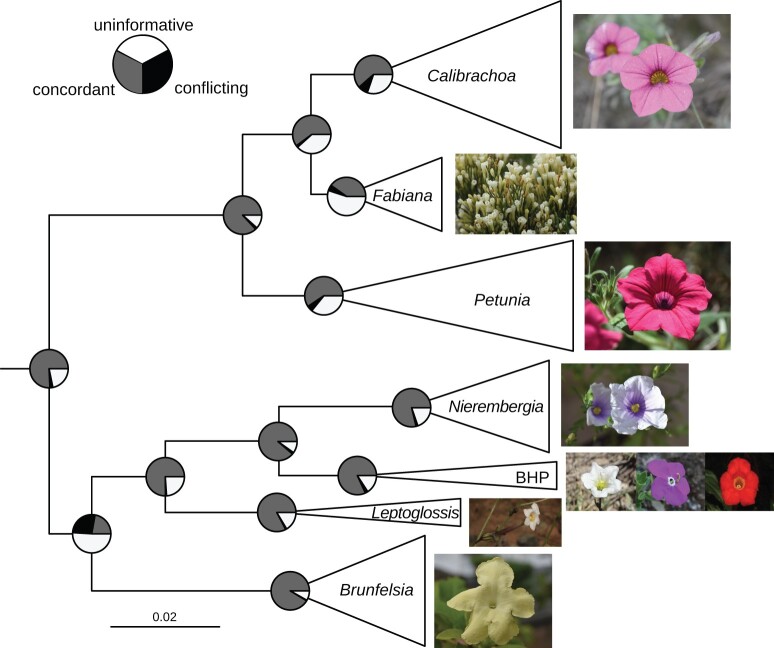
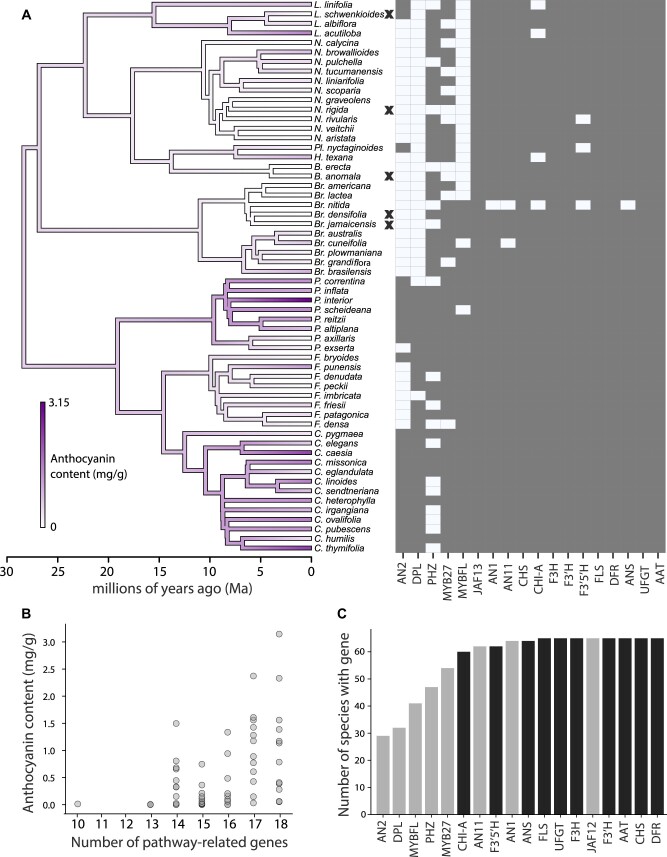
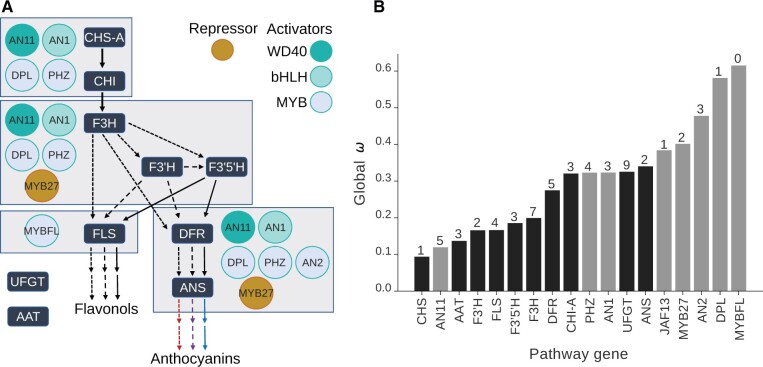
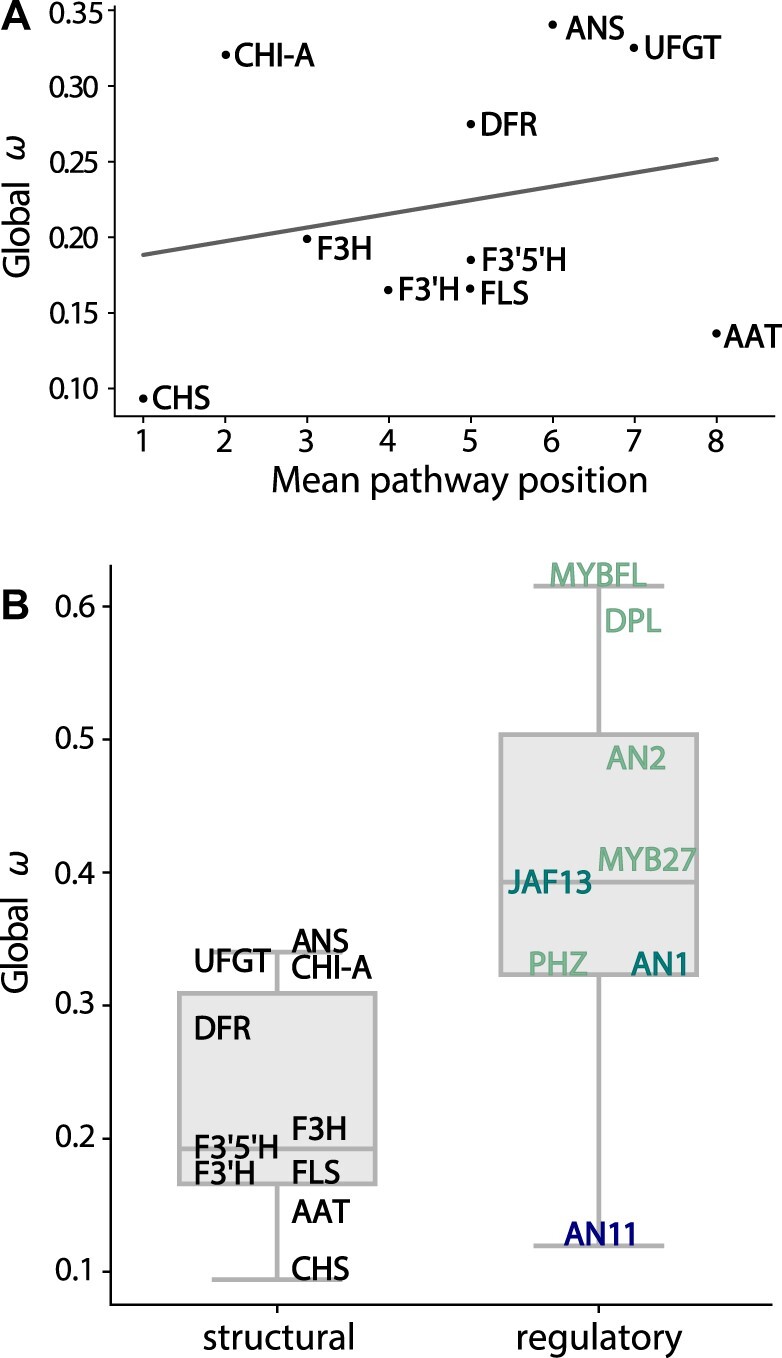
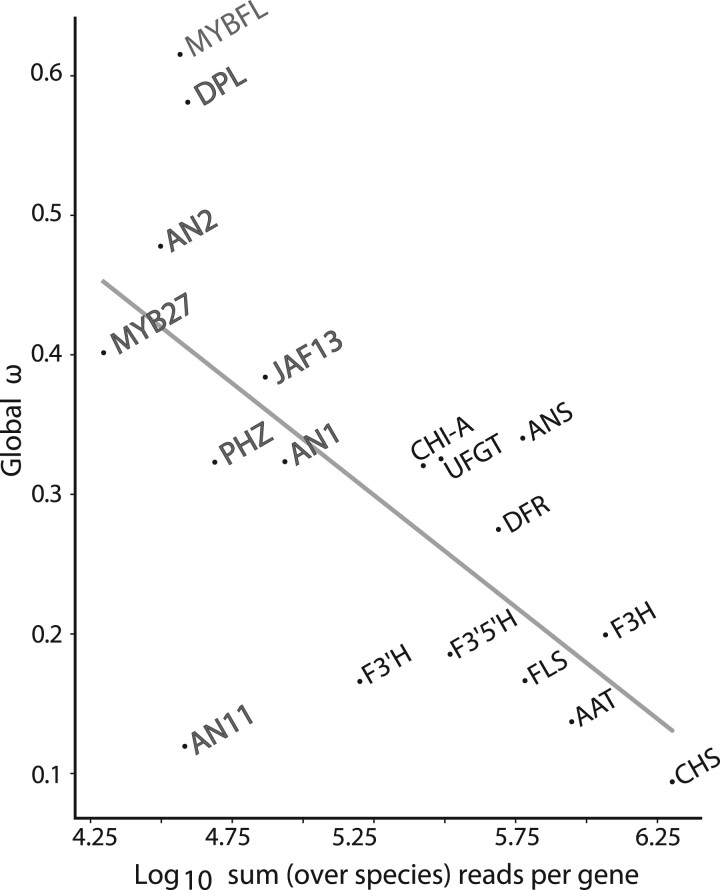
Dissecting the relationship between gene function and substitution rates is key to understanding genome-wide patterns of molecular evolution. Biochemical pathways provide powerful systems for investigating this relationship because the functional role of each gene is often well characterized. Here, we investigate the evolution of the flavonoid pigment pathway in the colorful Petunieae clade of the tomato family (Solanaceae). This pathway is broadly conserved in plants, both in terms of its structural elements and its MYB, basic helix-loop-helix, and WD40 transcriptional regulators, and its function has been extensively studied, particularly in model species of petunia. We built a phylotranscriptomic data set for 69 species of Petunieae to infer patterns of molecular evolution across pathway genes and across lineages. We found that transcription factors exhibit faster rates of molecular evolution (dN/dS) than their targets, with the highly specialized MYB genes evolving fastest. Using the largest comparative data set to date, we recovered little support for the hypothesis that upstream enzymes evolve slower than those occupying more downstream positions, although expression levels do predict molecular evolutionary rates. Although shifts in floral pigmentation were only weakly related to changes affecting coding regions, we found a strong relationship with the presence/absence patterns of MYB transcripts. Intensely pigmented species express all three main MYB anthocyanin activators in petals, whereas pale or white species express few or none. Our findings reinforce the notion that pathway regulators have a dynamic history, involving higher rates of molecular evolution than structural components, along with frequent changes in expression during color transitions.
剖析基因功能与替代率之间的关系是理解全基因组分子进化模式的关键。生化途径为研究这种关系提供了强大的系统,因为每个基因的功能作用通常都得到了很好的描述。在这里,我们研究了番茄科(茄科)多彩的 Petunieae 分支中类黄酮色素途径的进化。该途径在植物中广泛保守,无论是在其结构元素还是在其 MYB、碱性螺旋-环-螺旋和 WD40 转录调节因子方面,其功能都得到了广泛研究,尤其是在拟南芥等模式物种中。我们构建了 69 种 Petunieae 的 phylotranscriptomic 数据集,以推断途径基因和谱系之间的分子进化模式。我们发现转录因子的分子进化速度(dN/dS)比其靶标快,高度特化的 MYB 基因进化最快。利用迄今为止最大的比较数据集,我们几乎没有支持这样一种假说,即上游酶的进化速度比占据下游位置的酶慢,尽管表达水平确实可以预测分子进化率。尽管花色色素的变化与影响编码区的变化仅呈弱相关,但我们发现与 MYB 转录物的存在/缺失模式存在很强的关系。颜色强烈的物种在花瓣中表达所有三种主要的 MYB 花青素激活剂,而颜色较浅或白色的物种则很少或不表达。我们的研究结果强化了这样一种观点,即途径调节因子具有动态的历史,其分子进化速度比结构成分快,并且在颜色转变过程中表达经常发生变化。