Centers for Disease Control and Prevention, Atlanta, Georgia, United States of America.
IMA World Heath, Port-au-Prince, Haiti.
PLoS Negl Trop Dis. 2022 Feb 25;16(2):e0010231. doi: 10.1371/journal.pntd.0010231. eCollection 2022 Feb.
Lymphatic filariasis (LF) has been targeted for global elimination as a public health problem since 1997. The primary strategy to interrupt transmission is annual mass drug administration (MDA) for ≥5 years. The transmission assessment survey (TAS) was developed as a decision-making tool to measure LF antigenemia in children to determine when MDA in a region can be stopped. The objective of this study was to investigate potential sampling strategies for follow-up of LF-positive children identified in TAS to detect evidence of ongoing transmission.
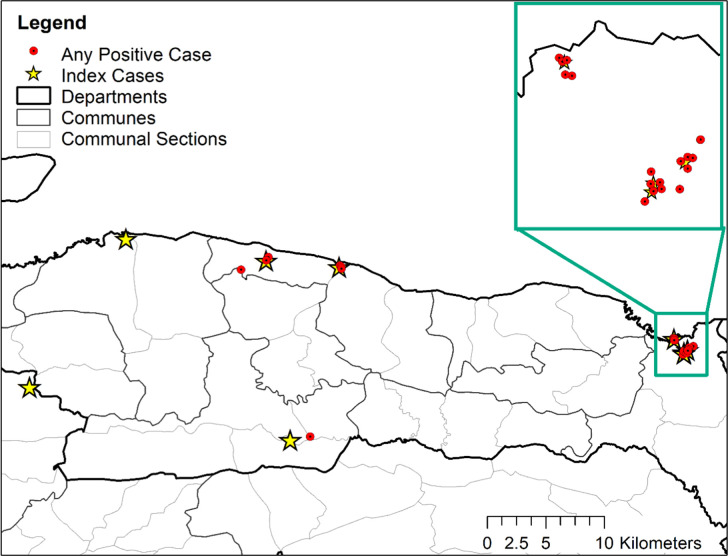
METHODOLOGY/PRINCIPLE FINDINGS: Nippes Department in Haiti passed TAS 1 with 2 positive cases and stopped MDA in 2015; however, 8 positive children were found during TAS 2 in 2017, which prompted a more thorough assessment of ongoing transmission. Purposive sampling was used to select the closest 50 households to each index case household, and systematic random sampling was used to select 20 households from each index case census enumeration area. All consenting household members aged ≥2 years were surveyed and tested for circulating filarial antigen (CFA) using the rapid filarial test strip and for Wb123-specific antibodies using the Filaria Detect IgG4 ELISA. Among 1,927 participants, 1.5% were CFA-positive and 4.5% were seropositive. CFA-positive individuals were identified for 6 of 8 index cases. Positivity ranged from 0.4-2.4%, with highest positivity in the urban commune Miragoane. Purposive sampling found the highest number of CFA-positives (17 vs. 9), and random sampling found a higher percent positive (2.4% vs. 1.4%).
CONCLUSIONS/SIGNIFICANCE: Overall, both purposive and random sampling methods were reasonable and achievable methods of TAS follow-up in resource-limited settings. Both methods identified additional CFA-positives in close geographic proximity to LF-positive children found by TAS, and both identified strong signs of ongoing transmission in the large urban commune of Miragoane. These findings will help inform standardized guidelines for post-TAS surveillance.
自 1997 年以来,淋巴丝虫病(LF)已被作为公共卫生问题进行全球消除。中断传播的主要策略是每年进行至少 5 年的大规模药物治疗(MDA)。传播评估调查(TAS)是作为一种决策工具开发的,用于测量儿童中的 LF 抗原血症,以确定该地区的 MDA 何时可以停止。本研究的目的是研究 TAS 中发现的 LF 阳性儿童的潜在抽样策略,以检测正在进行的传播的证据。
方法/原理发现:海地的 Nippes 省通过了 TAS1,发现了 2 个阳性病例,并于 2015 年停止了 MDA;然而,2017 年 TAS2 发现了 8 个阳性儿童,这促使对正在进行的传播进行更彻底的评估。采用目的抽样选择每个索引病例家庭最近的 50 户家庭,采用系统随机抽样从每个索引病例普查区选择 20 户家庭。所有同意的年龄≥2 岁的家庭成员均接受了调查,并使用快速丝虫病检测带进行循环丝状抗原(CFA)检测,使用 Filaria Detect IgG4 ELISA 进行 Wb123 特异性抗体检测。在 1927 名参与者中,有 1.5%的人 CFA 阳性,有 4.5%的人血清阳性。6 个索引病例中的 CFA 阳性个体得到了确认。阳性率从 0.4-2.4%不等,在米拉戈安市的城市公社最高。有针对性的抽样发现了最多的 CFA 阳性(17 对 9),随机抽样发现了更高的阳性百分比(2.4%对 1.4%)。
结论/意义:总体而言,有针对性和随机抽样方法都是资源有限环境下 TAS 后续行动的合理且可行的方法。两种方法都在 TAS 发现的 LF 阳性儿童的近地理范围内发现了更多的 CFA 阳性,并且都在米拉戈安的大型城市公社发现了正在进行的传播的强烈迹象。这些发现将有助于为 TAS 后监测提供标准化指南。