Department of Psychology, Cornell University, Ithaca, New York, United States of America.
Department of Psychology, Human Neuroscience Institute, Cornell University, Ithaca, New York, United States of America.
PLoS One. 2022 Feb 25;17(2):e0264250. doi: 10.1371/journal.pone.0264250. eCollection 2022.
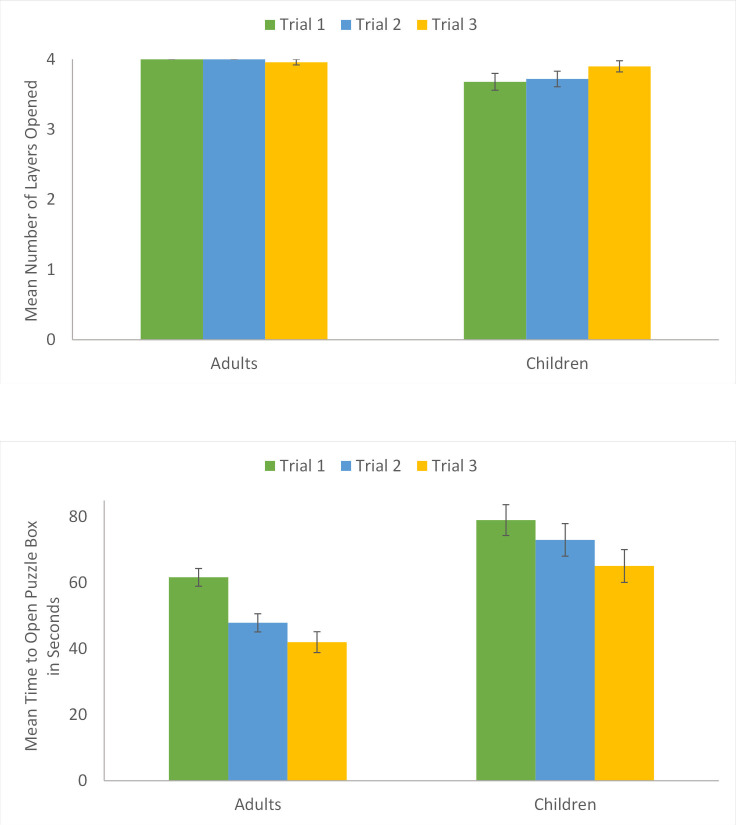
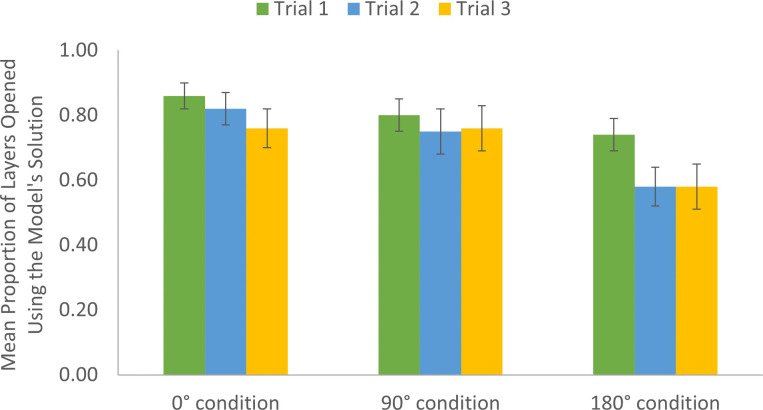
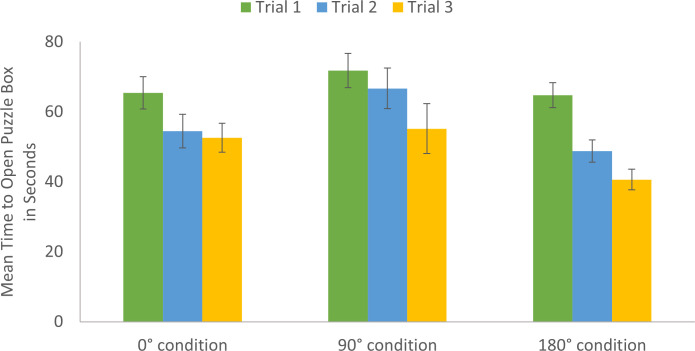
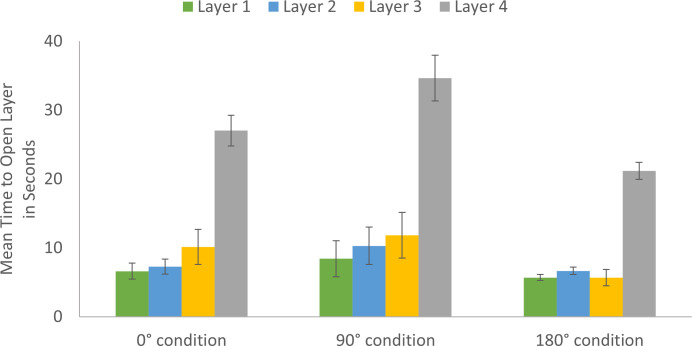
Learning from others provides the foundation for culture and the advancement of knowledge. Learning a new visuospatial skill from others represents a specific challenge-overcoming differences in perspective so that we understand what someone is doing and why they are doing it. The "what" of visuospatial learning is thought to be easiest from a shared 0° first-person perspective and most difficult from a 180° third-person perspective. However, the visual disparity at 180° promotes face-to-face interaction, which may enhance learning by scaffolding social perspective taking, the "why" of visuospatial learning. We tested these potentially conflicting hypotheses in child and young adult learners. Thirty-six children (4-6 years) and 57 young adults (18-27 years) observed a live model open a puzzle box from a first-person (0°) or third-person (90° or 180°) perspective. The puzzle box had multiple solutions, only one of which was modelled, which allowed for the assessment of imitation and goal emulation. Participants had three attempts to open the puzzle box from the model's perspective. While first-person (0°) observation increased imitation relative to a 180° third-person perspective, the 180° observers opened the puzzle box most readily (i.e., fastest). Although both age groups were excellent imitators and able to take the model's perspective, adults were more faithful imitators, and children were more likely to innovate a new solution. A shared visual perspective increased imitation, but a shared mental perspective promoted goal achievement and the social transmission of innovation. "Perfection of means and confusion of goals-in my opinion-seem to characterize our age" Einstein (1973) pg 337, Ideas and Opinions.
向他人学习为文化和知识的进步提供了基础。从他人那里学习新的视空间技能代表了一个特殊的挑战——克服视角差异,以便我们理解他人在做什么以及为什么要这样做。从共享的 0°第一人称视角来看,视空间学习的“是什么”被认为是最容易的,而从 180°第三人称视角来看则是最困难的。然而,180°的视觉差异促进了面对面的互动,这可能通过支撑社会视角的采用来增强视空间学习的“为什么”。我们在儿童和青年学习者中测试了这些潜在冲突的假设。36 名儿童(4-6 岁)和 57 名年轻人(18-27 岁)从第一人称(0°)或第三人称(90°或 180°)视角观察一个真人模型打开拼图盒。拼图盒有多种解决方案,只有一种是模型化的,这允许评估模仿和目标模拟。参与者有三次机会从模型的视角打开拼图盒。虽然第一人称(0°)观察比 180°第三人称视角增加了模仿,但 180°观察者最容易打开拼图盒(即最快)。尽管两个年龄组都是出色的模仿者,并且能够从模型的角度看问题,但成年人更忠实于模仿,而儿童更有可能创新出一个新的解决方案。共享的视觉视角增加了模仿,但共享的心理视角促进了目标的实现和创新的社会传播。“在我看来,手段的完善和目标的混乱——似乎是我们这个时代的特征”爱因斯坦(1973 年)第 337 页,《思想与见解》。