Pact Tanzania, Dar es Salaam, Tanzania.
Ifakara Health Institute, Dar es Salaam, Tanzania.
PLoS One. 2022 Feb 25;17(2):e0264315. doi: 10.1371/journal.pone.0264315. eCollection 2022.
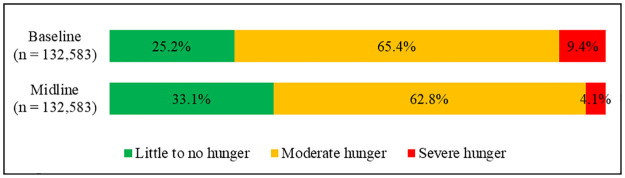
About 2 billion people worldwide suffer moderate or severe forms of food insecurity, calling for correctional measures involving economic strengthening interventions. This study assessed the impact of household economic strengthening (HES) intervention on food security among caregivers of orphans and vulnerable children (OVC) in Tanzania. The study was longitudinal in design, based on OVC caregivers' baseline (2017-2018) and midline (2019) data from the USAID Kizazi Kipya project. Food security, the outcome, was measured using the Household Hunger Scale (HHS) in three categories: little to no hunger (food secure), moderate hunger, and severe hunger. Membership in the USAID Kizazi Kipya-supported economic strengthening intervention (i.e. WORTH Yetu) was the main independent variable. Data analysis involved generalized estimating equation (GEE) for multivariate analysis. With mean age of 50.3 years at baseline, the study analyzed 132,583 caregivers, 72.2% of whom were female. At midline, 7.6% of all caregivers enrolled at baseline were members in WORTH Yetu. Membership in WORTH Yetu was significantly effective in reducing household hunger among the caregivers: severe hunger dropped from 9.4% at baseline to 4.1% at midline; moderate hunger dropped from 65.9% at baseline to 62.8% at midline; and food security (i.e., little to no hunger households) increased from 25.2% at baseline to 33.1% at midline. In the multivariate analysis, membership in WORTH Yetu reduced the likelihood of severe hunger by 47% (OR = 0.53, 95% CI 0.48-0.59), and moderate hunger by 21% (OR = 0.79, 95% CI 0.76-0.83), but increased the likelihood of food security by 45% (OR = 1.45, 95% CI 1.39-1.51). The USAID Kizazi Kipya's model of household economic strengthening for OVC caregivers was effective in improving food security and reducing household hunger in Tanzania. This underscores the need to expand WORTH Yetu coverage. Meanwhile, these results indicate a potential of applying the intervention in similar settings to address household hunger.
全球约有 20 亿人遭受中度或重度粮食不安全,需要采取包括经济强化干预在内的纠正措施。本研究评估了家庭经济强化(HES)干预对坦桑尼亚孤儿和弱势儿童(OVC)照顾者粮食安全的影响。该研究采用纵向设计,基于美国国际开发署 Kizazi Kipya 项目 OVC 照顾者的基线(2017-2018 年)和中期(2019 年)数据。粮食安全是使用家庭饥饿量表(HHS)衡量的结果,分为三个类别:几乎没有饥饿(粮食安全)、中度饥饿和严重饥饿。USAID Kizazi Kipya 支持的经济强化干预(即 WORTH Yetu)的成员身份是主要的独立变量。数据分析涉及广义估计方程(GEE)进行多变量分析。在基线时,研究分析了 132583 名照顾者,其中 72.2%为女性。在中期,基线时注册的所有照顾者中有 7.6%是 WORTH Yetu 的成员。WORTH Yetu 的成员身份对减少照顾者的家庭饥饿状况具有显著效果:严重饥饿从基线时的 9.4%降至中期时的 4.1%;中度饥饿从基线时的 65.9%降至中期时的 62.8%;粮食安全(即几乎没有饥饿的家庭)从基线时的 25.2%增加到中期时的 33.1%。在多变量分析中,WORTH Yetu 的成员身份使严重饥饿的可能性降低了 47%(OR=0.53,95%CI 0.48-0.59),中度饥饿的可能性降低了 21%(OR=0.79,95%CI 0.76-0.83),但使粮食安全的可能性增加了 45%(OR=1.45,95%CI 1.39-1.51)。USAID Kizazi Kipya 为 OVC 照顾者提供的家庭经济强化模式在坦桑尼亚有效改善了粮食安全和减少了家庭饥饿。这突显了扩大 WORTH Yetu 覆盖面的必要性。同时,这些结果表明,在类似环境中应用该干预措施以解决家庭饥饿问题具有潜力。