Department of Tumor Biology, H. Lee Moffitt Cancer Center & Research Institute, Tampa, Florida, USA.
Department of Neuro-Oncology, H. Lee Moffitt Cancer Center & Research Institute, Tampa, Florida, USA.
Neuro Oncol. 2022 Oct 3;24(10):1673-1686. doi: 10.1093/neuonc/noac054.
Leptomeningeal disease (LMD) occurs as a late complication of several human cancers and has no rationally designed treatment options. A major barrier to developing effective therapies for LMD is the lack of cell-based or preclinical models that recapitulate human disease. Here, we describe the development of in vitro and in vivo cultures of patient-derived cerebrospinal fluid circulating tumor cells (PD-CSF-CTCs) from patients with melanoma as a preclinical model to identify exploitable vulnerabilities in melanoma LMD.
CSF-CTCs were collected from melanoma patients with melanoma-derived LMD and cultured ex vivo using human meningeal cell-conditioned media. Using immunoassays and RNA-sequencing analyses of PD-CSF-CTCs, molecular signaling pathways were examined and new therapeutic targets were tested for efficacy in PD-CSF-CTCs preclinical models.
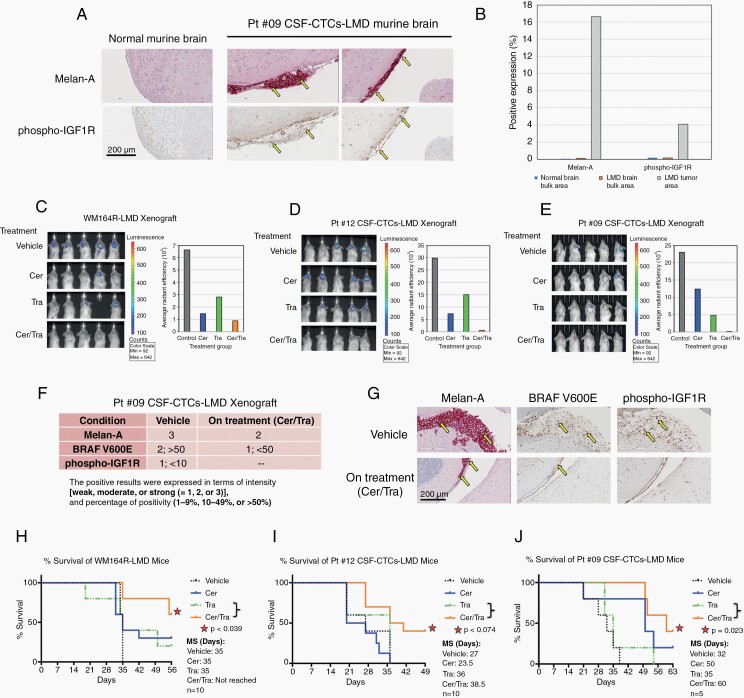
PD-CSF-CTCs were successfully established both in vitro and in vivo. Global RNA analyses of PD-CSF-CTCs revealed several therapeutically tractable targets. These studies complimented our prior proteomic studies highlighting IGF1 signaling as a potential target in LMD. As a proof of concept, combining treatment of ceritinib and trametinib in vitro and in vivo demonstrated synergistic antitumor activity in PD-CSF-CTCs and BRAF inhibitor-resistant melanoma cells.
This study demonstrates that CSF-CTCs can be grown in vitro and in vivo from some melanoma patients with LMD and used as preclinical models. These models retained melanoma expression patterns and had signaling pathways that are therapeutically targetable. These novel models/reagents may be useful in developing rationally designed treatments for LMD.
脑膜疾病(LMD)是几种人类癌症的晚期并发症,目前尚无合理设计的治疗选择。开发针对 LMD 的有效治疗方法的主要障碍是缺乏能够重现人类疾病的基于细胞或临床前模型。在这里,我们描述了从患有黑色素瘤的患者中分离的源自脑脊液的循环肿瘤细胞(PD-CSF-CTCs)的体外和体内培养,作为一种临床前模型,以鉴定黑色素瘤 LMD 中可利用的脆弱性。
从患有黑色素瘤 LMD 的黑色素瘤患者中收集 CSF-CTCs,并使用人脑膜细胞条件培养基在体外进行培养。通过对 PD-CSF-CTCs 的免疫测定和 RNA 测序分析,研究了分子信号通路,并测试了新的治疗靶点在 PD-CSF-CTCs 临床前模型中的疗效。
成功地在体外和体内建立了 PD-CSF-CTCs。PD-CSF-CTCs 的全基因组 RNA 分析揭示了几个有治疗潜力的靶点。这些研究补充了我们之前的蛋白质组学研究,强调了 IGF1 信号通路作为 LMD 的潜在靶点。作为概念验证,在体外和体内联合使用塞替尼和曲美替尼治疗,证明了在 PD-CSF-CTCs 和 BRAF 抑制剂耐药性黑色素瘤细胞中具有协同的抗肿瘤活性。
这项研究表明,从一些患有 LMD 的黑色素瘤患者中可以在体外和体内培养 CSF-CTCs,并将其用作临床前模型。这些模型保留了黑色素瘤的表达模式,并具有可治疗的信号通路。这些新型模型/试剂可能有助于开发针对 LMD 的合理设计的治疗方法。