Varnai Reka, Molnar Tihamer, Zavori Laszlo, Tőkés-Füzesi Margit, Illes Zsolt, Kanizsai Andrea, Csecsei Peter
Department of Primary Health Care, Medical School, University of Pecs, 7624 Pecs, Hungary.
Department of Anaesthesiology and Intensive Care, Medical School, University of Pecs, 7624 Pecs, Hungary.
Vaccines (Basel). 2022 Jan 21;10(2):165. doi: 10.3390/vaccines10020165.
Long COVID is a condition characterized by long-term sequelae persisting after the typical convalescence period of COVID-19. Previous reports have suggested the role of an unsatisfactory immune response and impaired viral clearance in the pathogenesis of long COVID syndrome. We focused on potential associations between post-vaccination changes of antibody titers and the severity of long COVID symptoms and factors influencing the state of remission observed in patients with long COVID after vaccination.
The severity of long COVID symptoms and serum anti-SARS-CoV-2 spike (S-Ig) and nucleocapsid (NC-Ig) levels were assessed in 107 post-COVID subjects at two time points: at baseline, and 17-24 weeks later. Besides, vaccination status was also assessed. Symptoms were evaluated based on the Chalder fatigue scale (CFQ-11) and visual analogue scale (VAS).
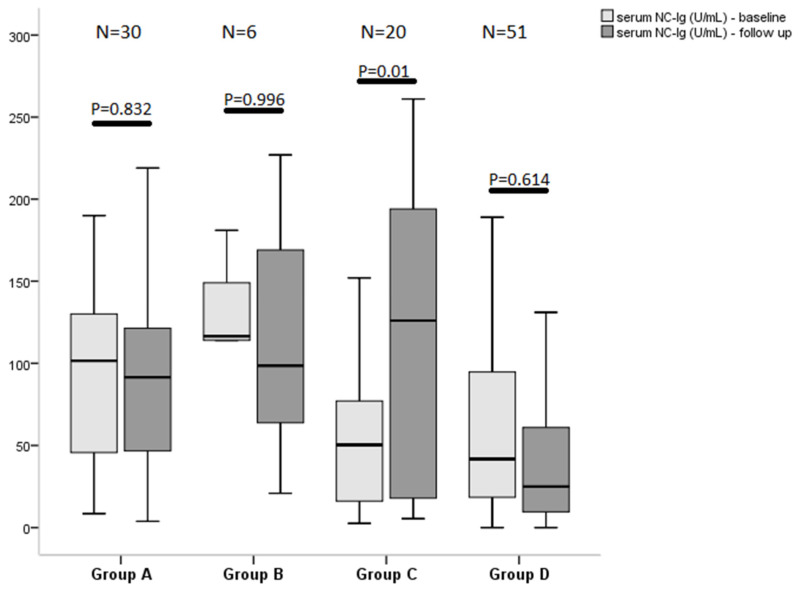
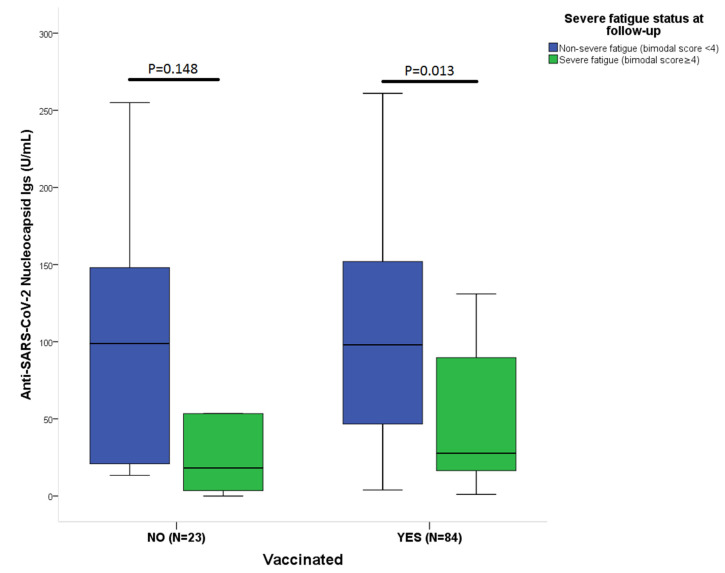
Serum level of S-Ig and NC-Ig at baseline were significantly higher in the patients with non-severe fatigue than those with severe fatigue, and this difference remained significant at follow-up in the case of NC-Ig. NC-Ig level above median was as an independent predictor for complete remission at follow-up. The difference in NC-Ig levels in subgroup analyses (severe fatigue vs. non-severe fatigue; complete remission vs. incomplete remission or progression) was found to be significant only in patients who received vaccination.
The immune response against the SARS-CoV-2 nucleocapsid may play a more important role than the spike in the course of long-term COVID syndrome.
新冠后遗症是指在新冠病毒病(COVID-19)典型恢复期后持续存在长期后遗症的一种状况。既往报道提示免疫反应不佳和病毒清除受损在新冠后遗症综合征发病机制中的作用。我们重点关注接种疫苗后抗体滴度变化与新冠后遗症症状严重程度之间的潜在关联,以及影响新冠后遗症患者接种疫苗后缓解状态的因素。
在两个时间点对107名新冠康复者的新冠后遗症症状严重程度、血清抗严重急性呼吸综合征冠状病毒2(SARS-CoV-2)刺突蛋白(S-Ig)和核衣壳蛋白(NC-Ig)水平进行评估:基线时以及17 - 24周后。此外,还评估了疫苗接种状况。症状基于查尔德疲劳量表(CFQ - 11)和视觉模拟量表(VAS)进行评估。
非严重疲劳患者基线时的S-Ig和NC-Ig血清水平显著高于严重疲劳患者,且在随访时NC-Ig的这种差异仍然显著。NC-Ig水平高于中位数是随访时完全缓解的独立预测因素。在亚组分析(严重疲劳与非严重疲劳;完全缓解与不完全缓解或病情进展)中,仅在接种疫苗的患者中发现NC-Ig水平存在显著差异。
在长期新冠综合征病程中,针对SARS-CoV-2核衣壳蛋白的免疫反应可能比针对刺突蛋白的免疫反应发挥更重要的作用。