Chaudhary Vandana, Punia Bangar Sneh, Thakur Neha, Trif Monica
College of Dairy Science and Technology, Lala Lajpat Rai University of Veterinary and Animal Sciences, Hisar 125001, India.
Department of Food, Nutrition and Packaging Sciences, Clemson University, Clemson, SC 29634, USA.
Polymers (Basel). 2022 Feb 21;14(4):829. doi: 10.3390/polym14040829.
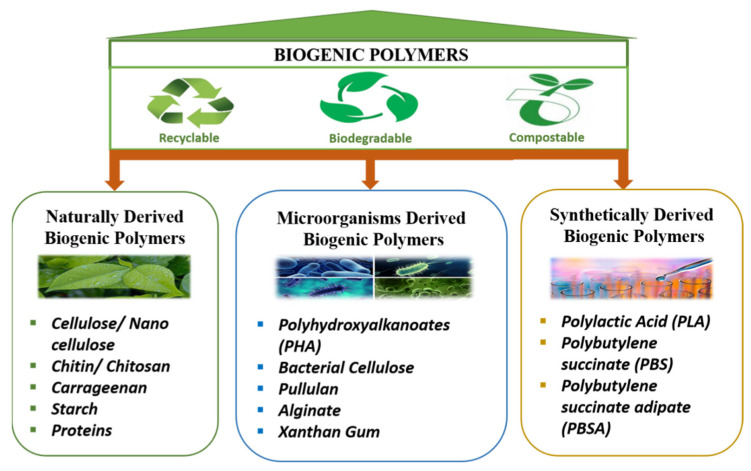
Due to their complete non-biodegradability, current food packages have resulted in major environmental issues. Today's smart consumer is looking for alternatives that are environmentally friendly, durable, recyclable, and naturally rather than synthetically derived. It is a well-established fact that complete replacement with environmentally friendly packaging materials is unattainable, and bio-based plastics should be the future of the food packaging industry. Natural biopolymers and nanotechnological interventions allow the creation of new, high-performance, light-weight, and environmentally friendly composite materials, which can replace non-biodegradable plastic packaging materials. This review summarizes the recent advancements in smart biogenic packaging, focusing on the shift from conventional to natural packaging, properties of various biogenic packaging materials, and the amalgamation of technologies, such as nanotechnology and encapsulation; to develop active and intelligent biogenic systems, such as the use of biosensors in food packaging. Lastly, challenges and opportunities in biogenic packaging are described, for their application in sustainable food packing systems.
由于当前食品包装完全不可生物降解,已引发了重大环境问题。如今精明的消费者正在寻找环保、耐用、可回收且源自天然而非合成材料的替代品。完全用环保包装材料替代是无法实现的,这是一个既定事实,而生物基塑料应成为食品包装行业的未来。天然生物聚合物和纳米技术干预使得新型高性能、轻质且环保的复合材料得以创造,这些材料能够替代不可生物降解的塑料包装材料。本综述总结了智能生物源包装的最新进展,重点关注从传统包装向天然包装的转变、各种生物源包装材料的特性以及纳米技术和包封等技术的融合;以开发活性和智能生物源系统,如在食品包装中使用生物传感器。最后,阐述了生物源包装在可持续食品包装系统中的应用所面临的挑战和机遇。