
用于抗病毒耐药性和复制研究的多功能 SARS-CoV-2 反向遗传学系统。
Versatile SARS-CoV-2 Reverse-Genetics Systems for the Study of Antiviral Resistance and Replication.
机构信息
Copenhagen Hepatitis C Program (CO-HEP), Department of Infectious Diseases, Copenhagen University Hospital, 2650 Hvidovre, Denmark.
Department of Immunology and Microbiology, Faculty of Health and Medical Sciences, University of Copenhagen, 2200 Copenhagen, Denmark.
出版信息
Viruses. 2022 Jan 18;14(2):172. doi: 10.3390/v14020172.
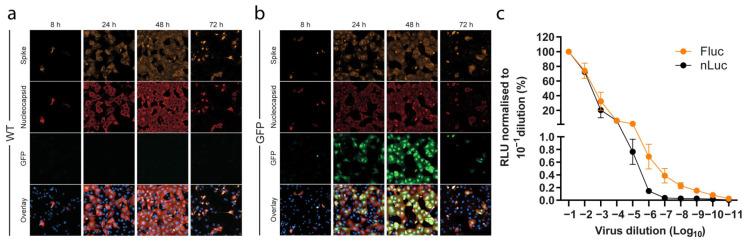
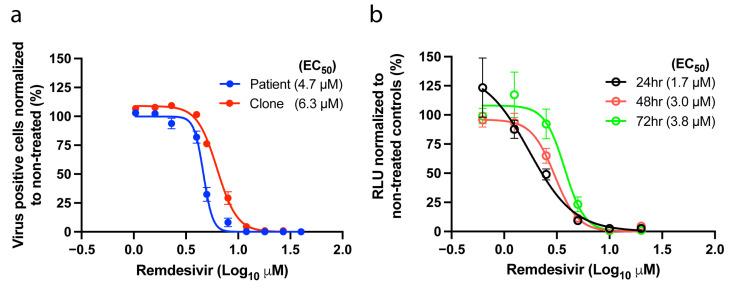
The COVID-19 pandemic continues to threaten healthcare systems worldwide due to the limited access to vaccines, suboptimal treatment options, and the continuous emergence of new and more transmissible SARS-CoV-2 variants. Reverse-genetics studies of viral genes and mutations have proven highly valuable in advancing basic virus research, leading to the development of therapeutics. We developed a functional and highly versatile full-length SARS-CoV-2 infectious system by cloning the sequence of a COVID-19 associated virus isolate (DK-AHH1) into a bacterial artificial chromosome (BAC). Viruses recovered after RNA-transfection of in vitro transcripts into Vero E6 cells showed growth kinetics and remdesivir susceptibility similar to the DK-AHH1 virus isolate. Insertion of reporter genes, green fluorescent protein, and nanoluciferase into the ORF7 genomic region led to high levels of reporter activity, which facilitated high throughput treatment experiments. We found that putative coronavirus remdesivir resistance-associated substitutions F480L and V570L-and naturally found polymorphisms A97V, P323L, and N491S, all in nsp12-did not decrease SARS-CoV-2 susceptibility to remdesivir. A nanoluciferase reporter clone with deletion of spike (S), envelope (E), and membrane (M) proteins exhibited high levels of transient replication, was inhibited by remdesivir, and therefore could function as an efficient non-infectious subgenomic replicon system. The developed SARS-CoV-2 reverse-genetics systems, including recombinants to modify infectious viruses and non-infectious subgenomic replicons with autonomous genomic RNA replication, will permit high-throughput cell culture studies-providing fundamental understanding of basic biology of this coronavirus. We have proven the utility of the systems in rapidly introducing mutations in nsp12 and studying their effect on the efficacy of remdesivir, which is used worldwide for the treatment of COVID-19. Our system provides a platform to effectively test the antiviral activity of drugs and the phenotype of SARS-CoV-2 mutants.
由于疫苗接种有限、治疗选择不佳以及新的和更具传染性的 SARS-CoV-2 变体不断出现,COVID-19 大流行继续威胁着全球的医疗保健系统。病毒基因和突变的反向遗传学研究已被证明在推进基础病毒研究方面非常有价值,并导致了治疗方法的发展。我们通过将与 COVID-19 相关的病毒分离株(DK-AHH1)的序列克隆到细菌人工染色体(BAC)中,开发了一种功能强大且用途广泛的全长 SARS-CoV-2 感染性系统。将体外转录的 RNA 转染到 Vero E6 细胞中后回收的病毒显示出与 DK-AHH1 病毒分离株相似的生长动力学和瑞德西韦敏感性。在 ORF7 基因组区域插入报告基因、绿色荧光蛋白和纳米荧光素酶导致高水平的报告基因活性,这便于高通量治疗实验。我们发现假定的冠状病毒瑞德西韦耐药相关取代 F480L 和 V570L-以及自然发生的多态性 A97V、P323L 和 N491S,都在 nsp12 中-并没有降低 SARS-CoV-2 对瑞德西韦的敏感性。带有刺突(S)、包膜(E)和膜(M)蛋白缺失的纳米荧光素酶报告基因克隆表现出高水平的瞬时复制,被瑞德西韦抑制,因此可以作为有效的非感染性亚基因组复制子系统。开发的 SARS-CoV-2 反向遗传学系统,包括用于修饰感染性病毒和具有自主基因组 RNA 复制的非感染性亚基因组复制子的重组体,将允许进行高通量细胞培养研究-提供对这种冠状病毒基本生物学的深入了解。我们已经证明了这些系统在快速引入 nsp12 突变并研究它们对瑞德西韦疗效的影响方面的效用,瑞德西韦已在全球用于治疗 COVID-19。我们的系统提供了一个平台,可有效测试药物的抗病毒活性和 SARS-CoV-2 突变体的表型。



 Zotero 插件