School of Life Science and Engineering, Foshan University, Foshan 528225, China.
Viruses. 2022 Feb 11;14(2):371. doi: 10.3390/v14020371.
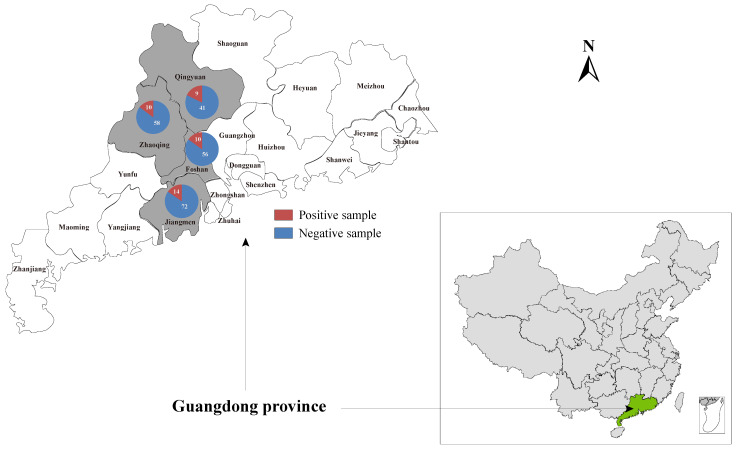
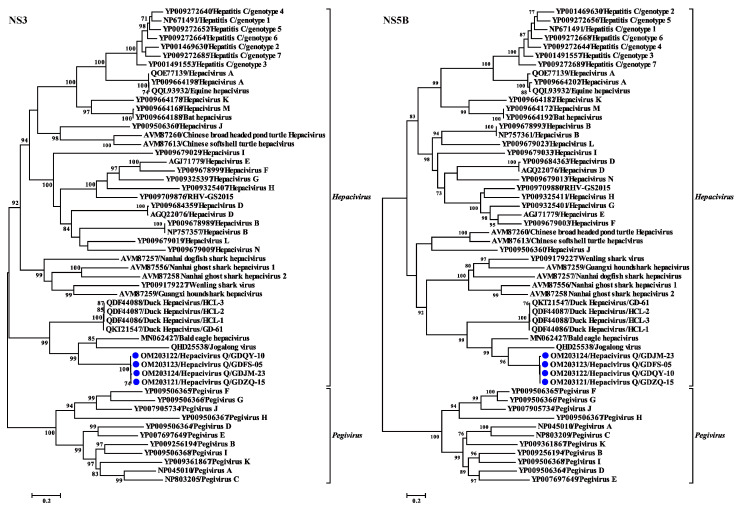
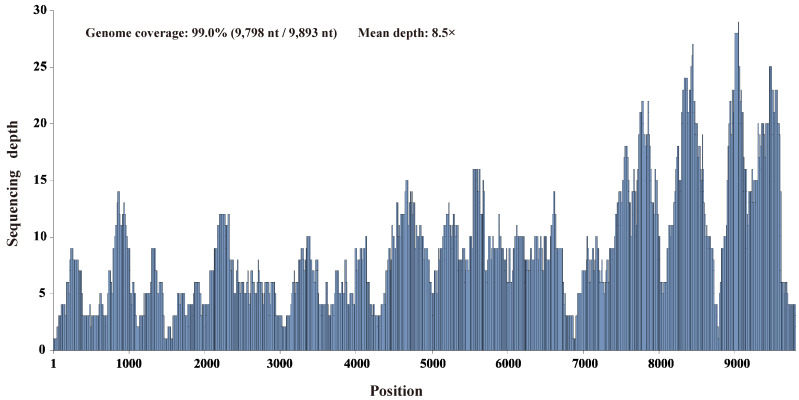
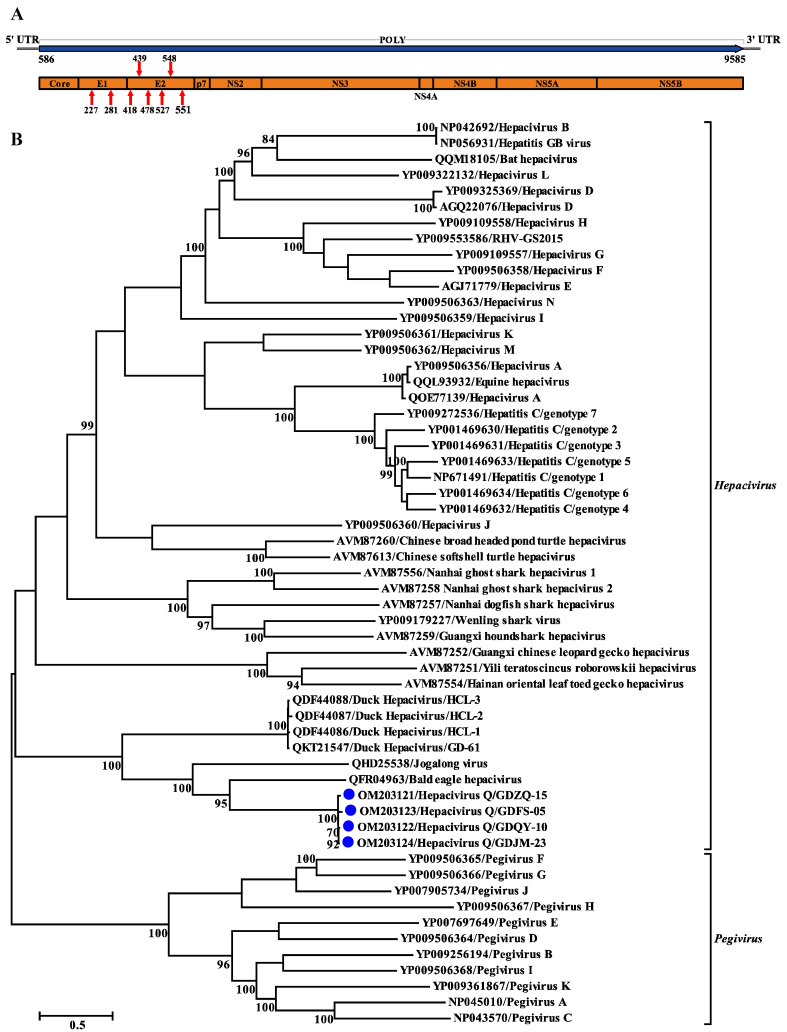
Hepaciviruses represent a group of viruses that pose a significant threat to the health of humans and animals. During the last decade, new members of the genus have been identified in various host species worldwide, indicating the widespread distribution of genetically diversified hepaciviruses among animals. By applying unbiased high-throughput sequencing, a novel hepacivirus, provisionally designated , was discovered in duck liver samples collected in Guangdong province of China. Genetic analysis revealed that the complete polyprotein of shares 23.9-46.6% amino acid identity with other representatives of the genus . Considering the species demarcation criteria for hepaciviruses, should be regarded as a novel hepacivirus species of the genus within the family . Phylogenetic analyses also indicate the large genetic distance between and other known hepaciviruses. Molecular detection of this novel hepacivirus showed an overall prevalence of 15.9% in duck populations in partial areas of Guangdong province. These results expand knowledge about the genetic diversity and evolution of hepaciviruses and indicate that genetically divergent hepaciviruses are circulating in duck populations in China.
Hepaciviruses 是一组对人类和动物健康构成重大威胁的病毒。在过去的十年中,已在全球各种宿主物种中鉴定出属的新成员,这表明遗传多样化的 hepaciviruses 在动物中广泛分布。通过应用无偏的高通量测序,在中国广东省采集的鸭肝样本中发现了一种新型 hepacivirus,暂命名为 。遗传分析表明, 的完整多蛋白与属内其他代表株共享 23.9-46.6%的氨基酸同一性。考虑到 hepaciviruses 的物种划分标准, 应被视为属内的一种新型 hepacivirus 种。系统进化分析也表明 与其他已知 hepaciviruses 之间存在较大的遗传距离。对这种新型 hepacivirus 的分子检测显示,在广东省部分地区的鸭群中总体流行率为 15.9%。这些结果扩展了对 hepaciviruses 的遗传多样性和进化的认识,并表明在中国鸭群中存在遗传分化的 hepaciviruses 。