Mifsud Jonathon C O, Costa Vincenzo A, Petrone Mary E, Marzinelli Ezequiel M, Holmes Edward C, Harvey Erin
Sydney Institute for Infectious Diseases, School of Medical Sciences, The University of Sydney, Sydney NSW 2006, Australia.
School of Life and Environmental Sciences, The University of Sydney, Sydney NSW 2006, Australia.
Virus Evol. 2022 Dec 26;9(1):veac124. doi: 10.1093/ve/veac124. eCollection 2023.
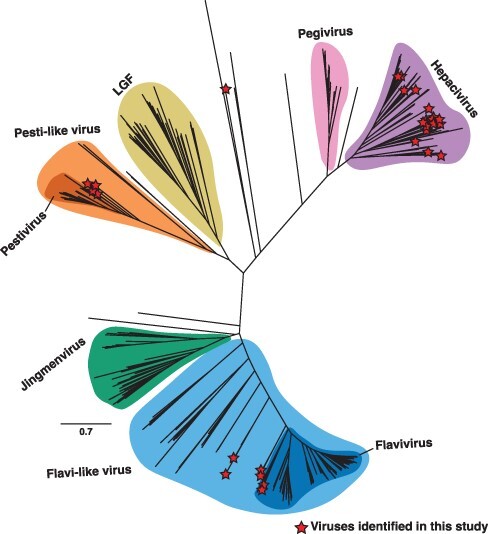
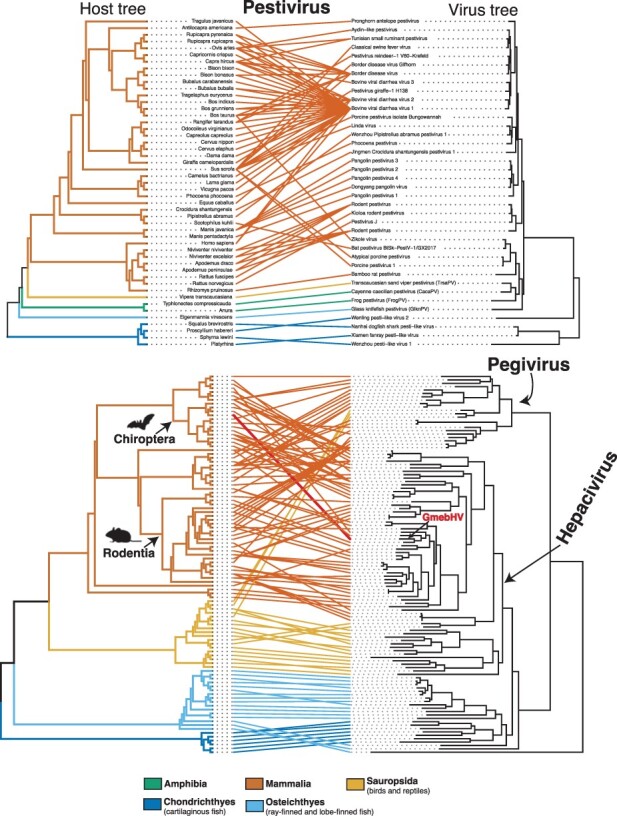
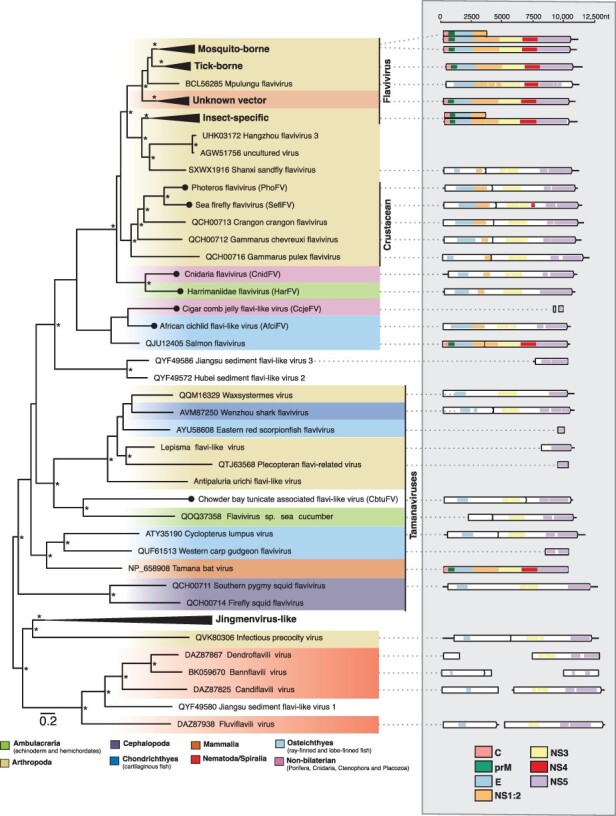
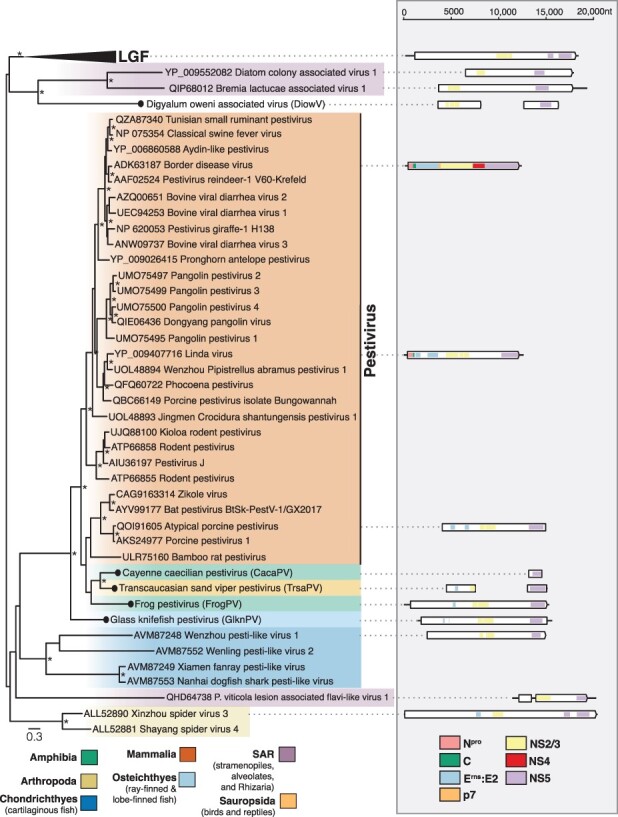
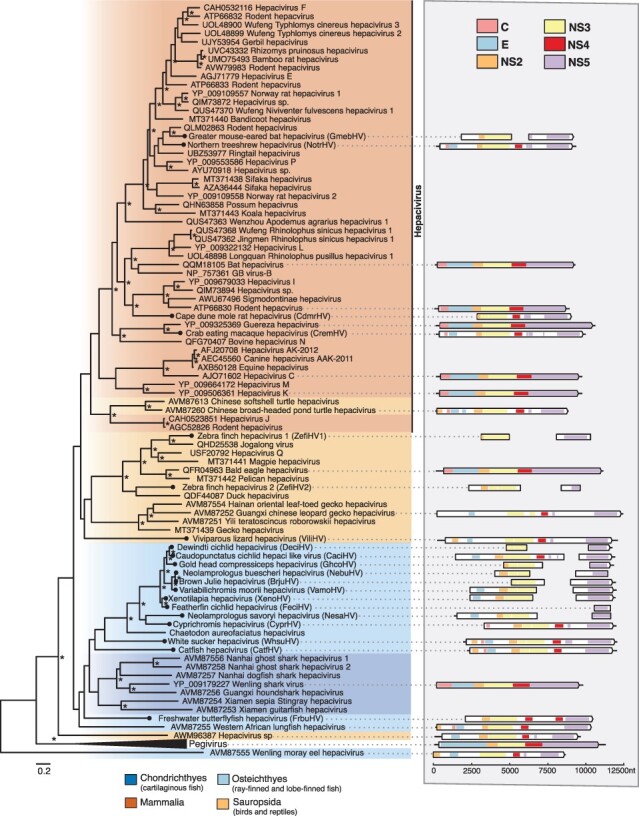
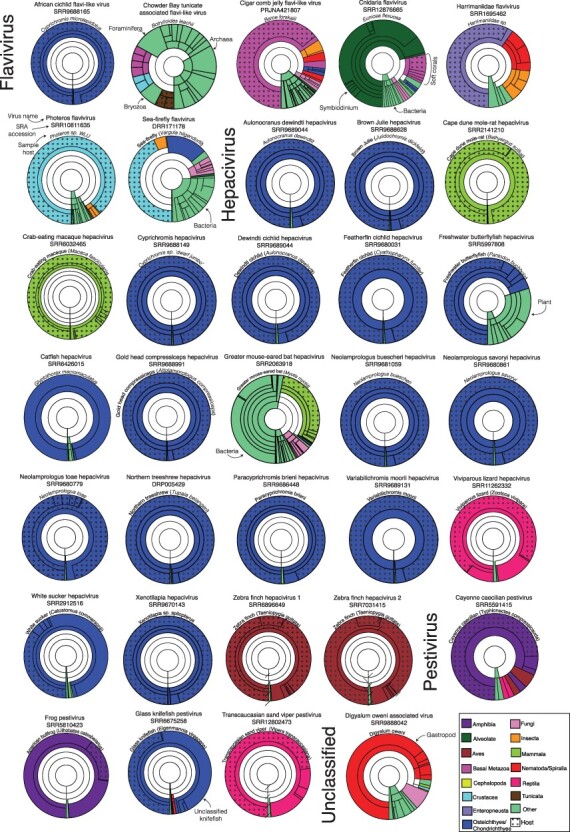
The flavivirids (family ) are a group of positive-sense RNA viruses that include well-documented agents of human disease. Despite their importance and ubiquity, the timescale of flavivirid evolution is uncertain. An ancient origin, spanning millions of years, is supported by their presence in both vertebrates and invertebrates and by the identification of a flavivirus-derived endogenous viral element in the peach blossom jellyfish genome (, phylum ), implying that the flaviviruses arose early in the evolution of the Metazoa. To date, however, no exogenous flavivirid sequences have been identified in these hosts. To help resolve the antiquity of the we mined publicly available transcriptome data across the Metazoa. From this, we expanded the diversity within the family through the identification of 32 novel viral sequences and extended the host range of the pestiviruses to include amphibians, reptiles, and ray-finned fish. Through co-phylogenetic analysis we found cross-species transmission to be the predominate macroevolutionary event across the non-vectored flavivirid genera (median, 68 per cent), including a cross-species transmission event between bats and rodents, although long-term virus-host co-divergence was still a regular occurrence (median, 23 per cent). Notably, we discovered flavivirus-like sequences in basal metazoan species, including the first associated with Cnidaria. This sequence formed a basal lineage to the genus and was closer to arthropod and crustacean flaviviruses than those in the tamanavirus group, which includes a variety of invertebrate and vertebrate viruses. Combined, these data attest to an ancient origin of the flaviviruses, likely close to the emergence of the metazoans 750-800 million years ago.
黄病毒科是一组正义RNA病毒,其中包括有充分文献记载的人类疾病病原体。尽管它们很重要且广泛存在,但黄病毒科的进化时间尺度尚不确定。它们在脊椎动物和无脊椎动物中均有存在,并且在桃花水母(刺胞动物门)基因组中鉴定出了一种源自黄病毒的内源性病毒元件,这支持了其古老的起源,跨越数百万年,这意味着黄病毒在后生动物进化的早期就已出现。然而,迄今为止,在这些宿主中尚未鉴定出任何外源性黄病毒序列。为了帮助确定黄病毒科的古老程度,我们挖掘了后生动物中公开可用的转录组数据。据此,我们通过鉴定32个新的病毒序列扩大了该科内的多样性,并将瘟病毒的宿主范围扩展至两栖动物、爬行动物和硬骨鱼。通过共系统发育分析,我们发现跨物种传播是所有非媒介传播黄病毒属中的主要宏观进化事件(中位数为68%),包括蝙蝠和啮齿动物之间的一次跨物种传播事件,尽管长期的病毒-宿主共同分化仍是常见现象(中位数为23%)。值得注意的是,我们在基础后生动物物种中发现了黄病毒样序列,包括首个与刺胞动物相关的序列。该序列形成了黄病毒属的一个基础谱系,并且与节肢动物和甲壳类黄病毒相比,比包括多种无脊椎动物和脊椎动物病毒的塔马纳病毒组中的病毒更接近。综合这些数据证明了黄病毒的古老起源,可能接近7.5亿至8亿年前后生动物的出现。