Integrative Toxicology, Institute of Environmental Medicine, Karolinska Institutet, Stockholm, Sweden.
Sustainable work and management, IVL Swedish Environmental Research Institute, Stockholm, Sweden.
Ann Work Expo Health. 2022 Jul 2;66(6):741-753. doi: 10.1093/annweh/wxac006.
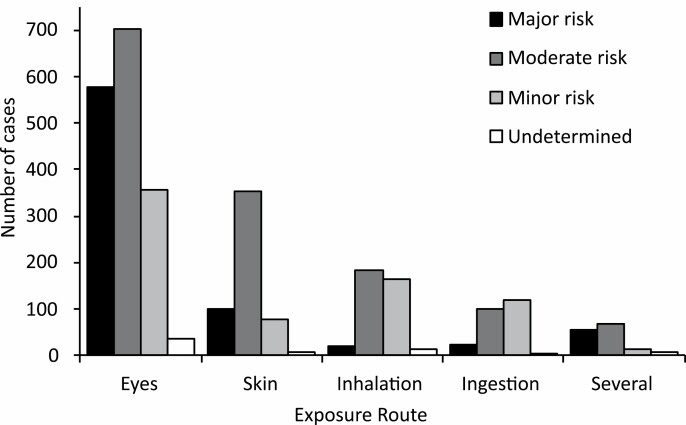
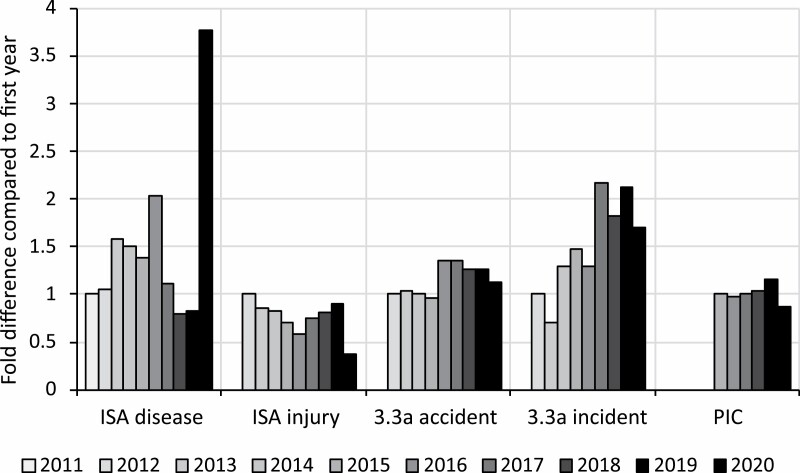
Using data from the Swedish Products Register, hosted by the Swedish Chemicals Agency (KemI), national occupational injury and disease statistics, and call records from the Swedish Poisons Information Centre (PIC) we characterize health hazards of marketed cleaning products and recorded injuries, disease, and incidents linked to cleaning or disinfection agents. The results show that cleaning agents pose many kinds of health hazards, although corrosion and irritation hazards dominate, in particular for the eyes (54% of all included products). Few products were recognized as inhalation hazards. The nature of the health hazards is reflected in the occupational disease and injury statistics and PIC records for eyes and skin but not for the respiratory tract. Among occupational disease cases attributed to cleaning or disinfection agents, 61% concern skin and 26% the respiratory tract. Among occupational injury cases 64% concern chemical burns. However, only a small part (<0.5%) of all reported diseases and injuries were explicitly attributed to cleaning or disinfection agents. On average, there were 11 cases of disease attributed to cleaning or disinfection agents per million workers and year. For occupational injuries the corresponding number was 8. The data concern a broad range of sectors and occupations, but notable sectors were healthcare, accommodation and food service, and manufacturing. Women were more likely to suffer from disease, men and women equally likely to suffer from injury. PIC cases were evenly distributed between men and women, but the clear risk cases more frequently involved men. Occupational diseases increased many-fold in 2020 while injuries decreased, which could be due to COVID-19 changing use patterns of cleaning and disinfection agents at work. We conclude that cleaning agents pose a variety of risks to a large part of the workforce, although particular attention for preventive efforts may need to be directed to the healthcare, accommodation and food service, and manufacturing sectors.
利用瑞典化学品署(KemI)托管的瑞典产品注册处的数据、国家职业伤害和疾病统计数据以及瑞典中毒信息中心(PIC)的呼叫记录,我们对市场上清洁产品的健康危害以及与清洁或消毒剂相关的伤害、疾病和事故进行了描述。结果表明,清洁产品存在多种健康危害,尽管主要是腐蚀和刺激危害,尤其是对眼睛(占所有包含产品的 54%)。很少有产品被认为存在吸入危害。健康危害的性质反映在职业疾病和伤害统计数据以及 PIC 对眼睛和皮肤的记录中,但对呼吸道没有反映。在归因于清洁或消毒剂的职业疾病病例中,61%涉及皮肤,26%涉及呼吸道。在职业伤害病例中,64%涉及化学灼伤。然而,只有一小部分(<0.5%)报告的疾病和伤害被明确归因于清洁或消毒剂。平均而言,每百万工人和每年有 11 例疾病归因于清洁或消毒剂。对于职业伤害,相应的数字为 8。这些数据涉及广泛的部门和职业,但值得注意的部门是医疗保健、住宿和餐饮服务以及制造业。女性更容易患病,男性和女性患病的可能性相同。PIC 病例在男女之间分布均匀,但明显的风险病例更多地涉及男性。2020 年职业疾病增加了数倍,而伤害减少,这可能是由于 COVID-19 改变了工作场所清洁和消毒剂的使用模式。我们的结论是,清洁产品对很大一部分劳动力构成了多种风险,尽管可能需要特别注意医疗保健、住宿和餐饮服务以及制造业部门的预防措施。