Nuclear Medicine, Department of Medical Sciences, AOU Città Della Salute E Della Scienza Di Torino, University of Turin, Turin, Italy.
Division of Nuclear Medicine, IEO European Institute of Oncology IRCCS, Milan, Italy.
Eur J Nucl Med Mol Imaging. 2022 Jul;49(9):3257-3268. doi: 10.1007/s00259-022-05741-9. Epub 2022 Feb 26.
BACKGROUND/AIM: Prostate-specific-membrane-antigen/positron emission tomography (PSMA-PET) detects with high accuracy disease-recurrence, leading to changes in the management of biochemically-recurrent (BCR) prostate cancer (PCa). However, data regarding the oncological outcomes of patients who performed PSMA-PET are needed. The aim of this study was to evaluate the incidence of clinically relevant events during follow-up in patients who performed PSMA-PET for BCR after radical treatment.
This analysis included consecutive, hormone-sensitive, hormone-free, recurrent PCa patients (HSPC) enrolled through a prospective study. All patients were eligible for salvage therapy, having at least 24 months of follow-up after PSMA-PET. The primary endpoint was the Event-Free Survival (EFS), defined as the time between the PSMA-PET and the date of event/last follow-up. The Kaplan-Meier method was used to estimate the EFS curves. EFS was also investigated by Cox proportional hazards regression. Events were defined as death, radiological progression, or PSA recurrence after therapy.
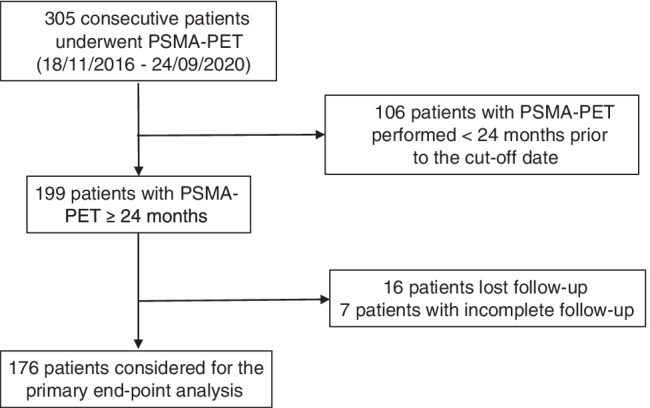
One-hundred and seventy-six (n = 176) patients were analyzed (median PSA 0.62 [IQR: 0.43-1.00] ng/mL; median follow-up of 35.4 [IQR: 26.5-40.3] months). The EFS was 78.8% at 1 year, 65.2% (2 years), and 52.2% (3 years). Patients experiencing events during study follow-up had a significantly higher median PSA (0.81 [IQR: 0.53-1.28] vs 0.51 [IQR: 0.36-0.80] ng/mL) and a lower PSA doubling time (PSAdt) (5.4 [IQR: 3.7-11.6] vs 12.7 [IQR: 6.6-24.3] months) (p < 0.001) compared to event-free patients. The Kaplan-Meier curves showed that PSA > 0.5 ng/mL, PSAdt ≤ 6 months, and a positive PSMA-PET result were associated with a higher event rate (p < 0.01). No significant differences of event rates were observed in patients who received changes in therapy management after PSMA-PET vs. patients who did not receive therapy changes. Finally, PSA > 0.5 ng/mL and PSAdt ≤ 6 months were statistically significant event-predictors in multivariate model (p < 0.001).
Low PSA and long PSAdt were significant predictors of longer EFS. A lower incidence of events was observed in patients having negative PSMA-PET, since longer EFS was significantly more probable in case of a negative scan.
背景/目的:前列腺特异性膜抗原/正电子发射断层扫描(PSMA-PET)能够高度准确地检测到疾病复发,从而改变生化复发性(BCR)前列腺癌(PCa)的治疗管理。然而,需要有关接受 PSMA-PET 检查的患者的肿瘤学结果的数据。本研究的目的是评估在接受根治性治疗后进行 BCR 治疗的患者中进行 PSMA-PET 检查后的随访期间发生临床相关事件的发生率。
这项分析包括通过一项前瞻性研究连续纳入的、激素敏感的、无激素的、复发性 PCa 患者(HSPC)。所有患者均有资格接受挽救性治疗,在 PSMA-PET 后至少有 24 个月的随访。主要终点是无事件生存(EFS),定义为 PSMA-PET 与事件/最后一次随访日期之间的时间。使用 Kaplan-Meier 方法估计 EFS 曲线。还通过 Cox 比例风险回归调查 EFS。事件定义为治疗后死亡、影像学进展或 PSA 复发。
分析了 176 名(n=176)患者(中位 PSA 0.62[IQR:0.43-1.00]ng/mL;中位随访 35.4[IQR:26.5-40.3]个月)。1 年时 EFS 为 78.8%,2 年时为 65.2%(2 年),3 年时为 52.2%。在研究随访期间发生事件的患者的中位 PSA 明显更高(0.81[IQR:0.53-1.28]ng/mL vs 0.51[IQR:0.36-0.80]ng/mL),PSA 倍增时间(PSAdt)明显更短(5.4[IQR:3.7-11.6]vs 12.7[IQR:6.6-24.3]个月)(p<0.001)。Kaplan-Meier 曲线显示,PSA>0.5ng/mL、PSAdt≤6 个月和 PSMA-PET 阳性结果与更高的事件发生率相关(p<0.01)。与未接受治疗改变的患者相比,在 PSMA-PET 后接受治疗管理改变的患者的事件发生率没有显著差异。最后,PSA>0.5ng/mL 和 PSAdt≤6 个月是多变量模型中具有统计学意义的事件预测因子(p<0.001)。
低 PSA 和短 PSAdt 是 EFS 延长的显著预测因素。在 PSMA-PET 阴性的患者中观察到较低的事件发生率,因为在扫描阴性的情况下,EFS 显著更有可能延长。