Academic Unit of Oral and Maxillofacial Medicine and Pathology 19 Claremont Cres, Broomhall, Sheffield S10 2TA, England
Med Oral Patol Oral Cir Bucal. 2022 Mar 1;27(2):e164-e173. doi: 10.4317/medoral.25138.
Appropriate DNA replication is vital to maintain cell integrity at the genomic level. Malfunction on DNA repair mechanisms can have implications related to tumor behavior. Our aim was to evaluate the expression of key complexes of the DNA mismatch-repair system MutSα (hMSH2-hMSH6) and MutSβ (hMSH2-hMSH3) in a panel comprising the most common benign and malignant salivary gland tumors (SGT), and to determine their association with disease-free survival.
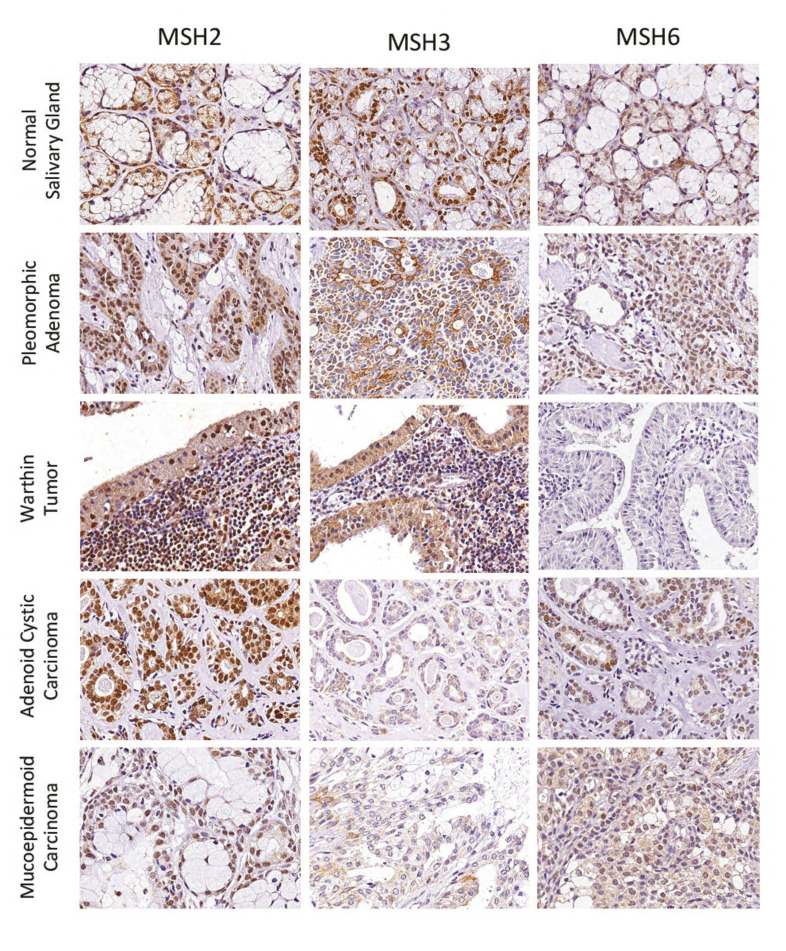
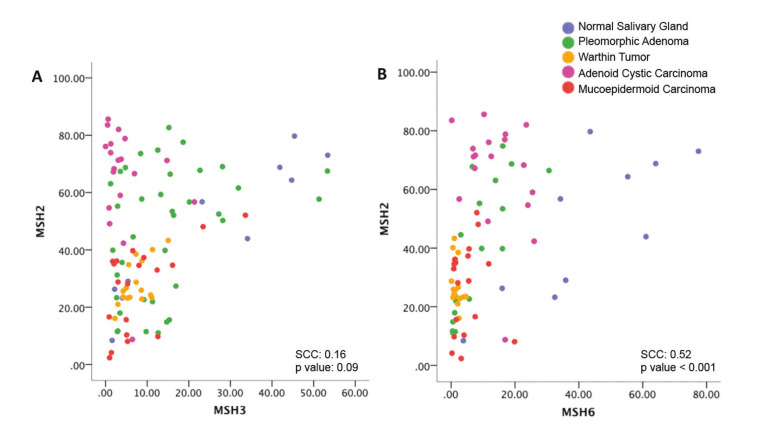
Ten cases of normal salivary gland (NSG) and 92 of SGT (54 benign and 38 malignant) were retrieved. Immunohistochemistry was performed for hMSH2, hMSH3, hMSH6. Scanned slides were digitally analyzed based on the percentage of positive cells with nuclear staining. Cases were further classified in MutSαhigh and MutSβhigh based on hMSH2-hMSH6 and hMSH3-hMSH6 expression, respectively.
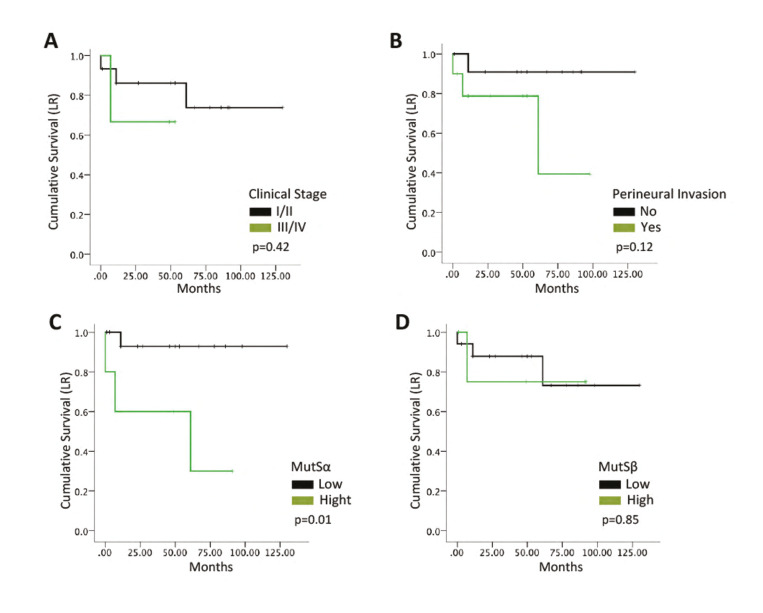
hMSH3 expression was lower in malignant SGT compared to NSG and benign cases. Adenoid cystic carcinoma (ACC) cases with perineural invasion presented a lower percentage of hMSH3 positive cells. hMSH6 was downregulated in both benign and malignant SGT compared to NSG. Malignant SGT cases with MutSαhigh expression had lower disease-free survival compared to MutSαlow cases. A 10.26-fold increased risk of presenting local recurrence was observed.
Our findings suggest that a lack of hMSH3 protein function is associated with a more aggressive phenotype (malignancy and perineural invasion) and that MutSα overexpression predicts a poor clinical outcome in malignant SGT.
适当的 DNA 复制对于维持基因组水平的细胞完整性至关重要。DNA 修复机制的功能障碍可能与肿瘤行为有关。我们的目的是评估 DNA 错配修复系统关键复合物 MutSα(hMSH2-hMSH6)和 MutSβ(hMSH2-hMSH3)在包括最常见的良性和恶性涎腺肿瘤(SGT)的面板中的表达,并确定它们与无病生存率的关系。
我们从 10 例正常涎腺(NSG)和 92 例 SGT(54 例良性和 38 例恶性)中选取标本。进行 hMSH2、hMSH3、hMSH6 的免疫组织化学染色。根据细胞核染色阳性细胞的百分比对扫描切片进行数字化分析。根据 hMSH2-hMSH6 和 hMSH3-hMSH6 的表达情况,将病例进一步分类为 MutSα高和 MutSβ高。
与 NSG 和良性病例相比,恶性 SGT 中 hMSH3 的表达较低。有神经周围侵犯的腺样囊性癌(ACC)病例中 hMSH3 阳性细胞的比例较低。与 NSG 相比,良性和恶性 SGT 中 hMSH6 的表达均下调。与 MutSα低表达病例相比,MutSα高表达的恶性 SGT 病例无病生存率较低。局部复发的风险增加了 10.26 倍。
我们的研究结果表明,hMSH3 蛋白功能缺失与更具侵袭性的表型(恶性和神经周围侵犯)相关,MutSα 过表达预示着恶性 SGT 的临床预后不良。