Department of Biomedicine, Aarhus University, Aarhus, Denmark; Department of Infectious Diseases, Aarhus University Hospital, Aarhus, Denmark.
Clin Microbiol Infect. 2022 Nov;28(11):1417-1421. doi: 10.1016/j.cmi.2022.02.022. Epub 2022 Feb 24.
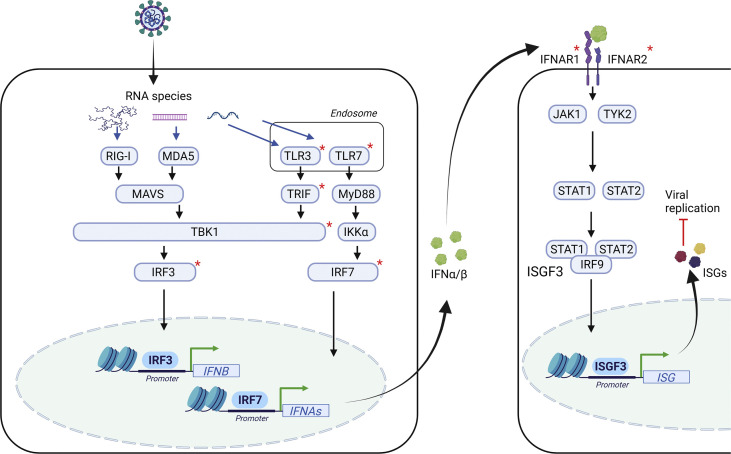
During the past 2 years, studies on patients with SARS-CoV-2 infection have revealed rare inborn errors of immunity (IEIs) in type interferon (IFN) pathways underlying critical COVID-19 pneumonia. This has provided insights into pathophysiological mechanisms and immune signaling circuits regulating antiviral responses to SARS-CoV-2 and governing the susceptibility to and outcome of SARS-CoV-2 infection in humans.
In this review, the current knowledge on IEIs underlying critical COVID-19 is presented, and the clinical implications of these findings for individualized prophylaxis and treatment are outlined.
The review is based on a broad literature search, including primarily studies on whole-exome sequencing, and to a lesser extent genome-wide association studies, of patients with critical COVID-19, as well as retrospective descriptive studies of the SARS-CoV-2 disease course in individuals with known IEIs.
The review describes the discovery of monogenic IEI in 9 genetic loci related to the production or responses to type I IFN in patients with critical COVID-19 pneumonia and the surprising finding of phenocopies of these, represented by neutralizing autoantibodies to type IFN in a significant proportion of patients with critical pneumonia, particularly in elderly men, and further enriched in patients with lethal disease course. Moreover insights gained from studies on SARS-CoV-2 infection, disease course, and outcome in patients with known IEI is presented. Finally, some hypotheses for a possible genetic basis of autoimmune, inflammatory, and long-term complications of SARS-CoV-2 infection are presented and discussed.
Uncovering IEIs underlying critical COVID-19 or other severe SARS-CoV-2 disease manifestations provides valuable insights into the basic principles of antiviral immune responses and pathophysiology related to SARS-CoV-2 infection. Such knowledge has important clinical implications for identification of susceptible individuals and for diagnosis, prophylaxis, and treatment of patients to reduce disease burden and improve preparedness against viral pandemics with known or emerging viruses in the future.
在过去的 2 年中,对 SARS-CoV-2 感染患者的研究揭示了 COVID-19 重症肺炎的关键干扰素(IFN)途径中罕见的先天性免疫缺陷(IEI)。这为理解调节针对 SARS-CoV-2 的抗病毒反应的病理生理学机制和免疫信号转导提供了思路,并为人类对 SARS-CoV-2 感染的易感性和结局提供了见解。
本综述介绍了 COVID-19 重症患者中潜在的 IEI 的最新知识,并概述了这些发现对个体化预防和治疗的临床意义。
该综述基于广泛的文献检索,包括对 COVID-19 重症患者全外显子测序的主要研究,以及对已知 IEI 个体 SARS-CoV-2 疾病过程的回顾性描述性研究。
该综述描述了在 COVID-19 重症肺炎患者中与 I 型 IFN 的产生或反应相关的 9 个遗传位点的单基因 IEI 的发现,以及这些位点的表型类似物的惊人发现,这些表型类似物代表了 COVID-19 重症患者,尤其是老年男性中相当比例的中和自身抗体到 I 型 IFN,并且在疾病进展更严重的患者中进一步富集。此外,还介绍了从已知 IEI 患者的 SARS-CoV-2 感染、疾病过程和结局研究中获得的见解。最后,提出并讨论了 SARS-CoV-2 感染的自身免疫、炎症和长期并发症的可能遗传基础的一些假说。
揭示 COVID-19 或其他严重 SARS-CoV-2 疾病表现的 IEI 为抗病毒免疫反应的基本原则和与 SARS-CoV-2 感染相关的病理生理学提供了有价值的见解。这些知识对识别易感个体以及对患者进行诊断、预防和治疗具有重要的临床意义,可减轻疾病负担,并为未来已知或新发病毒的病毒性大流行做好准备。