Department of Internal Medicine and Radboud Center for Infectious Diseases (RCI), Radboud University Medical Center, Nijmegen, 6525 GA, The Netherlands.
Department of Human Genetics, Radboud University Medical Center, Nijmegen, 6525 GA, The Netherlands.
Genome Med. 2022 Aug 19;14(1):96. doi: 10.1186/s13073-022-01100-3.
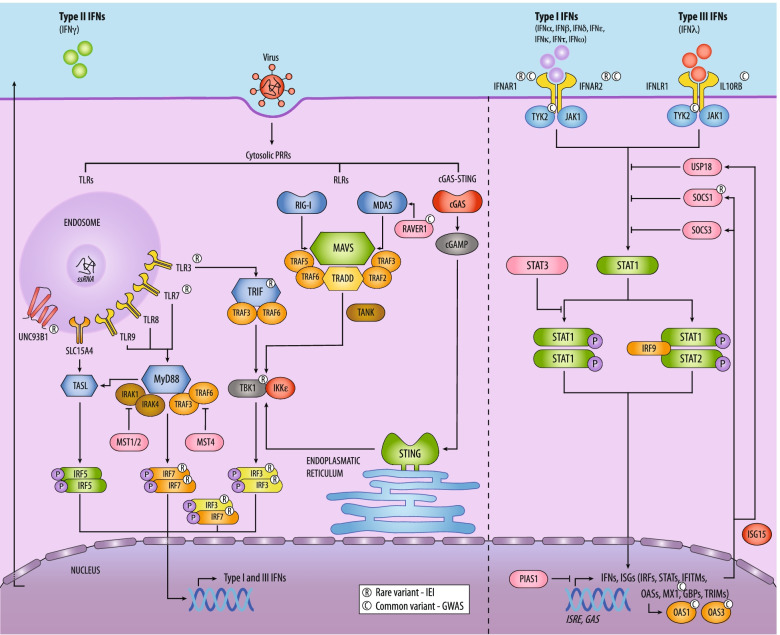
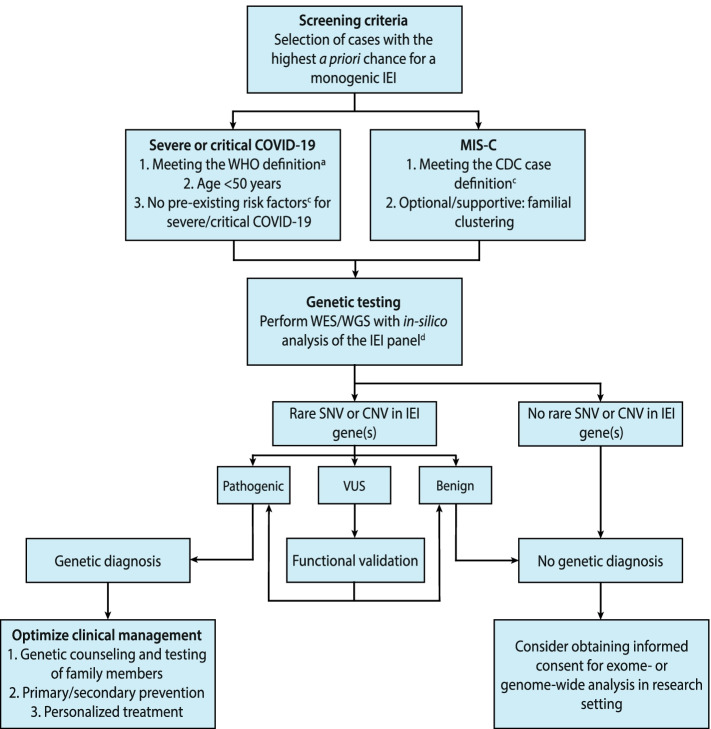
Since the start of the coronavirus disease 2019 (COVID-19) pandemic, important insights have been gained into virus biology and the host factors that modulate the human immune response against severe acute respiratory syndrome coronavirus 2 (SARS-CoV-2). COVID-19 displays a highly variable clinical picture that ranges from asymptomatic disease to lethal pneumonia. Apart from well-established general risk factors such as advanced age, male sex and chronic comorbidities, differences in host genetics have been shown to influence the individual predisposition to develop severe manifestations of COVID-19. These differences range from common susceptibility loci to rare genetic variants with strongly predisposing effects, or proven pathogenic variants that lead to known or novel inborn errors of immunity (IEI), which constitute a growing group of heterogeneous Mendelian disorders with increased susceptibility to infectious disease, auto-inflammation, auto-immunity, allergy or malignancies. The current genetic findings point towards a convergence of common and rare genetic variants that impact the interferon signalling pathways in patients with severe or critical COVID-19. Monogenic risk factors that impact IFN-I signalling have an expected prevalence between 1 and 5% in young, previously healthy individuals (<60 years of age) with critical COVID-19. The identification of these IEI such as X-linked TLR7 deficiency indicates a possibility for targeted genetic screening and personalized clinical management. This review aims to provide an overview of our current understanding of the host genetic factors that predispose to severe manifestations of COVID-19 and focuses on rare variants in IFN-I signalling genes and their potential clinical implications.
自 2019 年冠状病毒病(COVID-19)大流行开始以来,人们对病毒生物学和调节人类对严重急性呼吸综合征冠状病毒 2(SARS-CoV-2)免疫反应的宿主因素有了重要的认识。COVID-19 的临床表现高度多样化,从无症状疾病到致命性肺炎不等。除了年龄较大、男性和慢性合并症等公认的一般危险因素外,宿主遗传学差异已被证明会影响个体易患 COVID-19 严重表现的倾向。这些差异范围从常见的易感基因座到具有强烈易感性的罕见遗传变异体,或导致已知或新型先天性免疫缺陷(IEI)的致病变异体,IEI 构成了一组越来越多的具有易感性增加的异质性孟德尔疾病,包括传染病、自身炎症、自身免疫、过敏或恶性肿瘤。目前的遗传发现表明,影响严重或危重新冠肺炎患者干扰素信号通路的常见和罕见遗传变异体趋于一致。在年轻、以前健康的(<60 岁)危重新冠肺炎患者中,影响 IFN-I 信号的单基因危险因素的预期患病率为 1%至 5%。这些 IEI 的鉴定,如 X 连锁 TLR7 缺陷,表明有可能进行靶向遗传筛查和个性化临床管理。这篇综述旨在概述我们对导致 COVID-19 严重表现的宿主遗传因素的现有认识,并重点介绍 IFN-I 信号基因中的罕见变异体及其潜在的临床意义。