Orthopaedics of Zigong Fourth People's Hospital, Zigong, Sichuan, China.
Respiratory Medicine of Zigong Fourth People's Hospital, Zigong, 643000, Sichuan, China.
BMC Musculoskelet Disord. 2022 Feb 26;23(1):184. doi: 10.1186/s12891-022-05135-w.
To explore the influencing factors of bone cement leakage in the paravertebral vein after vertebroplasty for the treatment of osteoporotic vertebral compression fractures (OVCFs) and to determine the correlation between the puncture-side bone cement/vertebral body volume ratio and bone cement leakage in the paravertebral vein.
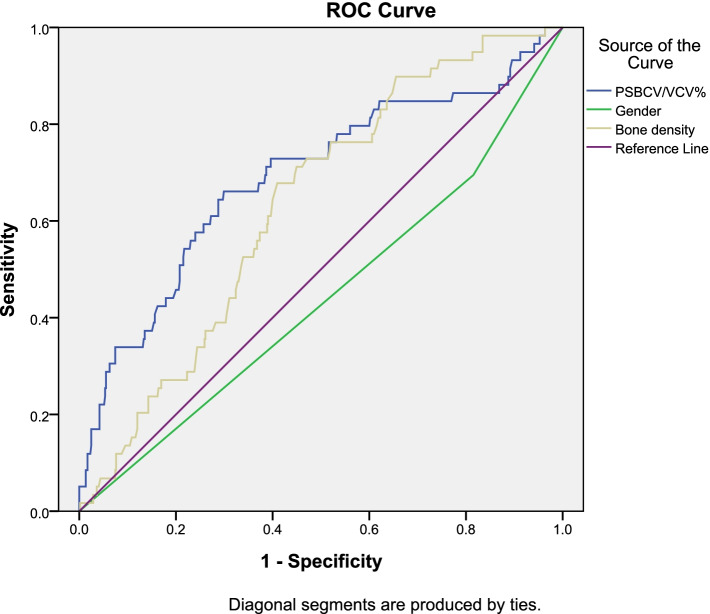
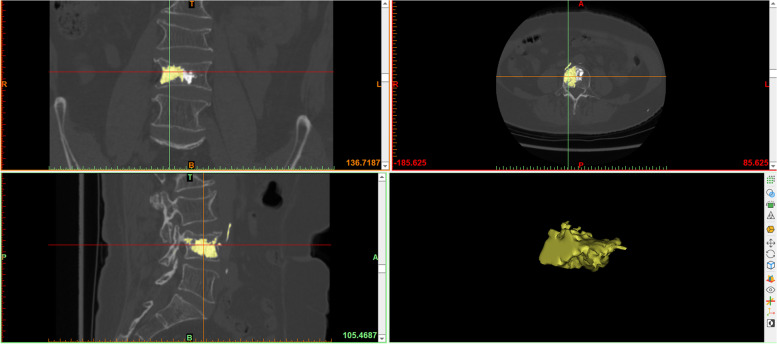
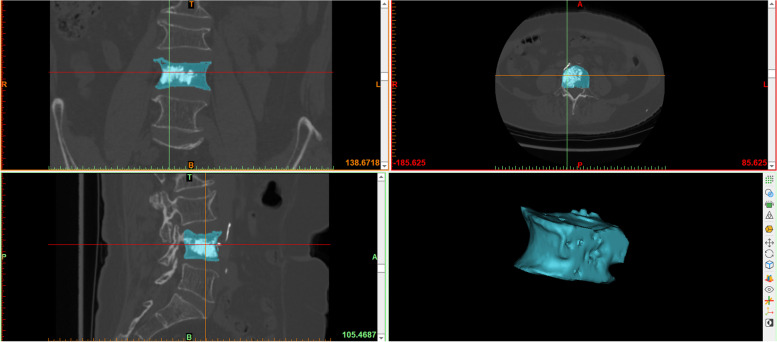
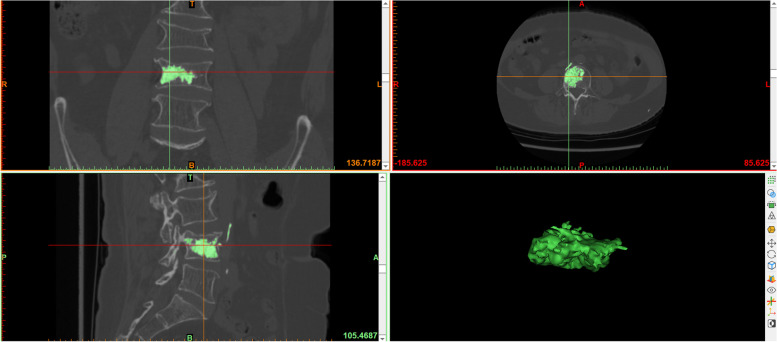
This was a retrospective analysis of 495 patients (585 vertebral bodies) with OVCFs treated from August 2018 to May 2021 in our hospital. The patients' postoperative CT data were imported into Mimics software, and the three-dimensional(3D) reconstruction function was used to calculate the bone cement volume (BCV), puncture-side bone cement volume (PSBCV), and vertebral body volume (VBV); the bone cement/vertebral body volume ratio (BCV/VCV%) and puncture-side bone cement/vertebral body volume ratio (PSBCV/VCV%) were additionally calculated. Sex, Age, Body mass index(BMI), Bone density, BCV, PSBCV, VBV, BCV/VCV%, and PSBCV/VCV were compared between the leakage group and the non-leakage group. Logistic regression analysis was used to assess the correlations between the factors that statistically significantly differed between the two groups and the presence of leakage in the paravertebral veins. A receiver operating characteristic (ROC) curve was used to determine the diagnostic value of the PSBCV/VCV% and to obtain the optional cut-off value.
A total of 102 males and 393 females with an average age of 72.89 (52 ~ 93) years were included in our study. There were 57 cases of cement leakage (59 vertebral bodies) in the paravertebral vein. There were 438 patients (526 vertebral bodies) without paravertebral cement leakage. Univariate analysis showed that the differences in sex, bone density, PSBCV, and PSBCV/VCV% between the two groups were statistically significant (P < 0.05). Logistic regression analysis showed that there were correlations between sex, bone density, and PSBCV/VCV% and the presence of paravertebral cement leakage (P < 0.05). The ROC curve showed that the area under the curve of the PSBCV/VCV% for the diagnosis of cement leakage in the paravertebral vein was greater than 0.65, and P < 0.05, indicating a diagnostic value. The best cut-off point for the diagnosis of paravertebral cement leakage with the PSBCV/VCV% was 13.68%, with a sensitivity of 84.7% and specificity of 37.8%.
Sex, bone density, and PSBCV/VCV% are risk factors for cement leakage in the paravertebral veins after vertebroplasty for the treatment of OVCFs; the PSBCV/VCV% is strongly associated with paravertebral venous leakage, and the optimal PSBCV/VCV% is 13.68%. When the PSBCV/VCV% exceeds the optimal value, the risk of cement leakage in the paravertebral vein becomes significantly increased.
探讨骨质疏松性椎体压缩性骨折(OVCFs)经皮椎体成形术后椎旁静脉骨水泥渗漏的影响因素,以及穿刺侧骨水泥/椎体体积比与椎旁静脉骨水泥渗漏的相关性。
回顾性分析 2018 年 8 月至 2021 年 5 月我院收治的 495 例(585 个椎体)OVCFs 患者的术后 CT 数据,将其导入 Mimics 软件,利用三维(3D)重建功能计算骨水泥体积(BCV)、穿刺侧骨水泥体积(PSBCV)和椎体体积(VBV);计算骨水泥/椎体体积比(BCV/VCV%)和穿刺侧骨水泥/椎体体积比(PSBCV/VCV%)。比较渗漏组和非渗漏组之间性别、年龄、体重指数(BMI)、骨密度、BCV、PSBCV、VBV、BCV/VCV%和 PSBCV/VCV%的差异。采用 logistic 回归分析两组间统计学差异有意义的因素与椎旁静脉渗漏的相关性。采用受试者工作特征(ROC)曲线确定 PSBCV/VCV%的诊断价值,并获得最佳截断值。
共纳入 102 例男性和 393 例女性患者,平均年龄 72.89(52~93)岁。57 例(59 个椎体)出现椎旁静脉骨水泥渗漏,438 例(526 个椎体)无椎旁骨水泥渗漏。单因素分析显示,两组间性别、骨密度、PSBCV 和 PSBCV/VCV%的差异有统计学意义(P<0.05)。logistic 回归分析显示,性别、骨密度和 PSBCV/VCV%与椎旁骨水泥渗漏存在相关性(P<0.05)。ROC 曲线显示,PSBCV/VCV%诊断椎旁静脉骨水泥渗漏的曲线下面积大于 0.65,P<0.05,具有诊断价值。PSBCV/VCV%诊断椎旁骨水泥渗漏的最佳截断点为 13.68%,其灵敏度为 84.7%,特异度为 37.8%。
性别、骨密度和 PSBCV/VCV%是经皮椎体成形术治疗 OVCFs 后椎旁静脉骨水泥渗漏的危险因素;PSBCV/VCV%与椎旁静脉渗漏密切相关,最佳 PSBCV/VCV%为 13.68%。当 PSBCV/VCV%超过最佳值时,椎旁静脉骨水泥渗漏的风险显著增加。