The Province and Ministry Co-Sponsored Collaborative Innovation Center for Medical Epigenetics; Tianjin Key Laboratory of Cellular Homeostasis and Human Diseases; Department of Physiology and Pathophysiology, School of Basic Medical Science, Tianjin Medical University, Heping, China.
Department of Central Laboratory and Institute of Clinical Molecular Biology, Peking University People's Hospital; National Center for Trauma Medicine, Beijing, China.
Clin Transl Med. 2022 Feb;12(2):e746. doi: 10.1002/ctm2.746.
Aging-associated osteoporosis is frequently seen in the elderly in clinic, but efficient managements are limited because of unclear nosogenesis. The current study aims to investigate the role of melatonin on senescent bone marrow stromal cells (BMSCs) and the underlying regulating mechanism.
Melatonin levels were tested by ELISA. Gene expression profiles were performed by RNA-sequencing, enrichment of H3K36me2 on gene promoters was analyzed by Chromatin Immunoprecipitation Sequencing (ChIP-seq), and chromatin accessibility was determined by Assay for Transposase-Accessible Chromatin with high-throughput sequencing (ATAC-seq). Osteogenesis of BMSCs in vitro was measured by Alizarin Red and Alkaline Phosphatase staining, and in vivo effects of melatonin was assessed by histological staining and micro computed tomography (micro-CT) scan. Correlation of NSD2 expression and severity of senile osteoporosis patients were analyzed by Pearson correlation.
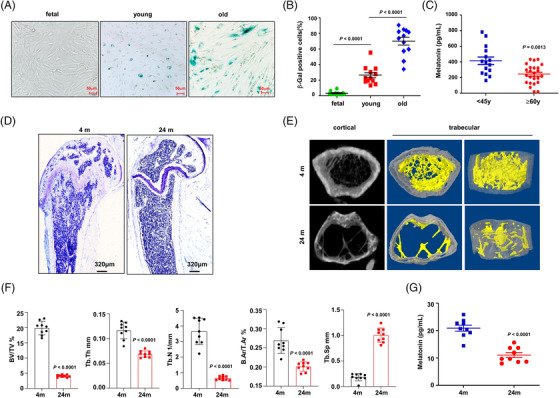
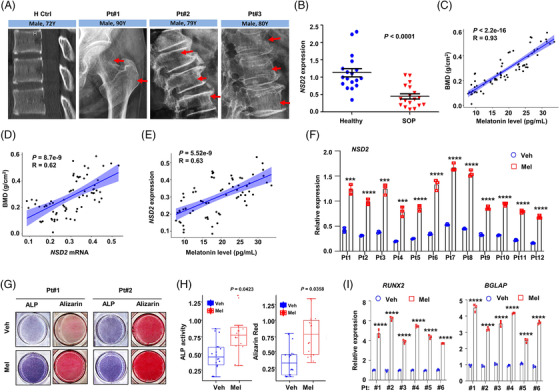
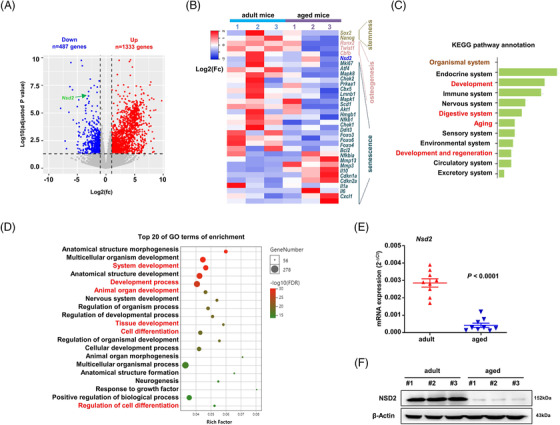
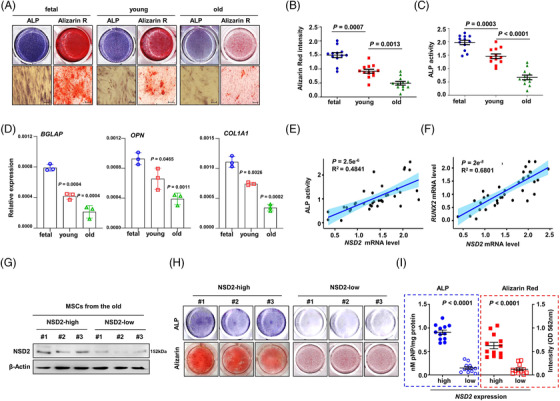
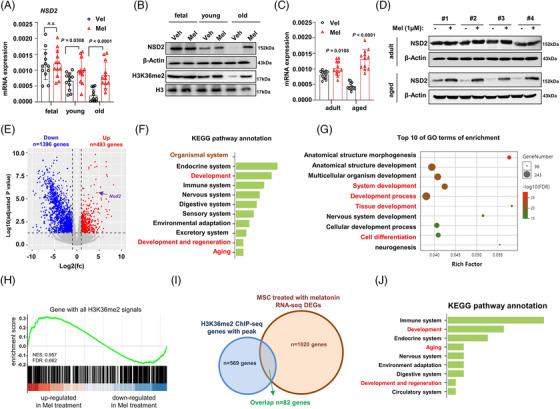
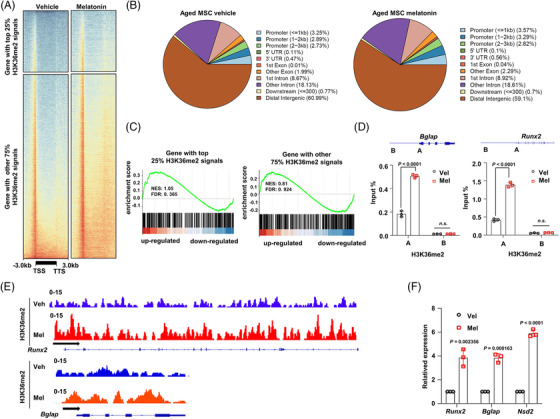
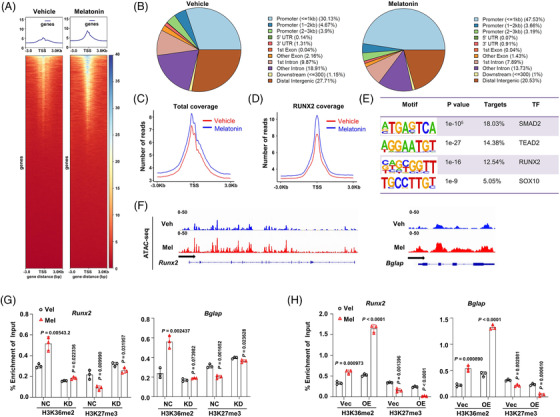
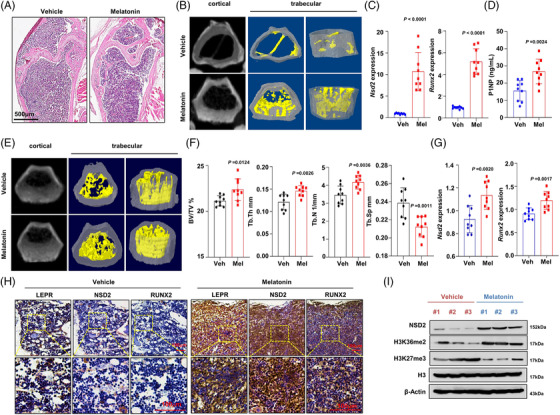
Melatonin levels were decreased during aging in human bone marrow, accompanied by downregulation of the histone methyltransferase nuclear receptor binding SET domain protein 2 (NSD2) expression in the senescent BMSCs. Melatonin stimulated the expression of NSD2 through MT1/2-mediated signaling pathways, resulting in the rebalancing of H3K36me2 and H3K27me3 modifications to increase chromatin accessibility of the osteogenic genes, runt-related transcription factor 2 (RUNX2) and bone gamma-carboxyglutamate protein (BGLAP). Melatonin promoted osteogenesis of BMSCs in vitro, and alleviates osteoporosis progression in the aging mice. In clinic, severity of senile osteoporosis (SOP) was negatively correlated with melatonin level in bone marrow, as well as NSD2 expression in BMSCs. Similarly, melatonin remarkably enhanced osteogenic differentiation of BMSCs derived from SOP patients in vitro.
Collectively, our study dissects previously unreported mechanistic insights into the epigenetic regulating machinery of melatonin in meliorating osteogenic differentiation of senescent BMSC, and provides evidence for application of melatonin in preventing aging-associated bone loss.
临床中经常会遇到与衰老相关的骨质疏松症,但是由于发病机制不明确,有效的治疗方法有限。本研究旨在探讨褪黑素对衰老骨髓基质细胞(BMSCs)的作用及其潜在调节机制。
通过 ELISA 检测褪黑素水平。通过 RNA 测序进行基因表达谱分析,通过染色质免疫沉淀测序(ChIP-seq)分析基因启动子上 H3K36me2 的富集情况,通过高通量测序检测转座酶可及染色质(ATAC-seq)确定染色质可及性。通过茜素红和碱性磷酸酶染色体外检测 BMSCs 的成骨能力,通过组织学染色和微计算机断层扫描(micro-CT)评估褪黑素的体内作用。通过 Pearson 相关性分析 NSDS 表达与老年骨质疏松症患者严重程度的相关性。
在人类骨髓中,褪黑素水平随年龄的增长而降低,衰老的 BMSCs 中组蛋白甲基转移酶核受体结合 SET 域蛋白 2(NSD2)的表达下调。褪黑素通过 MT1/2 介导的信号通路刺激 NSD2 的表达,导致 H3K36me2 和 H3K27me3 修饰的再平衡,增加成骨基因 runt 相关转录因子 2(RUNX2)和骨γ-羧基谷氨酸蛋白(BGLAP)的染色质可及性。褪黑素促进了 BMSCs 的体外成骨作用,并缓解了衰老小鼠的骨质疏松症进展。在临床上,骨髓中褪黑素水平以及 BMSCs 中的 NSD2 表达与老年性骨质疏松症(SOP)的严重程度呈负相关。同样,褪黑素显著增强了 SOP 患者 BMSCs 的体外成骨分化。
总之,本研究揭示了褪黑素在改善衰老 BMSC 成骨分化中的表观遗传调节机制的新机制见解,并为褪黑素在预防与衰老相关的骨丢失中的应用提供了证据。