Sakurada Takeshi, Matsumoto Mayuko, Yamamoto Shin-Ichiroh
Department of Robotics, College of Science and Engineering, Ritsumeikan University, Shiga, Japan.
Functional Brain Science Laboratory, Center for Development of Advanced Medical Technology, Jichi Medical University, Tochigi, Japan.
Front Syst Neurosci. 2022 Feb 10;16:774475. doi: 10.3389/fnsys.2022.774475. eCollection 2022.
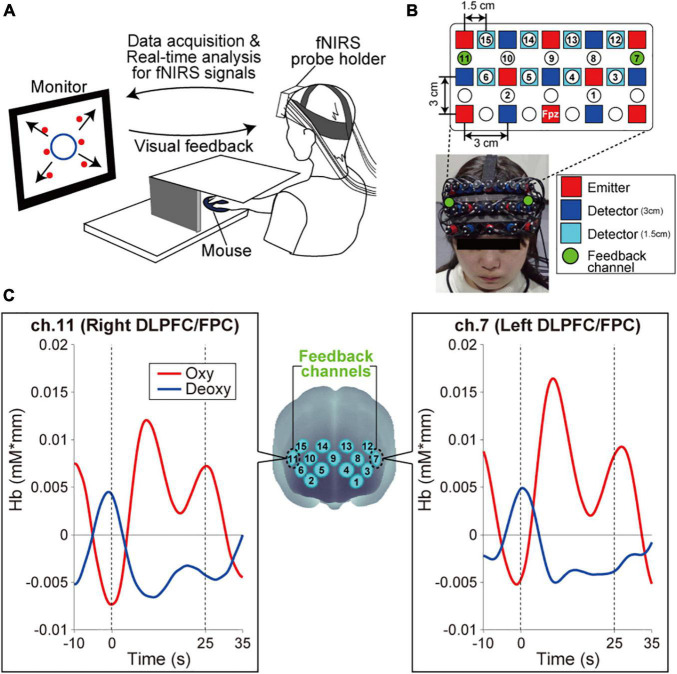
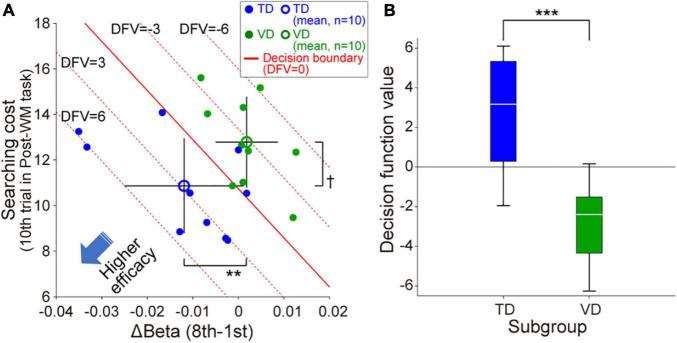
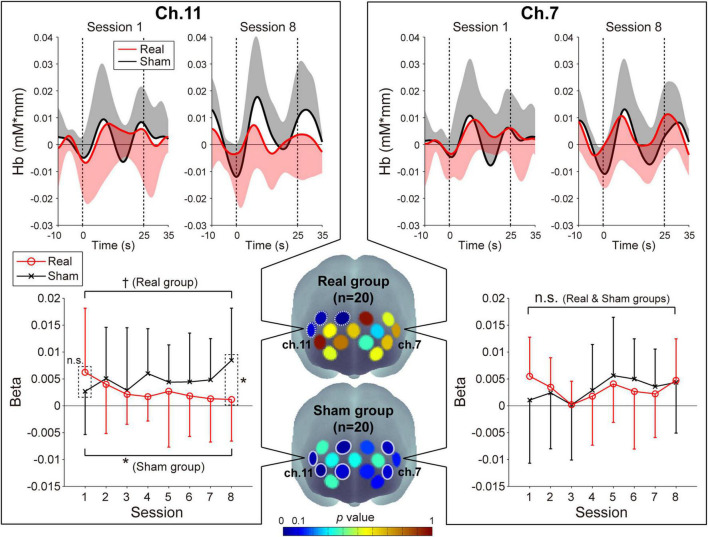
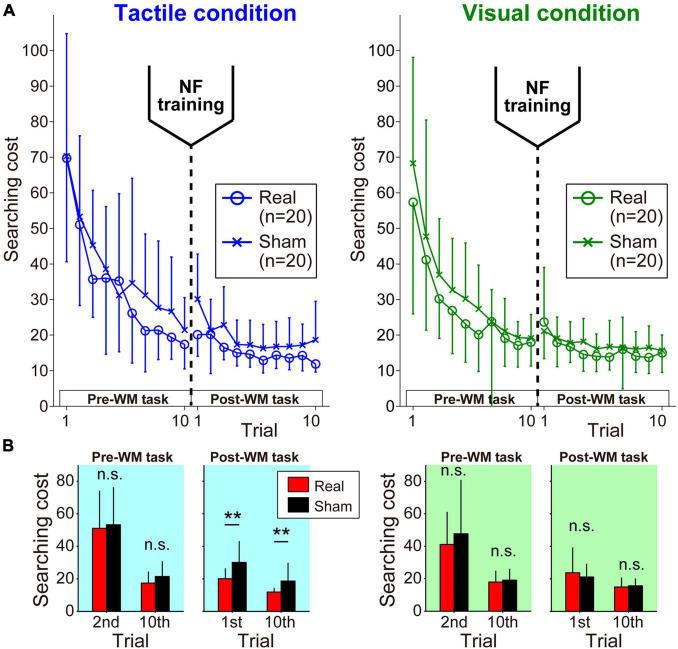
Neurofeedback is a neuromodulation technique used to improve brain function by self-regulating brain activity. However, the efficacy of neurofeedback training varies widely between individuals, and some participants fail to self-regulate brain activity. To overcome intersubject variation in neurofeedback training efficacy, it is critical to identify the factors that influence this type of neuromodulation. In this study, we considered that individual differences in cognitive ability may influence neurofeedback training efficacy and aimed to clarify the effect of individual working memory (WM) abilities, as characterized by sensory modality dominance, on neurofeedback training efficacy in healthy young adults. In particular, we focused on the abilities of individuals to retain internal (tactile or somatosensory) or external (visual) body information in their WM. Forty participants performed functional near-infrared spectroscopy-based neurofeedback training aimed at producing efficient and lower-level activity in the bilateral dorsolateral prefrontal cortex and frontopolar cortex. We carried out a randomized, sham-controlled, double-blind study that compared WM ability before and after neurofeedback training. Individual WM ability was quantified using a target searching task that required the participants to retain spatial information presented as vibrotactile or visual stimuli. Participants who received feedback information based on their own prefrontal activity showed gradually decreasing activity in the right prefrontal area during the neurofeedback training and demonstrated superior WM ability during the target searching task with vibrotactile stimuli compared with the participants who performed dummy neurofeedback training. In comparison, left prefrontal activity was not influenced by the neurofeedback training. Furthermore, the efficacy of neurofeedback training (i.e., lower right prefrontal activity and better searching task performance) was higher in participants who exhibited tactile dominance rather than visual dominance in their WM. These findings indicate that sensory modality dominance in WM may be an influential neurophysiological factor in determining the efficacy of neurofeedback training. These results may be useful in the development of neurofeedback training protocols tailored to individual needs.
神经反馈是一种神经调节技术,用于通过自我调节大脑活动来改善脑功能。然而,神经反馈训练的效果在个体之间差异很大,一些参与者无法自我调节大脑活动。为了克服神经反馈训练效果的个体间差异,识别影响这种神经调节类型的因素至关重要。在本研究中,我们认为认知能力的个体差异可能会影响神经反馈训练效果,并旨在阐明以感觉模态优势为特征的个体工作记忆(WM)能力对健康年轻成年人神经反馈训练效果的影响。特别是,我们关注个体在其工作记忆中保留内部(触觉或体感)或外部(视觉)身体信息的能力。40名参与者进行了基于功能近红外光谱的神经反馈训练,旨在在双侧背外侧前额叶皮层和额极皮层产生高效且较低水平的活动。我们进行了一项随机、假对照、双盲研究,比较了神经反馈训练前后的工作记忆能力。使用目标搜索任务对个体工作记忆能力进行量化,该任务要求参与者保留以振动触觉或视觉刺激呈现的空间信息。与进行虚拟神经反馈训练的参与者相比,基于自身前额叶活动接收反馈信息的参与者在神经反馈训练期间右侧前额叶区域的活动逐渐减少,并且在使用振动触觉刺激的目标搜索任务中表现出 superior 工作记忆能力。相比之下,左侧前额叶活动不受神经反馈训练的影响。此外,在工作记忆中表现出触觉优势而非视觉优势的参与者,神经反馈训练的效果(即右侧前额叶较低的活动和更好的搜索任务表现)更高。这些发现表明,工作记忆中的感觉模态优势可能是决定神经反馈训练效果的一个有影响的神经生理因素。这些结果可能有助于制定针对个体需求的神经反馈训练方案。