Department of Oncology, Barbara Ann Karmanos Cancer Institute, Wayne State University, Detroit, MI, United States.
Department of Industrial and Physical Pharmacy, Purdue University, West Lafayette, IN, United States.
Front Immunol. 2022 Feb 9;13:823618. doi: 10.3389/fimmu.2022.823618. eCollection 2022.
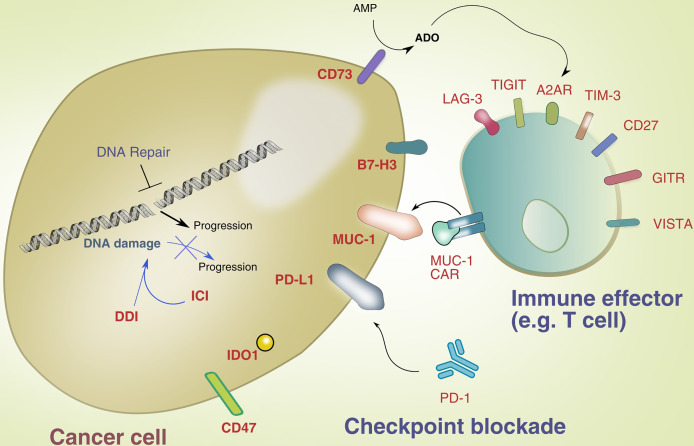
Over the past decade, lung cancer treatment has undergone a major paradigm shift. A greater understanding of lung cancer biology has led to the development of many effective targeted therapies as well as of immunotherapy. Immune checkpoint inhibitors (ICIs) have shown tremendous benefit in the treatment of non-small cell lung cancer (NSCLC) and are now being used as first-line therapies in metastatic disease, consolidation therapy following chemoradiation in unresectable locally advanced disease, and adjuvant therapy following surgical resection and chemotherapy in resectable disease. Despite these benefits, predicting who will respond to ICIs has proven to be difficult and there remains a need to discover new predictive immunotherapy biomarkers. Furthermore, resistance to ICIs in lung cancer is frequent either because of a lack of response or disease progression after an initial response. The utility of ICIs in the treatment of small cell lung cancer (SCLC) remains limited to first-line treatment of extensive stage disease in combination with chemotherapy with modest impact on overall survival. It is thus important to explore and exploit additional targets to reap the full benefits of immunotherapy in the treatment of lung cancer. Here, we will summarize the current state of immunotherapy in lung cancer, discuss novel targets, and explore the intersection between DNA repair defects and immunotherapy.
在过去的十年中,肺癌治疗发生了重大的范式转变。对肺癌生物学的更深入理解导致了许多有效的靶向治疗方法以及免疫疗法的发展。免疫检查点抑制剂(ICI)在非小细胞肺癌(NSCLC)的治疗中显示出巨大的益处,现在已被用作转移性疾病的一线治疗药物、不可切除的局部晚期疾病放化疗后的巩固治疗药物,以及可切除疾病手术后和化疗后的辅助治疗药物。尽管有这些益处,但预测谁将对 ICI 有反应已被证明是困难的,仍然需要发现新的预测性免疫治疗生物标志物。此外,肺癌对 ICI 的耐药性很常见,要么是因为缺乏反应,要么是因为初始反应后的疾病进展。ICI 在小细胞肺癌(SCLC)治疗中的应用仍然仅限于与化疗联合治疗广泛期疾病,对总生存期的影响不大。因此,探索和利用额外的靶点以充分利用免疫疗法治疗肺癌的益处非常重要。在这里,我们将总结肺癌免疫治疗的现状,讨论新的靶点,并探讨 DNA 修复缺陷与免疫治疗之间的交叉点。