El-Kady Rasha R, Ali Amani K, El Wakeel Lamia M, Sabri Nagwa A, Shawki May A
Department of Clinical Pharmacy, Faculty of Pharmacy, Ain Shams University, Cairo, Egypt.
Department of Internal Medicine, Faculty of Medicine for Girls, Al-Azhar University, Cairo, Egypt.
Ther Adv Chronic Dis. 2022 Feb 23;13:20406223221077958. doi: 10.1177/20406223221077958. eCollection 2022.
Nicotinamide has been reported to protect against liver steatosis and metabolic imbalances in nonalcoholic fatty liver disease (NAFLD) in animal models.
The objective was to investigate the efficacy and safety of nicotinamide supplementation in diabetic NAFLD patients.
This is a prospective randomized controlled open label study.
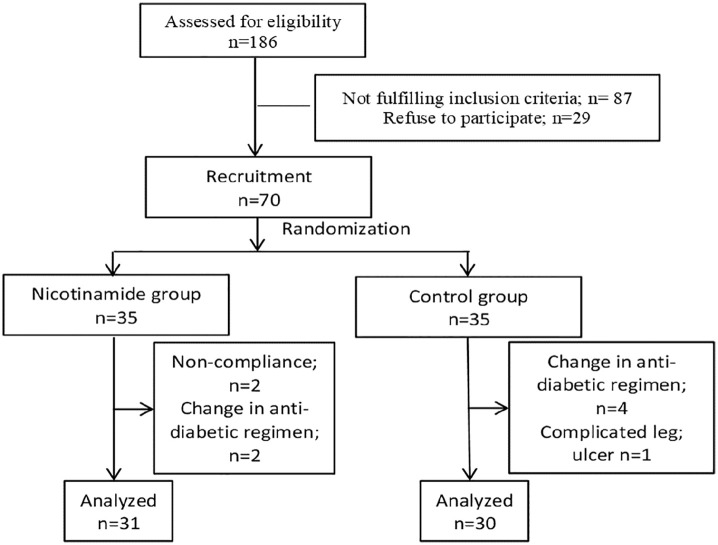
Seventy diabetic NAFLD patients were randomly assigned either to the nicotinamide group ( = 35) who received nicotinamide 1000 mg once daily for 12 weeks in addition to their antidiabetic therapy or the control group ( = 35) who received their antidiabetic therapy only. The primary outcome was improvement in steatosis score, while secondary outcomes included assessment of liver stiffness, liver enzymes, lipid profile, insulin resistance, serum malondialdehyde, serum adiponectin, and patients' quality of life (QOL).
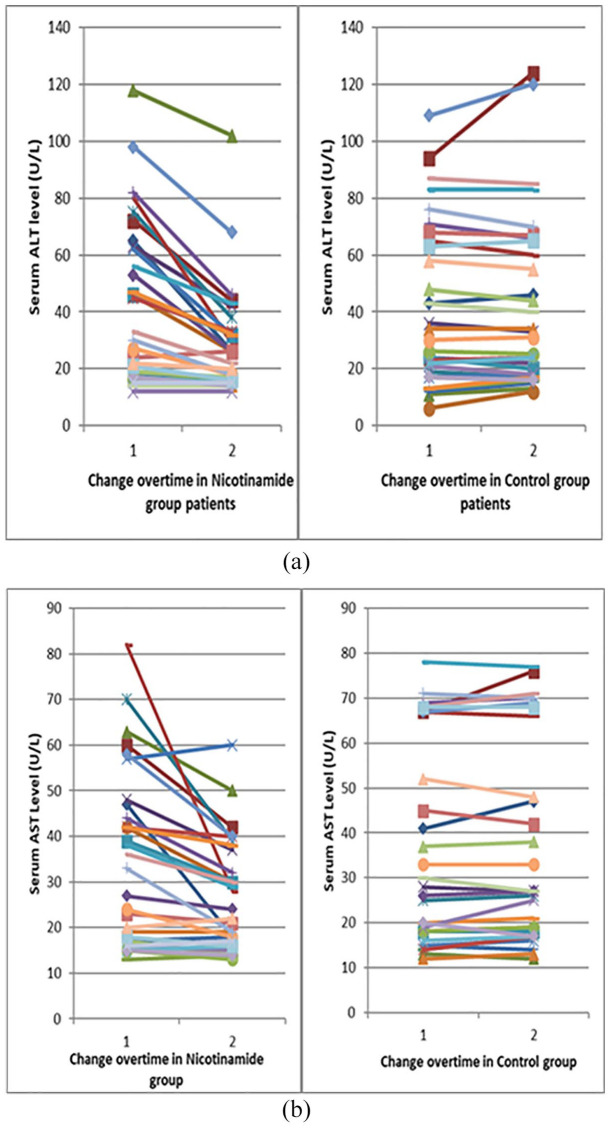
Only 61 patients completed the study; 31 in the nicotinamide group and 30 in the control group. Comparisons between groups and within groups revealed nonsignificant changes in steatosis and fibrosis scores. However, significant reduction was observed in liver enzymes with a median decrease in alanine transaminase of 26.6% 0.74% in nicotinamide and control groups, respectively. After 12 weeks of treatment, the nicotinamide group showed significantly lower levels of low-density lipoprotein cholesterol ( value = 0.004), total cholesterol ( value = 0.006), and insulin resistance marker ( value = 0.005) compared with control. Serum triglycerides, malondialdehyde, and adiponectin levels were all comparable between the two groups. Regarding QOL, a significant improvement was detected in the total scores and the activity and fatigue domains scores.
Nicotinamide at a dose of 1000 mg daily was tolerable, improved metabolic abnormalities and QOL of diabetic NAFLD patients with no effect on liver fibrosis or steatosis.
The study was registered at clinicaltrials.gov and given the ID number: ''. https://clinicaltrials.gov/ct2/show/NCT03850886.
据报道,在动物模型中烟酰胺可预防非酒精性脂肪性肝病(NAFLD)中的肝脂肪变性和代谢失衡。
研究补充烟酰胺对糖尿病性NAFLD患者的疗效和安全性。
这是一项前瞻性随机对照开放标签研究。
70例糖尿病性NAFLD患者被随机分为烟酰胺组(n = 35)和对照组(n = 35)。烟酰胺组除接受抗糖尿病治疗外,每天服用1000 mg烟酰胺,持续12周;对照组仅接受抗糖尿病治疗。主要结局是脂肪变性评分的改善,次要结局包括肝硬度、肝酶、血脂谱、胰岛素抵抗、血清丙二醛、血清脂联素以及患者生活质量(QOL)的评估。
仅61例患者完成了研究,烟酰胺组31例,对照组30例。组间和组内比较显示,脂肪变性和纤维化评分无显著变化。然而,肝酶显著降低,烟酰胺组和对照组丙氨酸转氨酶的中位数分别下降了26.6%和24.74%。治疗12周后,与对照组相比,烟酰胺组的低密度脂蛋白胆固醇水平(P值 = 0.004)、总胆固醇水平(P值 = 0.006)和胰岛素抵抗标志物水平(P值 = 0.005)显著降低。两组血清甘油三酯、丙二醛和脂联素水平均相当。关于生活质量,总分以及活动和疲劳领域得分有显著改善。
每日剂量为1000 mg的烟酰胺耐受性良好,可改善糖尿病性NAFLD患者的代谢异常和生活质量,对肝纤维化或脂肪变性无影响。
该研究已在clinicaltrials.gov注册,注册号为:''。https://clinicaltrials.gov/ct2/show/NCT03850886 。