Majoros Samantha E, Adamowicz Sarah J
Department of Integrative Biology University of Guelph Guelph ON Canada.
Ecol Evol. 2022 Feb 16;12(2):e8520. doi: 10.1002/ece3.8520. eCollection 2022 Feb.
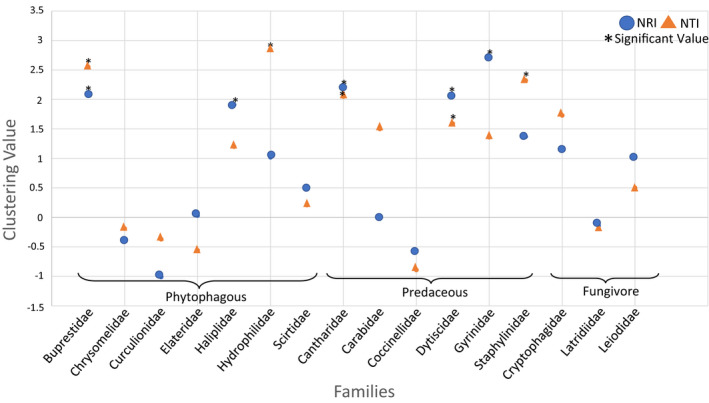
Postglacial dispersal and colonization processes have shaped community patterns in sub-Arctic regions such as Churchill, Manitoba, and Canada. This study investigates evolutionary community structure within the beetle (Coleoptera) families of Churchill and tests whether biological traits have played a role in governing colonization patterns from refugial and southerly geographic regions. This study quantifies sub-Arctic beetle phylogenetic community structure for each family using the net relatedness index (NRI) and nearest taxon index (NTI), calculated using publicly available data from the Barcode of Life Data Systems (BOLD); compares patterns across families with different traits (habitat, diet) using standard statistical analysis (ANOVA) as well as phylogenetic generalized least squares (PGLS) using a family-level beetle phylogeny obtained from the literature; and compares community structure in Churchill with a region in southern Canada (Guelph, Ontario). These analyses were also repeated at a genus level. The dominant pattern detected in our study was that aquatic families were much better represented in Churchill compared to terrestrial families, when compared against richness sampled from across Canada and Alaska. Individually, most families showed significant phylogenetic clustering in Churchill, likely due to the strong environmental filtering present in Arctic environments. There was no significant difference in phylogenetic structure between Churchill and Guelph but with a trend toward stronger clustering in the North. Fungivores were significantly more overdispersed than other feeding modes, predators were significantly more clustered, and aquatic families showed significantly stronger clustering compared to terrestrial. This study contributes to our understanding of the traits and processes structuring insect biodiversity and macroecological trends in the sub-Arctic.
冰期后扩散和定殖过程塑造了加拿大马尼托巴省丘吉尔市等亚北极地区的群落格局。本研究调查了丘吉尔市甲虫(鞘翅目)科内的进化群落结构,并测试了生物学特征是否在控制来自避难所和南方地理区域的定殖模式中发挥了作用。本研究使用净亲缘关系指数(NRI)和最近分类单元指数(NTI)对每个科的亚北极甲虫系统发育群落结构进行量化,这些指数是根据生命条形码数据系统(BOLD)的公开数据计算得出的;使用标准统计分析(方差分析)以及使用从文献中获得的科级甲虫系统发育进行系统发育广义最小二乘法(PGLS),比较具有不同特征(栖息地、食性)的科之间的模式;并将丘吉尔市的群落结构与加拿大南部的一个地区(安大略省圭尔夫市)进行比较。这些分析也在属一级重复进行。在我们的研究中检测到的主要模式是,与陆地科相比,水生科在丘吉尔市的代表性要比从加拿大和阿拉斯加各地采样的丰富度更好。单独来看,大多数科在丘吉尔市显示出显著的系统发育聚类,这可能是由于北极环境中存在强烈的环境过滤作用。丘吉尔市和圭尔夫市在系统发育结构上没有显著差异,但有在北方聚类更强的趋势。食真菌者的过度分散程度明显高于其他取食模式,捕食者的聚类程度明显更高,与陆地科相比,水生科显示出明显更强的聚类。本研究有助于我们理解塑造亚北极地区昆虫生物多样性和宏观生态趋势的特征和过程。