Heckenhauer Jacqueline, Abu Salim Kamariah, Chase Mark W, Dexter Kyle G, Pennington R Toby, Tan Sylvester, Kaye Maria Ellen, Samuel Rosabelle
Department of Botany and Biodiversity Research, Faculty of Life Sciences, University of Vienna, Vienna, Austria.
Environmental and Life Sciences, Faculty of Science, University of Brunei Darussalam, Gadong, Brunei Darussalam.
PLoS One. 2017 Oct 19;12(10):e0185861. doi: 10.1371/journal.pone.0185861. eCollection 2017.
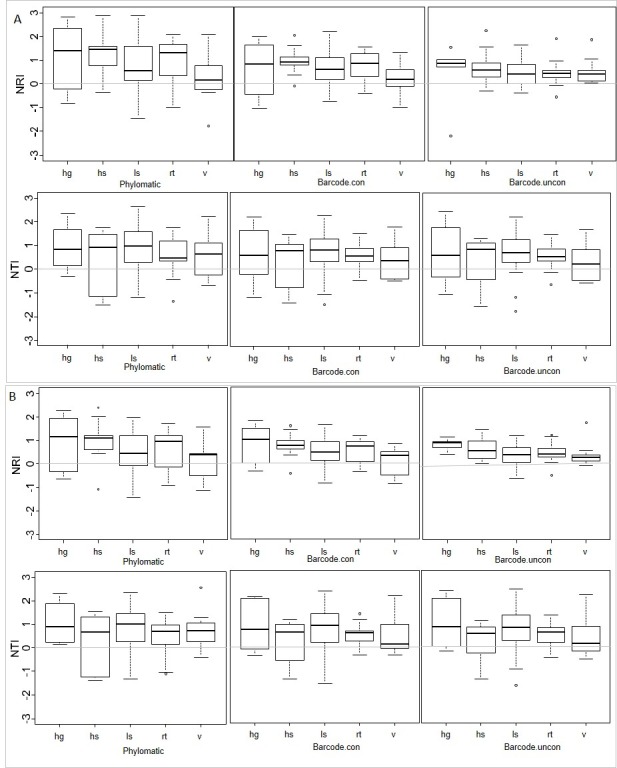
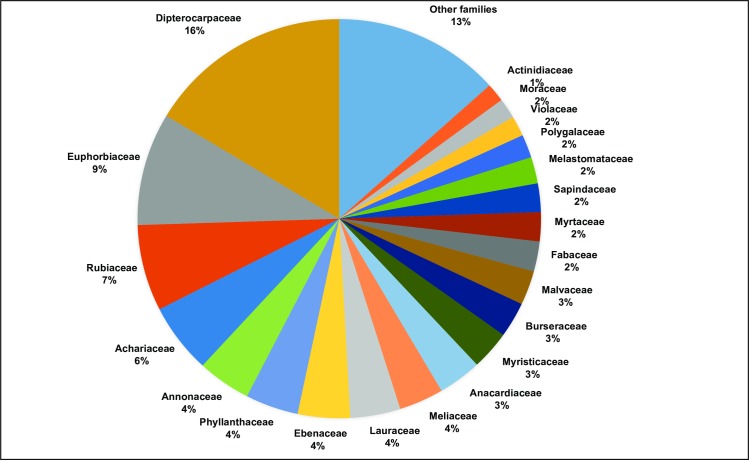
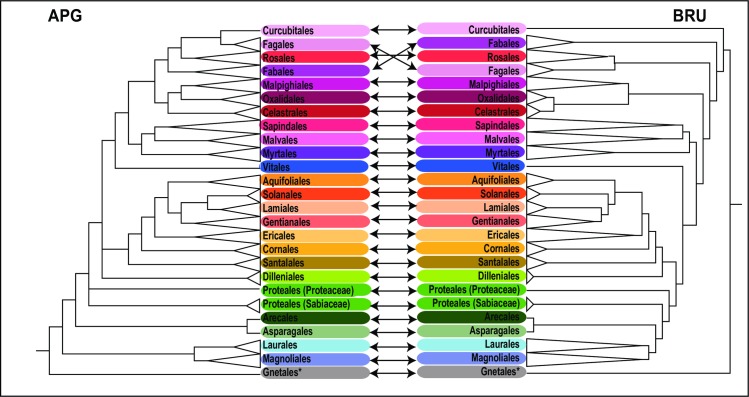
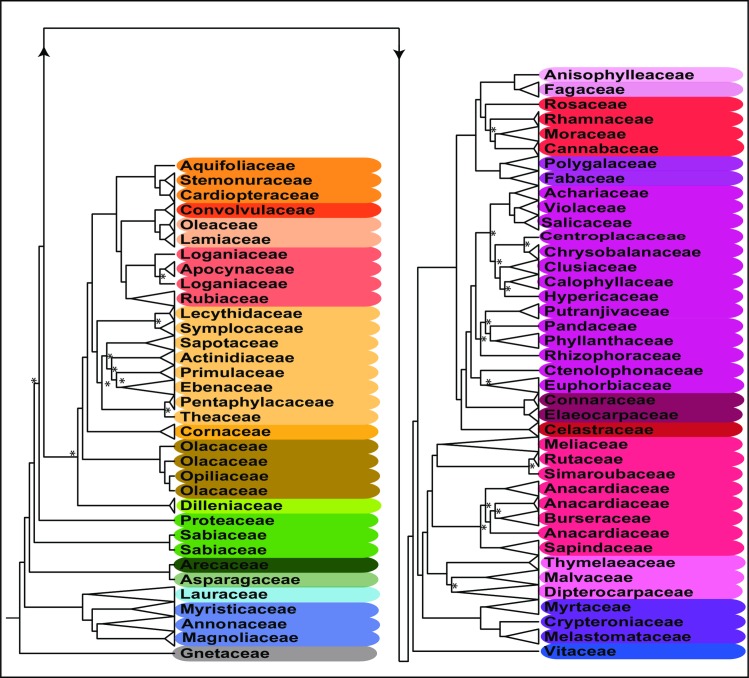
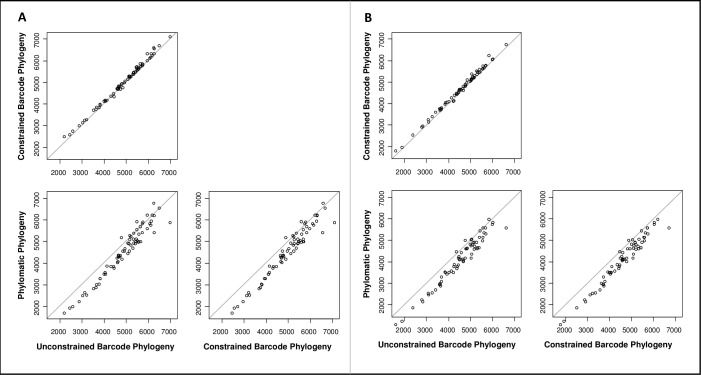
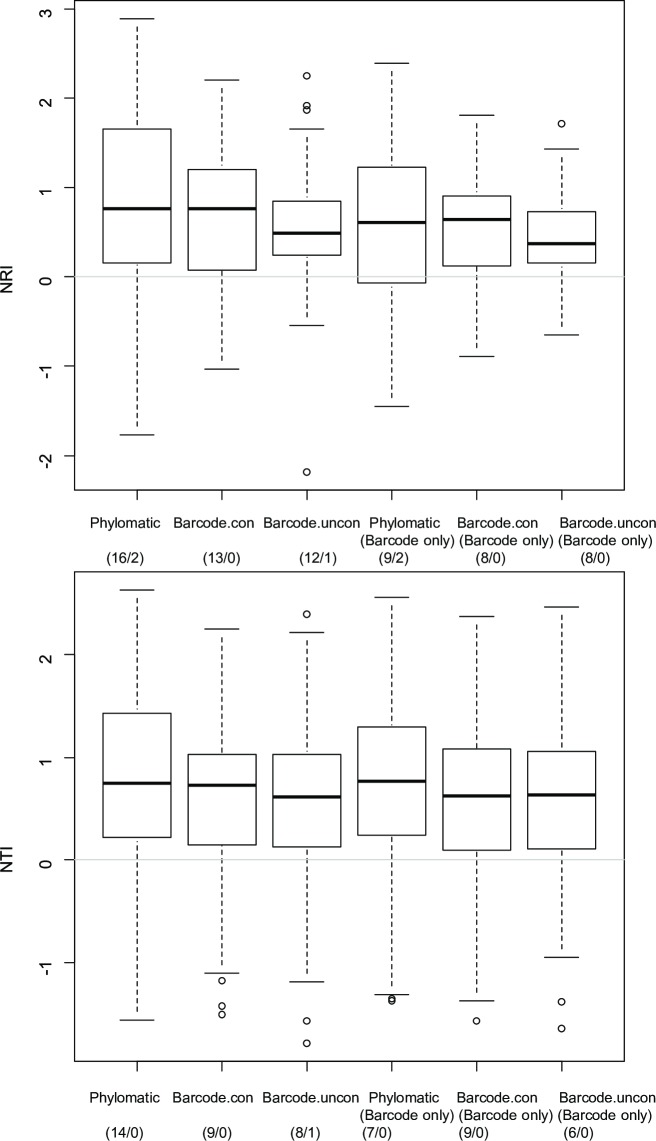
DNA barcoding is a fast and reliable tool to assess and monitor biodiversity and, via community phylogenetics, to investigate ecological and evolutionary processes that may be responsible for the community structure of forests. In this study, DNA barcodes for the two widely used plastid coding regions rbcL and matK are used to contribute to identification of morphologically undetermined individuals, as well as to investigate phylogenetic structure of tree communities in 70 subplots (10 × 10m) of a 25-ha forest-dynamics plot in Brunei (Borneo, Southeast Asia). The combined matrix (rbcL + matK) comprised 555 haplotypes (from ≥154 genera, 68 families and 25 orders sensu APG, Angiosperm Phylogeny Group, 2016), making a substantial contribution to tree barcode sequences from Southeast Asia. Barcode sequences were used to reconstruct phylogenetic relationships using maximum likelihood, both with and without constraining the topology of taxonomic orders to match that proposed by the Angiosperm Phylogeny Group. A third phylogenetic tree was reconstructed using the program Phylomatic to investigate the influence of phylogenetic resolution on results. Detection of non-random patterns of community assembly was determined by net relatedness index (NRI) and nearest taxon index (NTI). In most cases, community assembly was either random or phylogenetically clustered, which likely indicates the importance to community structure of habitat filtering based on phylogenetically correlated traits in determining community structure. Different phylogenetic trees gave similar overall results, but the Phylomatic tree produced greater variation across plots for NRI and NTI values, presumably due to noise introduced by using an unresolved phylogenetic tree. Our results suggest that using a DNA barcode tree has benefits over the traditionally used Phylomatic approach by increasing precision and accuracy and allowing the incorporation of taxonomically unidentified individuals into analyses.
DNA条形码是一种快速且可靠的工具,可用于评估和监测生物多样性,并通过群落系统发育学来研究可能导致森林群落结构的生态和进化过程。在本研究中,两个广泛使用的质体编码区域rbcL和matK的DNA条形码被用于帮助鉴定形态学上无法确定的个体,以及研究文莱(东南亚婆罗洲)一个25公顷森林动态样地中70个亚样地(10×10米)树木群落的系统发育结构。合并后的矩阵(rbcL + matK)包含555个单倍型(来自≥154属、68科和25个目,按照被子植物系统发育组2016年的分类法),为东南亚的树木条形码序列做出了重大贡献。条形码序列被用于使用最大似然法重建系统发育关系,分别采用了约束和不约束分类阶元拓扑结构以匹配被子植物系统发育组提出的拓扑结构这两种方式。使用Phylomatic程序重建了第三棵系统发育树,以研究系统发育分辨率对结果的影响。通过净亲缘关系指数(NRI)和最近分类单元指数(NTI)来确定群落组装的非随机模式检测。在大多数情况下,群落组装要么是随机的,要么是系统发育聚类的,这可能表明基于系统发育相关性状的生境过滤对群落结构的重要性。不同的系统发育树给出了相似的总体结果,但Phylomatic树在各亚样地的NRI和NTI值上产生了更大的差异,可能是由于使用未解析的系统发育树引入了噪声。我们的结果表明,使用DNA条形码树比传统使用的Phylomatic方法更具优势,因为它提高了精度和准确性,并允许将分类学上未鉴定的个体纳入分析。