Wu Yan, Wei Huiping, Li Pei, Zhao Hui, Li Ruifang, Yang Feiyun
Department of Emergency, Hubei Maternal and Child Health Hospital, Tongji Medical College, Huazhong University of Science and Technology, Wuhan, China.
Department of Neurology, Qinghai Provincial People's Hospital, Xining, China.
Front Pediatr. 2022 Feb 11;10:791815. doi: 10.3389/fped.2022.791815. eCollection 2022.
Neonatal seizures commonly caused by hypoxia could lead to brain injury and cognitive deficits. Quercetin could cross the blood brain barrier and exerts neuroprotective effects in many neurological disease settings. In this study, we aim to investigate the role of quercetin in attenuating cognitive impairment following hypoxia-induced neonatal seizure (HINS).
Sprague-Dawley rats at P7 were exposed to a premixed gas in a hypoxic chamber to induce brain injury, and then continuously administered with quercetin for 21 days. Pentylenetetrazol kindling was used to induce seizures in the evolution. After the hypoxic lesion was stablished, anxiety-related behavior of rats after HINS was assessed using open field test. Memory impairment of rats after HINS was evaluated using novel object-recognition test and elevated plus maze test. The serum and hippocampal concentrations of TNF-a, iNOS, IL-6 MCP-1, and IL-1β were measured using ELISA. The mRNA expression levels of TNF-a, iNOS, IL-6 in the hippocampus were determined using qRT-PCR. The protein levels of TLR4, NF-κB p65, and p-NF-κB p65 in the hippocampus were determined using Western blot.
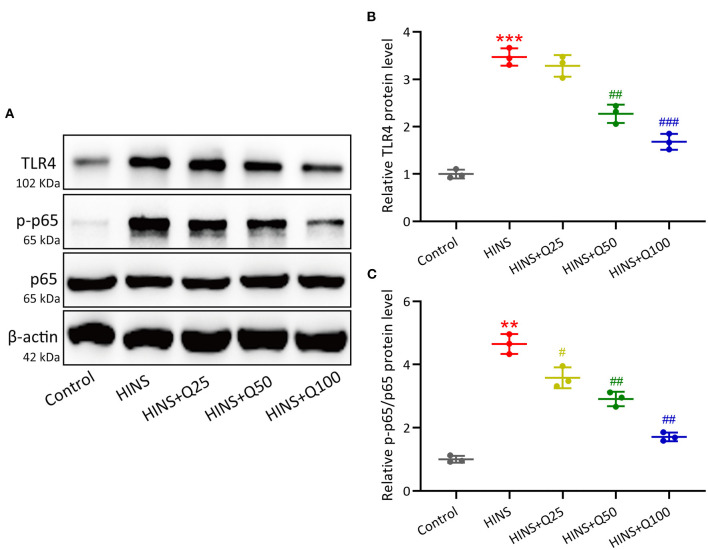
Quercetin administration significantly reduced later-life seizure susceptibility, anxiety-related behavior, and memory impairments in the rats following the HINS when compared to the HINS group without treatment. Both serum and hippocampal proinflammatory cytokines levels were significantly elevated in the rat after HINS. TLR4 protein expressions were increased in the HINS group when compared to control group, and decreased in the group of quercetin. The protein level of p-NF-κB p65 was significantly lower in the quercetin group compared to the HINS group.
We demonstrated that Quercetin significantly reduced susceptibility to later-life seizures. Quercetin could downregulate inflammatory response through TLR4/ NF-κB pathway, thereby attenuating HINS-induced anxiety, hippocampal memory impairment, and cognitive impairment in later life following HINS.
缺氧引起的新生儿惊厥常可导致脑损伤和认知缺陷。槲皮素能够穿过血脑屏障,并在许多神经疾病中发挥神经保护作用。在本研究中,我们旨在探讨槲皮素在减轻缺氧诱导的新生儿惊厥(HINS)后认知障碍中的作用。
将7日龄的Sprague-Dawley大鼠置于缺氧舱中暴露于预混气体以诱导脑损伤,然后连续21天给予槲皮素。在疾病进展过程中使用戊四氮点燃诱导惊厥。在确立缺氧损伤后,使用旷场试验评估HINS后大鼠的焦虑相关行为。使用新物体识别试验和高架十字迷宫试验评估HINS后大鼠的记忆障碍。使用酶联免疫吸附测定法(ELISA)测量血清和海马中肿瘤坏死因子-α(TNF-α)、诱导型一氧化氮合酶(iNOS)、白细胞介素-6(IL-6)、单核细胞趋化蛋白-1(MCP-1)和白细胞介素-1β的浓度。使用实时定量聚合酶链反应(qRT-PCR)测定海马中TNF-α、iNOS、IL-6的mRNA表达水平。使用蛋白质免疫印迹法测定海马中Toll样受体4(TLR4)、核因子κB p65(NF-κB p65)和磷酸化核因子κB p65(p-NF-κB p65)的蛋白水平。
与未治疗的HINS组相比,给予槲皮素显著降低了HINS后大鼠后期生活中的惊厥易感性、焦虑相关行为和记忆障碍。HINS后大鼠血清和海马促炎细胞因子水平均显著升高。与对照组相比,HINS组中TLR4蛋白表达增加,而槲皮素组中TLR4蛋白表达降低。与HINS组相比,槲皮素组中p-NF-κB p65的蛋白水平显著降低。
我们证明了槲皮素显著降低了后期生活中惊厥的易感性。槲皮素可通过TLR4/NF-κB途径下调炎症反应,从而减轻HINS诱导的焦虑、海马记忆障碍以及HINS后后期生活中的认知障碍。