Chu Liting, Zhu Peiying, Ma Chenhuan, Pan Lizhu, Shen Li, Wu Danmai, Wang Yu, Yu Guangjun
Department of Child Health Care, Shanghai Children's Hospital, Shanghai Jiao Tong University, Shanghai, China.
School of Public Health, Shanghai Jiao Tong University, Shanghai, China.
Front Pediatr. 2022 Feb 11;9:813305. doi: 10.3389/fped.2021.813305. eCollection 2021.
The acceptance of drug treatment for younger children with attention-deficit/hyperactivity disorder (ADHD) in China remains low. Here, we explored the clinical benefits of a non-pharmaceutical intervention method combining a group and executive function training and an online parent training program, termed group executive functioning and online parent training (GEF-OPT), for school-aged students with ADHD through a randomized controlled trial.
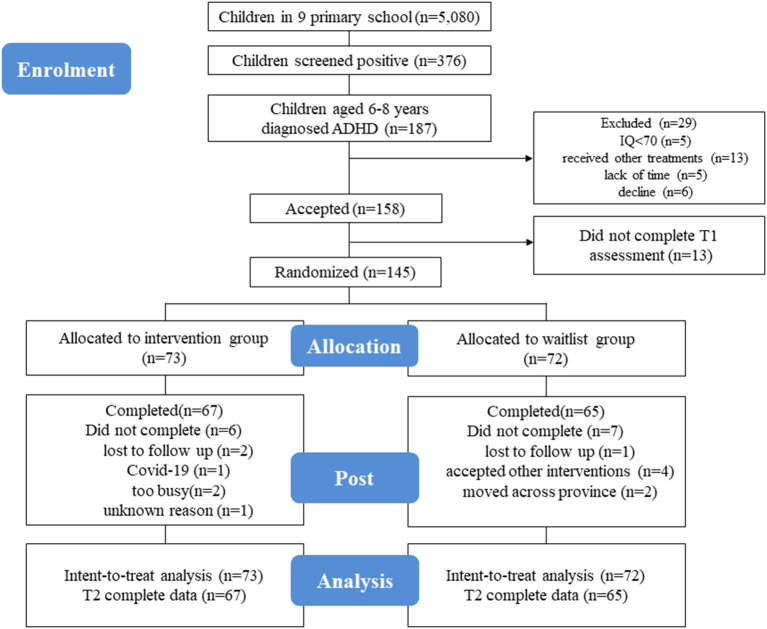
A total of 145 children (aged 6-8 years) were formally registered and randomized to the intervention group ( = 73) and waitlist group ( = 72). The enrolled children received eight sessions of GEF-OPT treatment, which consists of a hospital-based children executive function (EF) training program and an online parent training program. Treatment outcome was assessed by a parent/teacher report questionnaire and neurophysiological experiment.
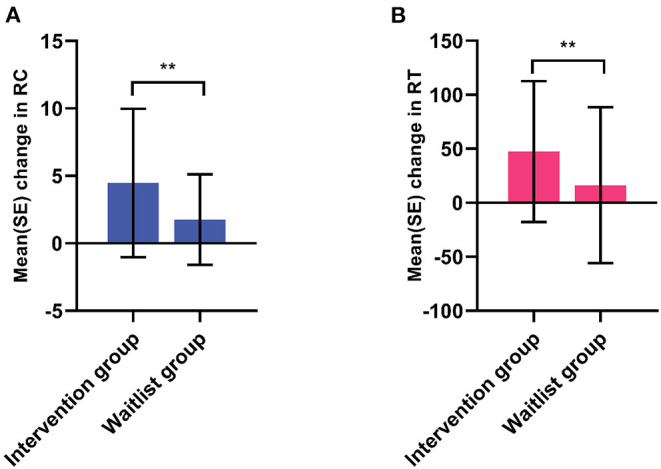
After eight sessions of intervention, children in the intervention group showed a significant improvement in inattentive symptom compared to the waitlist group (14.70 ± 4.35 vs. 16.03 ± 2.93; = 0.024), but an insignificant difference in hyperactive-impulsivity (9.85 ± 5.30 vs. 10.69 ± 5.10; = 0.913). Comorbid oppositional defiant disorder was significantly reduced in the intervention group (7.03 ± 4.39 vs. 8.53 ± 4.41; = 0.035). Children in the intervention group had greater reduction in the scores of behavioral regulation index (inhibition, emotional control) and metacognition index (working memory, planning/organization, monitoring) in executive function than those in the waitlist group ( < 0.05). Significant effects were also found in learning problem of Weiss Functional Impairment Scale-Parent form and parental distress between two groups at post-treatment ( < 0.05). In line with this, the result of go/no-go task showed significant improvements in accuracy change (4.45 ± 5.50% vs. 1.76 ± 3.35%; = 0.001) and reaction time change (47.45 ± 62.25 s vs. 16.19 ± 72.22 s; = 0.007) in the intervention group compared with the waitlist group.
We conclude that participants in the GEF-OPT program improved outcomes for inattentive symptom, executive function, learning problems, and parental distress. GEF-OPT is a promising non-pharmaceutical therapeutic option for younger children.
ChiCTR2100052803.
在中国,年幼儿童注意力缺陷多动障碍(ADHD)的药物治疗接受度仍然较低。在此,我们通过一项随机对照试验,探讨了一种非药物干预方法的临床益处,该方法结合了小组和执行功能训练以及在线家长培训项目,称为小组执行功能与在线家长培训(GEF-OPT),用于治疗学龄期ADHD学生。
总共145名儿童(6 - 8岁)正式登记并随机分为干预组(n = 73)和候补组(n = 72)。入选的儿童接受了八次GEF-OPT治疗,该治疗包括一个基于医院的儿童执行功能(EF)训练项目和一个在线家长培训项目。通过家长/教师报告问卷和神经生理学实验评估治疗结果。
经过八次干预后,与候补组相比,干预组儿童的注意力不集中症状有显著改善(14.70 ± 4.35 vs. 16.03 ± 2.93;P = 0.024),但多动冲动方面差异不显著(9.85 ± 5.30 vs. 10.69 ± 5.10;P = 0.913)。干预组中对立违抗障碍共病显著减少(7.03 ± 4.39 vs. 8.53 ± 4.41;P = 0.035)。与候补组相比,干预组儿童在执行功能的行为调节指数(抑制、情绪控制)和元认知指数(工作记忆、计划/组织、监控)得分上有更大幅度的降低(P < 0.05)。在治疗后,两组在韦斯功能损害量表-家长版的学习问题和家长困扰方面也发现了显著差异(P < 0.05)。与此一致,与候补组相比,干预组的停止信号任务结果显示在准确性变化(4.45 ± 5.50% vs. 1.76 ± 3.35%;P = 0.001)和反应时间变化(47.45 ± 62.25秒 vs. 16.19 ± 72.22秒;P = 0.007)方面有显著改善。
我们得出结论,GEF-OPT项目的参与者在注意力不集中症状、执行功能、学习问题和家长困扰方面的结果有所改善。GEF-OPT是一种有前景的针对年幼儿童的非药物治疗选择。
ChiCTR2100052803。