Chou Yu-Tsung, Sun Zih-Jie, Shen Wei-Chen, Yang Yi-Ching, Lu Feng-Hwa, Chang Chih-Jen, Li Chung-Yi, Wu Jin-Shang
Department of Health Management Center, National Cheng Kung University Hospital, College of Medicine, National Cheng Kung University, Tainan, Taiwan.
Department of Family Medicine, National Cheng Kung University Hospital, College of Medicine, National Cheng Kung University, Tainan, Taiwan.
Front Nutr. 2022 Feb 11;9:765206. doi: 10.3389/fnut.2022.765206. eCollection 2022.
Betel quid chewing is associated with metabolic disorders, oral cancer, cardiovascular disease, and chronic liver diseases. Metabolic syndrome (MetS) is also a factor associated with liver fibrosis, cirrhosis, and hepatocellular carcinoma (HCC). However, studies on the relationship between betel quid and liver fibrosis while also considering MetS are lacking. The aim of this study was thus to investigate the association of betel quid chewing and liver fibrosis with MetS.
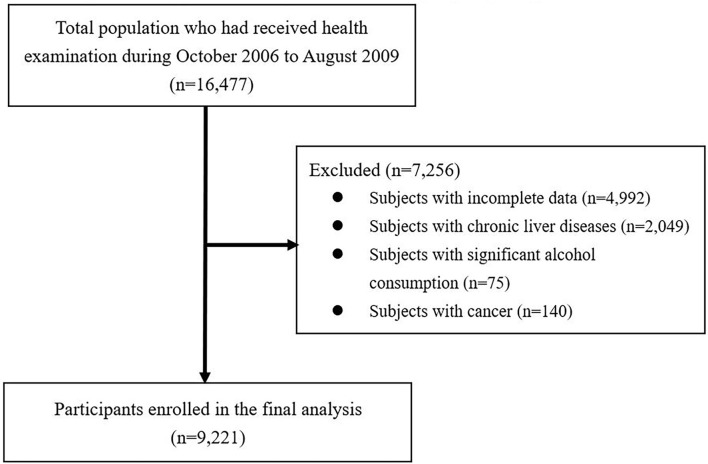
A total of 9,221 subjects were enrolled after excluding subjects <18 years of age, with past history of chronic liver diseases, cancer, significant alcohol consumption, and incomplete data. Betel nut chewing habit was classified into three groups: none, former-chewing, and current-chewing, and cumulative exposure was calculated by multiplying the duration with the quantity. Liver fibrosis was evaluated based on the NAFLD fibrosis score (NFS), which is a composite score of age, hyperglycemia, BMI, platelet count, albumin, and the AST/ALT ratio. Significant liver fibrosis was defined as NFS ≥-1.455.
After adjusting for other variables, MetS was positively associated with significant liver fibrosis. Subjects with both MetS and betel quid chewing had a higher associated risk of significant liver fibrosis than those with neither MetS nor betel quid chewing (adjusted OR: 3.03, 95% CI: 2.04-4.50, < 0.001). Betel quid chewing was associated with significant liver fibrosis (adjusted OR: 2.00, 95% CI: 1.14-3.49, = 0.015) in subjects with MetS, but not in subjects without.
Metabolic syndrome increased the associated risk of significant liver fibrosis. Cumulative betel quid exposure increased the associated risk of significant liver fibrosis in subjects with MetS, but not in subjects without.
嚼槟榔与代谢紊乱、口腔癌、心血管疾病和慢性肝病有关。代谢综合征(MetS)也是与肝纤维化、肝硬化和肝细胞癌(HCC)相关的一个因素。然而,缺乏同时考虑MetS因素的关于槟榔与肝纤维化关系的研究。因此,本研究的目的是调查嚼槟榔和肝纤维化与MetS之间的关联。
排除年龄<18岁、有慢性肝病病史、癌症病史、大量饮酒史及数据不完整的受试者后,共纳入9221名受试者。槟榔咀嚼习惯分为三组:从不嚼、曾经嚼和现在嚼,并通过持续时间乘以数量来计算累积暴露量。基于非酒精性脂肪性肝病纤维化评分(NFS)评估肝纤维化,NFS是年龄、高血糖、体重指数、血小板计数、白蛋白和AST/ALT比值的综合评分。显著肝纤维化定义为NFS≥-1.455。
在调整其他变量后,MetS与显著肝纤维化呈正相关。同时患有MetS和嚼槟榔的受试者比既没有MetS也不嚼槟榔的受试者发生显著肝纤维化的相关风险更高(调整后的比值比:3.03,95%置信区间:2.04-4.50,P<0.001)。在患有MetS的受试者中,嚼槟榔与显著肝纤维化相关(调整后的比值比:2.00,95%置信区间:1.14-3.49,P=0.015),但在未患MetS的受试者中则不然。
代谢综合征增加了显著肝纤维化的相关风险。槟榔累积暴露增加了患有MetS的受试者发生显著肝纤维化的相关风险,但在未患MetS的受试者中则不然。