China Center for Health Development Studies (Y Yao MD), Center for Healthy Aging and Development Studies, Raissun Institute for Advanced Studies, National School of Development (Y Yao, Prof Y Zeng PhD), Dementia Care and Research Center, Clinical Research Division, Peking University Institute of Mental Health, Sixth Hospital (X Lv PhD, Prof H Wang MD), Beijing Dementia Key Lab, National Clinical Research Center for Mental Disorders, Peking University Sixth Hospital, National Health Commission Key Laboratory of Mental Health (X Lv, Prof H Wang), Institute of Reproductive and Child Health, Ministry of Health Key Laboratory of Reproductive Health and Department of Epidemiology and Biostatistics, School of Public Health (J Li MS, T Xue PhD), Peking University, Beijing, China; Aging Research Center, Department of Neurobiology, Care Sciences and Society, Karolinska Institutet-Stockholm University, Stockholm, Sweden (Prof C Qiu PhD); Stanford Data Science and Department of Statistics, Stanford University, Stanford, CA, USA (X Wu PhD); Department of Healthcare Policy and Research, Weill Cornell Medicine, New York, NY, USA (H Zhang PhD); Department of Health Policy and Management, University of Maryland School of Public Health, College Park, MD, USA (D Yue PhD); Public Health, Department of Social Medicine, Osaka University Graduate School of Medicine, Suita Shi, Osaka, Japan (K Liu PhD, E Salah Eshak PhD); School of Public Health, Peking University Health Science Center, Beijing, China (K Liu); Department of Public Health, Faculty of Medicine, Minia University, Minia, Egypt (E Salah Eshak); Department of Cardiology, University Heart and Vascular Center Hamburg, Hamburg, Germany (T Lorenz MA); Aging Futures Institute, The University of New South Wales, Sydney, NSW, Australia (Prof K J Anstey PhD); Division of Psychiatry, University College London, London, UK (Prof G Livingston MD); Global Health Institute and the Nicholas School of Environment (Prof J Zhang PhD), Center for the Study of Aging and Human Development and Geriatrics Division (Prof Y Zeng), Duke University, Durham, NC, USA.
Lancet Healthy Longev. 2022 Feb;3(2):e98-e108. doi: 10.1016/S2666-7568(22)00004-6. Epub 2022 Feb 7.
Air pollution might accelerate cognitive ageing; it is unclear whether large-scale interventions, such as China's Clean Air Act (CCAA), can mitigate cognitive deterioration. We aimed to evaluate the effect of CCAA on changes in cognitive function in older adults.
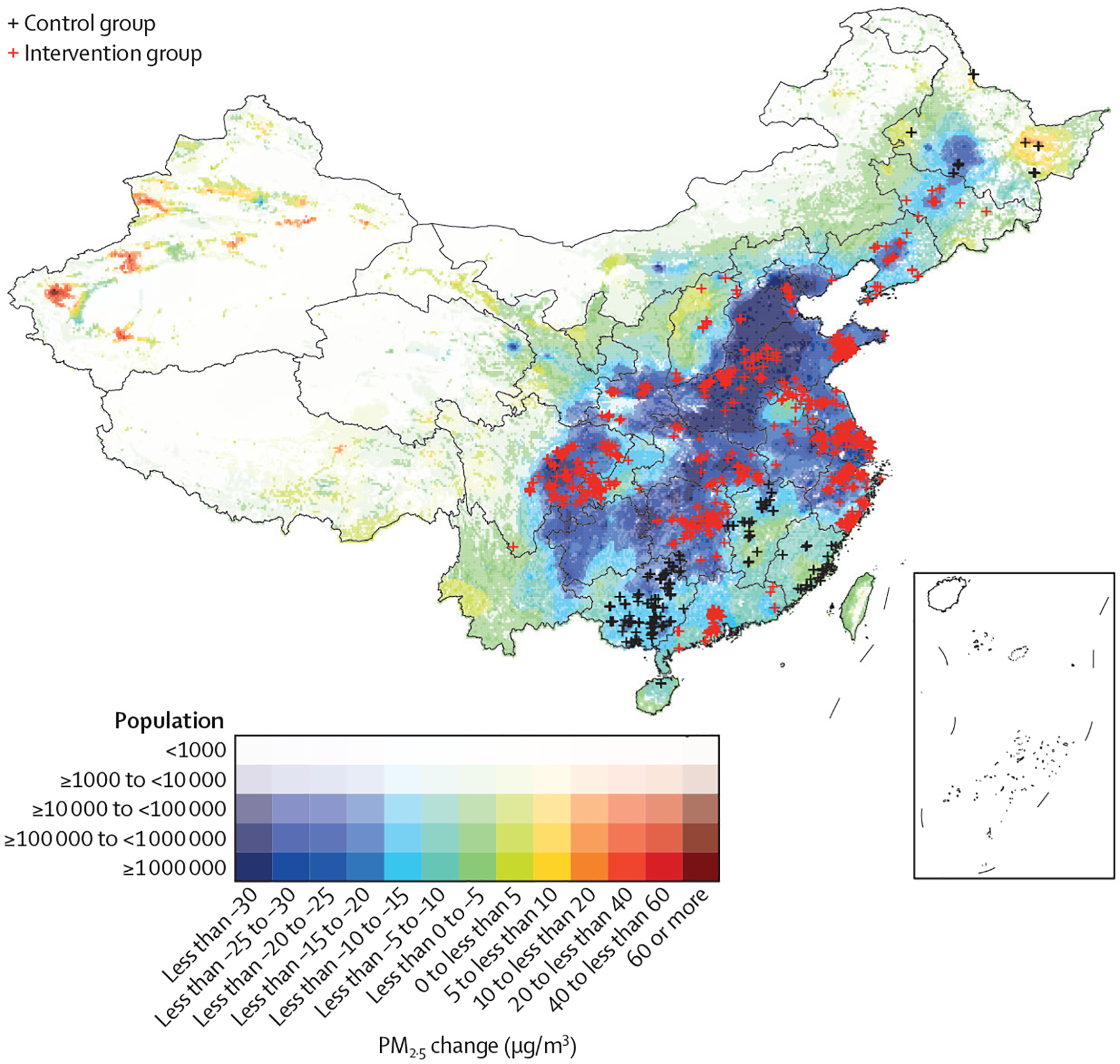
In this population-based, quasi-experimental study, we did a difference-in-differences analysis of the data collected during the 2014 and 2018 waves of the Chinese Longitudinal Healthy Longevity Survey (CLHLS). The study design used a counterfactual analysis feature by dividing CLHLS participants into two groups. The intervention group included participants who lived in areas where the provincial government set a target of reducing particulate matter (PM) by at least 5% annually from 2014 onward, whereas the control group consisted of individuals who lived in areas without a PM reduction target. Global cognitive function was measured using the Mini-Mental State Examination (MMSE). We used fixed-effects models to examine the between-group differences in MMSE score changes before and after CCAA implementation. We associated longitudinal changes in MMSE scores with changes in concentrations of PM with a diameter of less than 2·5 μm (PM) concentration and other regulated pollutants. We used alternative models and sensitivity analyses to evaluate the robustness of the results from the main models.
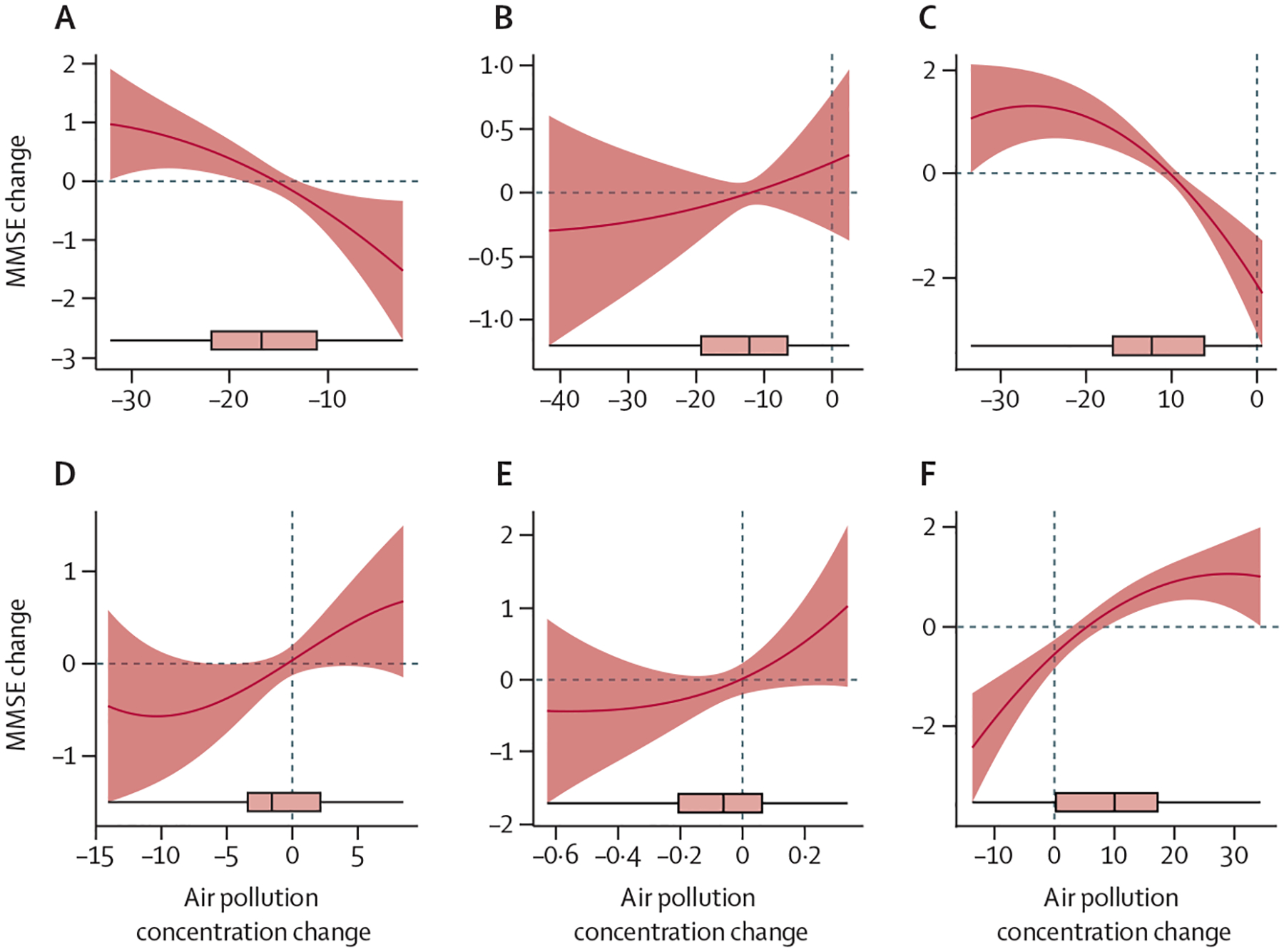
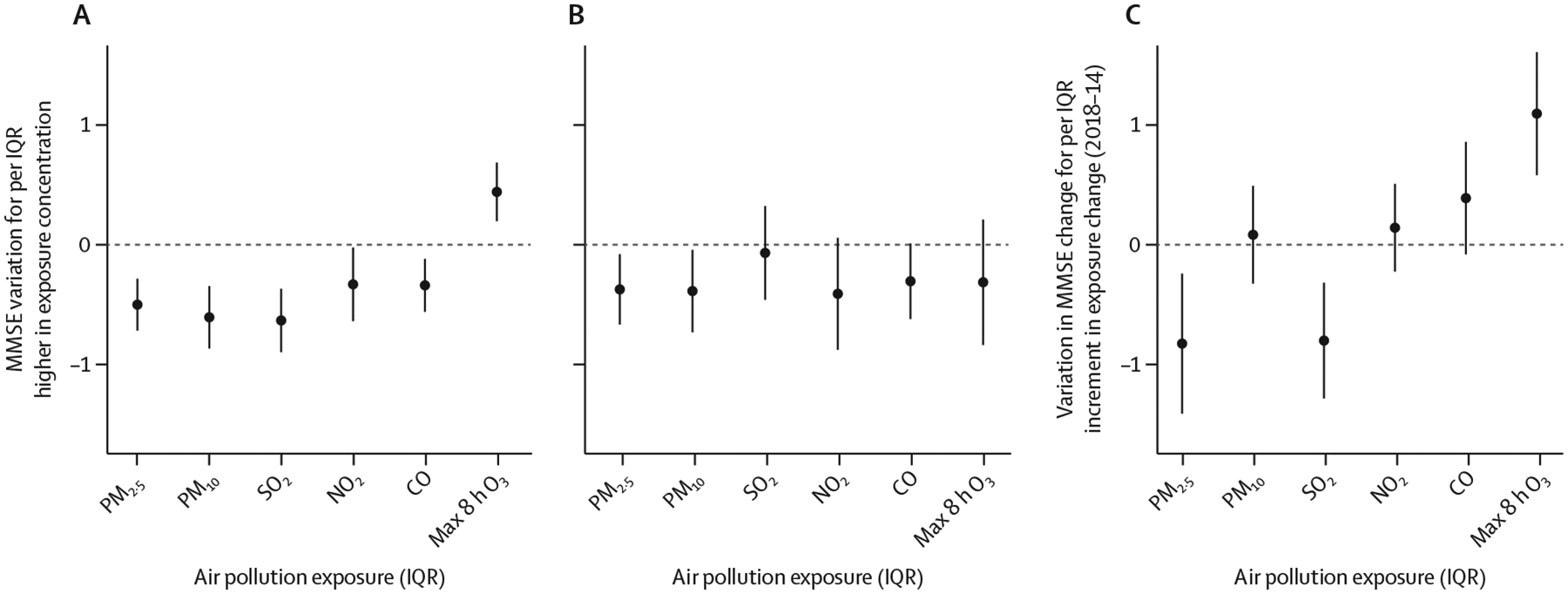
2812 individuals participated in the 2014 and 2018 surveys (mean age 81·0 years [SD 9·3] in 2014; 1408 [50·1%] female and 1404 [49·9%] male). 2251 (80·0%) were included in the intervention group and 561 (20·0%) in the control group. After controlling for potential confounders, the intervention group had a significantly smaller decline in MMSE scores from 2014 to 2018 compared with the control group: the mean between-group difference was 2·45 points (95% CI 1·32-3·57). Interquartile increases in PM were associated with a significant MMSE score decline of 0·83 points (95% CI 0·24-1·42); similarly, increases in SO were also associated with a significant MMSE score decline of 0·80 points (0·32-1·29).
Implementing stringent clean air policies might mitigate the risk of air pollutant-associated cognitive ageing in older people.
National Natural Sciences Foundation of China, National Key R&D Program of China, China Postdoctoral Science Foundation funded project, the Duke/Duke-National University of Singapore Collaboration Pilot Project, the National Institute on Aging and Peking University-Baidu Fund, Energy Foundation, and the Fundamental Research Funds for the Central Universities.
空气污染可能会加速认知老化;目前尚不清楚大规模干预措施(如中国的《清洁空气法案》(CCAA))是否可以减轻认知能力的下降。我们旨在评估 CCAA 对老年人认知功能变化的影响。
在这项基于人群的准实验研究中,我们对中国长寿纵向研究(CLHLS)2014 年和 2018 年波次的数据进行了差值差异分析。该研究设计通过将 CLHLS 参与者分为两组来利用反事实分析功能。干预组包括居住在省政府设定颗粒物(PM)年度减排目标至少为 5%的地区的参与者,而对照组则包括居住在没有 PM 减排目标地区的个人。使用简易精神状态检查量表(MMSE)衡量整体认知功能。我们使用固定效应模型来检验 CCAA 实施前后 MMSE 评分变化的组间差异。我们将 MMSE 评分的纵向变化与 PM2.5 浓度和其他受监管污染物浓度的变化相关联。我们使用替代模型和敏感性分析来评估主要模型结果的稳健性。
共有 2812 人参加了 2014 年和 2018 年的调查(2014 年平均年龄为 81.0 岁[9.3 岁];1408[50.1%]为女性,1404[49.9%]为男性)。2251 人(80.0%)被纳入干预组,561 人(20.0%)被纳入对照组。在控制了潜在的混杂因素后,与对照组相比,干预组的 MMSE 评分从 2014 年到 2018 年的下降幅度明显较小:组间平均差异为 2.45 分(95%CI 1.32-3.57)。PM 浓度的四分位距增加与 MMSE 评分显著下降 0.83 分(95%CI 0.24-1.42)相关;同样,SO 浓度的增加也与 MMSE 评分显著下降 0.80 分(0.32-1.29)相关。
实施严格的清洁空气政策可能会降低老年人因空气污染物导致认知老化的风险。
国家自然科学基金委员会、中国国家重点研发计划、中国博士后科学基金会资助项目、杜克大学-新加坡国立大学合作试点项目、国家老龄问题研究所和北京大学-百度基金、能源基金会以及中央高校基本科研业务费。