Cui Yong, Cai Hui, Zheng Wei, Shu Xiao-Ou
Division of Epidemiology, Department of Medicine, Vanderbilt-Ingram Cancer Center, Vanderbilt Epidemiology Center Vanderbilt University Medical Center Nashville TN USA.
JBMR Plus. 2021 Nov 23;6(2):e10563. doi: 10.1002/jbm4.10563. eCollection 2022 Feb.
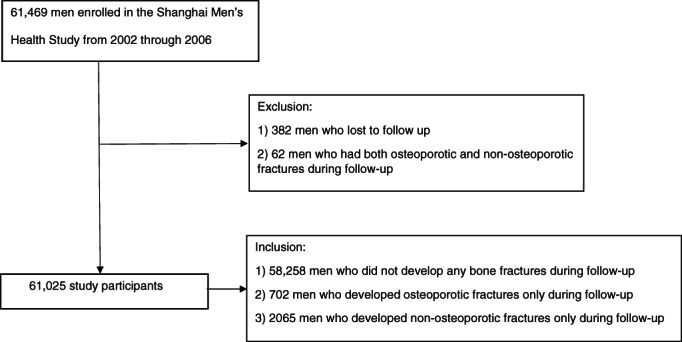
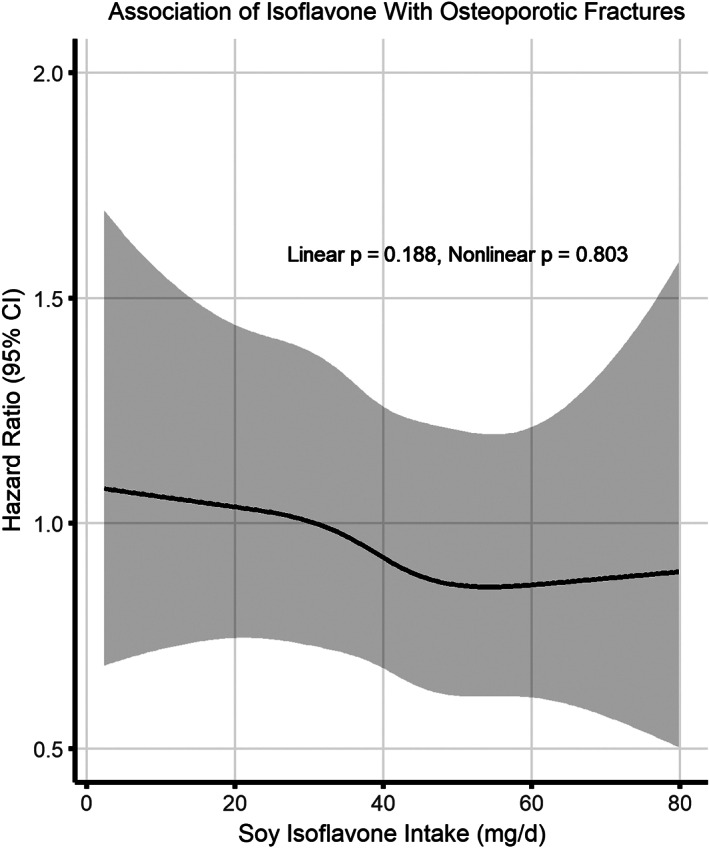
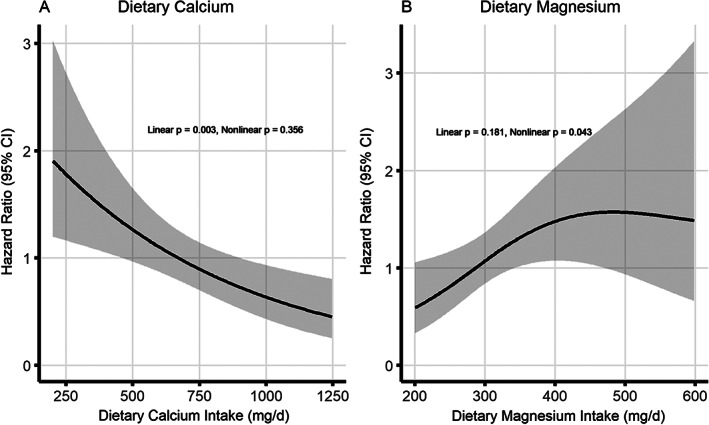
The role of dietary factors in osteoporotic fractures in men is underinvestigated. We examined the associations of dietary intakes of calcium, magnesium, and soy isoflavones with risk of osteoporotic fractures in the Shanghai Men's Health Study. Included in this prospective study were 61,025 men aged 40 to 74 years at study enrollment (2002-2006). The cohort was followed up via in-person surveys for occurrence of bone fractures, major diseases, and survival status. Multivariable Cox regression was applied to evaluate the associations of variables under study (ie, dietary intakes of calcium, magnesium, and soy isoflavones) with incidence of osteoporotic and non-osteoporotic fractures, measured by hazard ratio (HR) and 95% confidence interval (CI). During a median follow-up of 9.5 years, 1.2% and 3.4% of participants experienced osteoporotic or non-osteoporotic fractures, respectively. Dietary calcium intake was inversely associated with risk of osteoporotic fractures with adjusted HRs of 0.78 (95% CI 0.60-1.02) and 0.27 (95% CI 0.13-0.56), respectively, for intake levels of 401 mg/d and >1000 mg/d versus ≤400 mg/d. Higher magnesium intake was associated with increased risk of osteoporotic fractures after adjusting for dietary calcium intake, with HRs of 1.27 (95% CI 0.97-1.66) and 2.21 (95% CI 1.08-4.50), respectively, for intakes of 251 mg/d and >450 mg/d versus intake ≤250 mg/d. High soy isoflavone intake was associated with a 25% reduction of osteoporotic fracture risk (HR = 0.73, 95% CI 0.56-0.97 for soy isoflavone intake >45.2 mg/d versus <21.7 mg/d). Dietary intakes of calcium, magnesium, or soy isoflavones were unrelated to the risk of non-osteoporotic fractures. Our study added to the evidence that dietary calcium intake was inversely associated with a reduced risk of osteoporotic fractures in a dose-response fashion, while high magnesium intake was associated with an increased risk. Our study also revealed a novel association between higher soy isoflavone consumption and osteoporotic fractures in men. © 2021 The Authors. published by Wiley Periodicals LLC on behalf of American Society for Bone and Mineral Research.
饮食因素在男性骨质疏松性骨折中的作用尚未得到充分研究。在上海男性健康研究中,我们研究了钙、镁和大豆异黄酮的饮食摄入量与骨质疏松性骨折风险之间的关联。这项前瞻性研究纳入了61025名年龄在40至74岁之间的男性(研究招募时间为2002年至2006年)。通过面对面调查对该队列进行随访,以了解骨折、重大疾病的发生情况和生存状态。应用多变量Cox回归来评估所研究变量(即钙、镁和大豆异黄酮的饮食摄入量)与骨质疏松性和非骨质疏松性骨折发生率之间的关联,以风险比(HR)和95%置信区间(CI)衡量。在中位随访9.5年期间,分别有1.2%和3.4%的参与者发生了骨质疏松性或非骨质疏松性骨折。饮食钙摄入量与骨质疏松性骨折风险呈负相关,对于摄入量为401mg/d和>1000mg/d的情况,与≤400mg/d相比,调整后的HR分别为0.78(95%CI 0.60-1.02)和0.27(95%CI 0.13-0.56)。在调整饮食钙摄入量后,较高的镁摄入量与骨质疏松性骨折风险增加相关,对于摄入量为251mg/d和>450mg/d的情况,与摄入量≤250mg/d相比,HR分别为1.27(95%CI 0.97-1.66)和2.21(95%CI 1.08-4.50)。高大豆异黄酮摄入量与骨质疏松性骨折风险降低25%相关(大豆异黄酮摄入量>45.2mg/d与<21.7mg/d相比,HR = 0.73,95%CI 0.56-0.97)。钙、镁或大豆异黄酮的饮食摄入量与非骨质疏松性骨折风险无关。我们的研究进一步证明,饮食钙摄入量与骨质疏松性骨折风险降低呈剂量反应关系,而高镁摄入量与风险增加相关。我们的研究还揭示了男性较高的大豆异黄酮摄入量与骨质疏松性骨折之间的新关联。© 2021作者。由Wiley Periodicals LLC代表美国骨与矿物质研究学会出版。