Department of Oncology, Johns Hopkins University School of Medicine, Baltimore, Maryland, USA.
The Sidney Kimmel Comprehensive Cancer Center at Johns Hopkins, Baltimore, Maryland, USA.
J Clin Invest. 2022 Mar 1;132(5). doi: 10.1172/JCI157434.
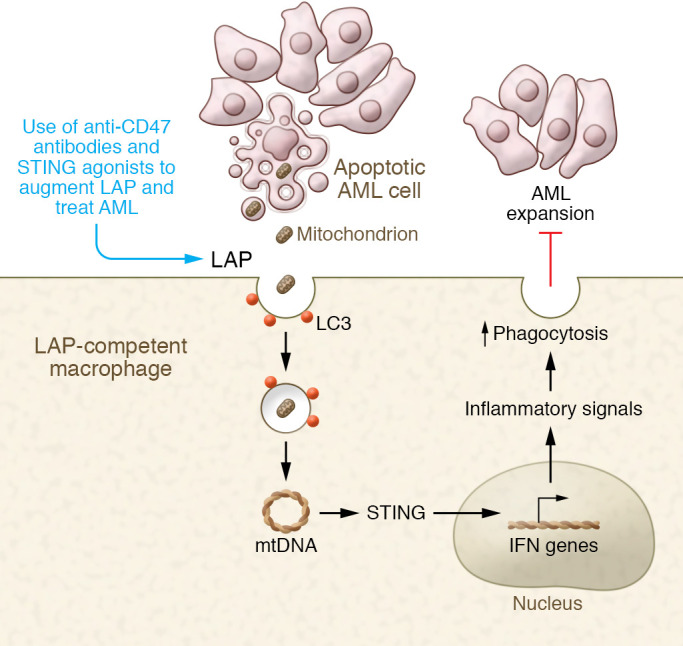
Macrophages within the bone marrow (BM) microenvironment take on unexpected roles in acute myeloid leukemia (AML) as reported by Moore and colleagues in this issue of the JCI. In contrast to solid tumors, where tumor-associated macrophages frequently assume an immunosuppressive phenotype that promotes tumor progression, this study revealed that BM macrophages repressed leukemia expansion in AML through a pathway called LC3-associated phagocytosis (LAP). After phagocytosis of dead and dying leukemic cells, including the mitochondria within the leukemic blasts, mitochondrial DNA activated stimulator of IFN genes (STING), leading to inflammatory signals that enhanced phagocytosis and restrained leukemic cell expansion. These findings unveil the modulation of macrophage-mediated phagocytosis via LAP as a potential therapeutic strategy directed at the BM microenvironment in AML.
骨髓(BM)微环境中的巨噬细胞在急性髓系白血病(AML)中发挥了意想不到的作用,这是由 Moore 及其同事在本期 JCI 中报道的。与实体瘤不同,肿瘤相关巨噬细胞通常表现出一种免疫抑制表型,促进肿瘤进展,本研究表明,BM 巨噬细胞通过一种称为 LC3 相关吞噬作用(LAP)的途径抑制 AML 中的白血病扩张。在吞噬死亡和垂死的白血病细胞后,包括白血病细胞中的线粒体,线粒体 DNA 激活干扰素基因刺激物(STING),导致增强吞噬作用并抑制白血病细胞扩张的炎症信号。这些发现揭示了通过 LAP 调节巨噬细胞介导的吞噬作用作为针对 AML BM 微环境的潜在治疗策略。