Department of Molecular Genetics, Erasmus MC Cancer Institute, Oncode Institute, Erasmus University Medical Center, Rotterdam, The Netherlands.
Cell Mol Life Sci. 2022 Mar 1;79(3):166. doi: 10.1007/s00018-022-04194-5.
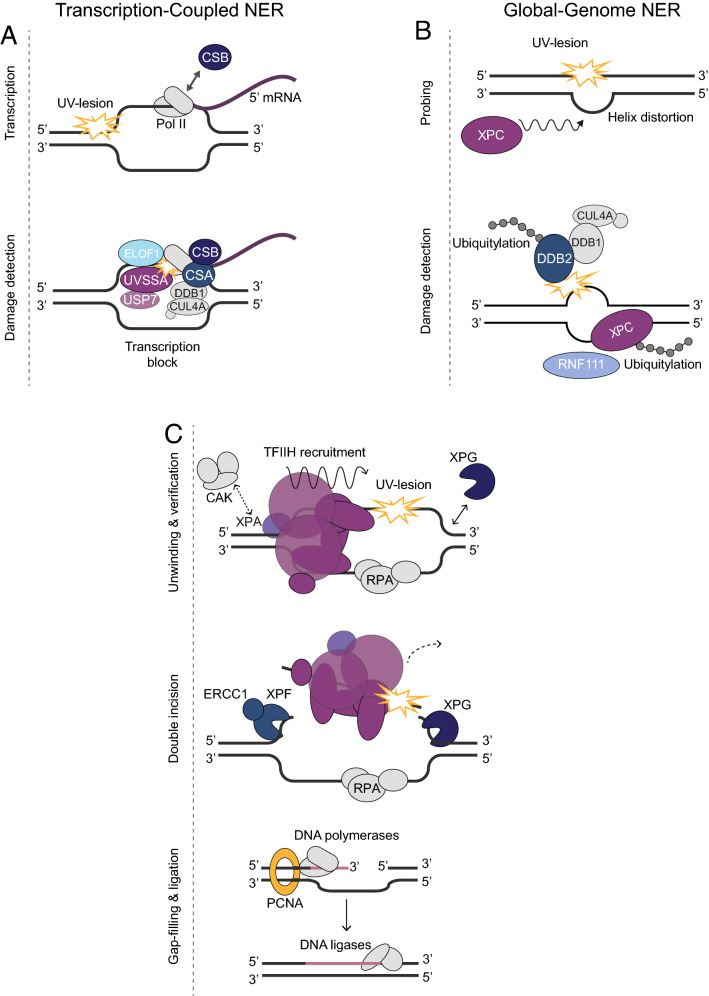
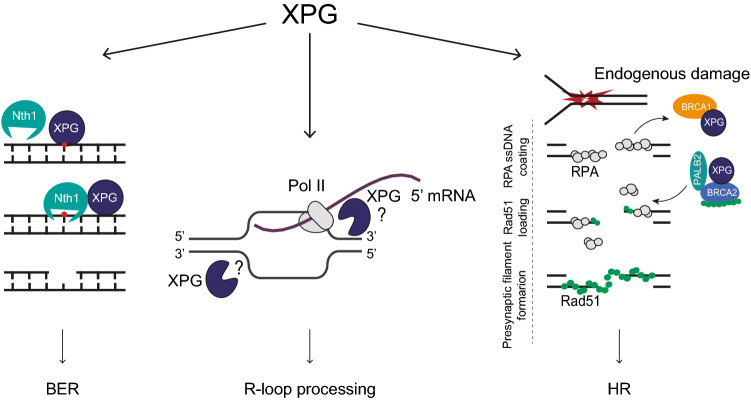
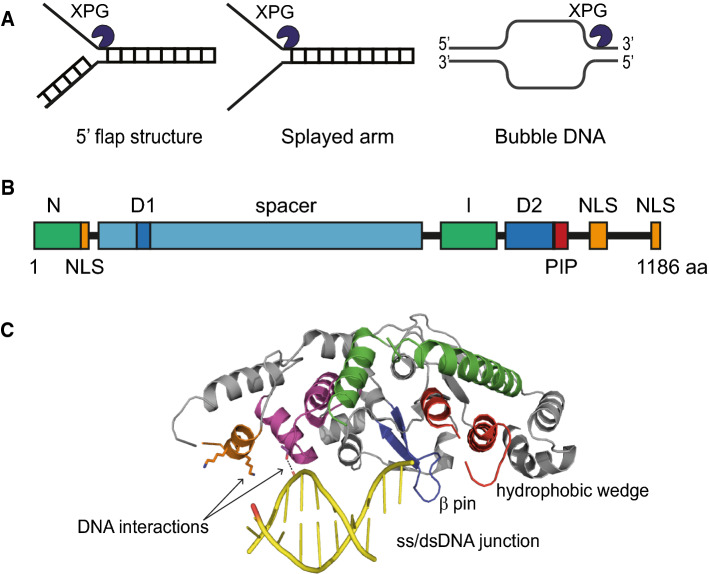
The XPG/ERCC5 endonuclease was originally identified as the causative gene for Xeroderma Pigmentosum complementation group G. Ever since its discovery, in depth biochemical, structural and cell biological studies have provided detailed mechanistic insight into its function in excising DNA damage in nucleotide excision repair, together with the ERCC1-XPF endonuclease. In recent years, it has become evident that XPG has additional important roles in genome maintenance that are independent of its function in NER, as XPG has been implicated in protecting replication forks by promoting homologous recombination as well as in resolving R-loops. Here, we provide an overview of the multitasking of XPG in genome maintenance, by describing in detail how its activity in NER is regulated and the evidence that points to important functions outside of NER. Furthermore, we present the various disease phenotypes associated with inherited XPG deficiency and discuss current ideas on how XPG deficiency leads to these different types of disease.
XPG/ERCC5 内切酶最初被鉴定为 Xeroderma Pigmentosum 互补组 G 的致病基因。自发现以来,深入的生化、结构和细胞生物学研究为其在核苷酸切除修复中切除 DNA 损伤的功能,以及与 ERCC1-XPF 内切酶一起,提供了详细的机制见解。近年来,XPG 在基因组维护中具有额外的重要作用,这与其在 NER 中的功能无关,这一点已经很明显,因为 XPG 已被牵连到通过促进同源重组以及解决 R-环来保护复制叉。在这里,我们通过详细描述 NER 中 XPG 活性的调节以及指向 NER 之外重要功能的证据,提供了 XPG 在基因组维护中的多任务概述。此外,我们介绍了与遗传性 XPG 缺乏相关的各种疾病表型,并讨论了 XPG 缺乏导致这些不同类型疾病的当前观点。