
当代眼用润滑剂的剪切稀化和温度依赖黏度关系。
Shear-Thinning and Temperature-Dependent Viscosity Relationships of Contemporary Ocular Lubricants.
机构信息
Department of Mechanical and Mechatronics Engineering, University of Waterloo, Waterloo, ON, Canada.
Centre for Ocular Research & Education (CORE), School of Optometry & Vision Science, University of Waterloo, Waterloo, ON, Canada.
出版信息
Transl Vis Sci Technol. 2022 Mar 2;11(3):1. doi: 10.1167/tvst.11.3.1.
PURPOSE
To evaluate the shear viscosity of contemporary, commercially available ocular lubricants at various shear rates and temperatures and to derive relevant mathematical viscosity models that are impactful for prescribing and developing eye drops to treat dry eye disease.
METHODS
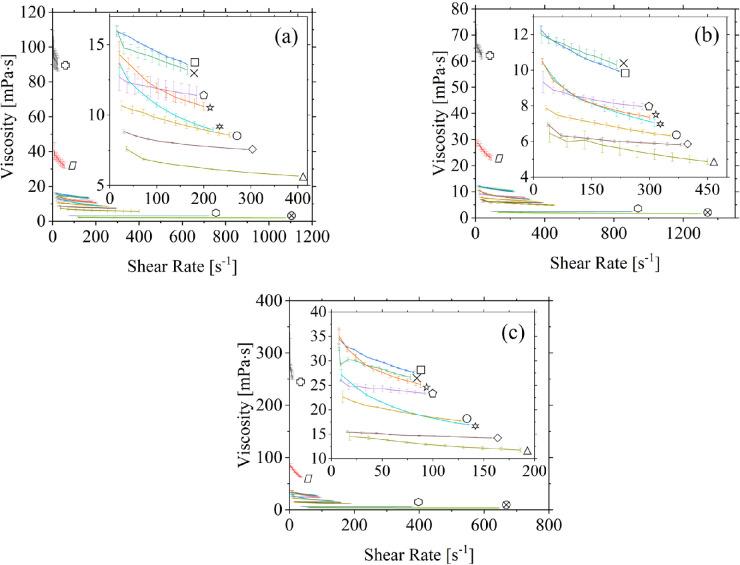
The shear viscosity of 12 ocular lubricants was measured using a rheometer and a temperature-controlled bath at clinically relevant temperatures at which users may experience exposure to the drops (out of the refrigerator [4.3°C]; room temperature [24.6°C]; ocular surface temperature [34.5°C]). Three replicates for each sample at each temperature were obtained using a standard volume (0.5 mL) of each sample. The viscosity of each ocular lubricant was measured over the full range of shear rates allowed by the rheometer.
RESULTS
The shear viscosity of the same ocular lubricant varied significantly among the three temperatures. In general, a higher temperature resulted in smaller viscosities than a lower temperature (an average of -48% relative change from 4.3°C to 24.6°C and -21% from 24.6°C to 34.5°C). At a constant temperature, the viscosity of an ocular lubricant over the studied shear rates can be well approximated by a power-law model.
CONCLUSIONS
Rheological analysis revealed that the ocular lubricants exhibited shear-thinning behavior at the measured temperatures. Differences in the ocular lubricants' formulations and measured temperatures resulted in different viscosities.
TRANSLATIONAL RELEVANCE
When prescribing eye drops, eye care professionals can select the optimal one for their patients by considering a variety of factors, including its rheological property at physiologically relevant shear rates and temperatures, which can improve residence time on the ocular surface, while ensuring appropriate comfort and vision. However, care must be taken when using the derived mathematical models in this study because the in vivo shear behavior of the ocular lubricants has not been examined and might show deviations from those reported when placed on the ocular surface.
目的
评估各种剪切率和温度下当代市售眼用润滑剂的剪切黏度,并得出相关的数学黏度模型,以便于为治疗干眼症开具和开发滴眼液。
方法
使用流变仪和控温浴在临床相关温度下(患者可能会接触到滴眼液的温度,即冰箱外温度[4.3°C];室温[24.6°C];眼表面温度[34.5°C])测量 12 种眼用润滑剂的剪切黏度。每种样品在每种温度下重复 3 次,每次使用 0.5 毫升标准体积的每种样品。在流变仪允许的全剪切速率范围内测量每种眼用润滑剂的黏度。
结果
相同眼用润滑剂在三种温度下的剪切黏度差异显著。一般来说,较高的温度会导致较小的黏度,而较低的温度则会导致较大的黏度(平均而言,从 4.3°C 到 24.6°C 时黏度降低了 48%,从 24.6°C 到 34.5°C 时黏度降低了 21%)。在恒定温度下,研究的剪切速率范围内眼用润滑剂的黏度可以很好地用幂律模型来近似。
结论
流变分析表明,所测量的温度下,眼用润滑剂表现出剪切稀化行为。眼用润滑剂配方和测量温度的差异导致了不同的黏度。
翻译
岳玲


 Zotero 插件