Laboratorio de Microbiología y Probióticos, INTA Universidad de Chile, Avenida El Líbano 5524 Macul, Santiago, Chile.
Doctorado en Acuicultura, Programa Cooperativo Universidad de Chile, Universidad Católica del Norte, Pontificia Universidad Católica de Valparaíso, Valparaíso, Chile.
Biol Res. 2022 Mar 2;55(1):9. doi: 10.1186/s40659-022-00376-4.
Listeria monocytogenes is a foodborne pathogen that causes listeriosis in humans. This pathogen activates multiple regulatory mechanisms in response to stress, and cobalamin biosynthesis might have a potential role in bacterial protection. Low temperature is a strategy used in the food industry to control bacteria proliferation; however, L. monocytogenes can grow in cold temperatures and overcome different stress conditions. In this study we selected L. monocytogenes List2-2, a strain with high tolerance to the combination of low temperature + copper, to understand whether the cobalamin biosynthesis pathway is part of the tolerance mechanism to this stress condition. For this, we characterized the transcription level of three cobalamin biosynthesis-related genes (cbiP, cbiB, and cysG) and the eutV gene, a transcriptional regulator encoding gene involved in ethanolamine metabolism, in L. monocytogenes strain List2-2 growing simultaneously under two environmental stressors: low temperature (8 °C) + copper (0.5 mM of CuSO × 5HO). In addition, the gene cbiP, which encodes an essential cobyric acid synthase required in the cobalamin pathway, was deleted by homologous recombination to evaluate the impact of this gene in L. monocytogenes tolerance to a low temperature (8 °C) + different copper concentrations.
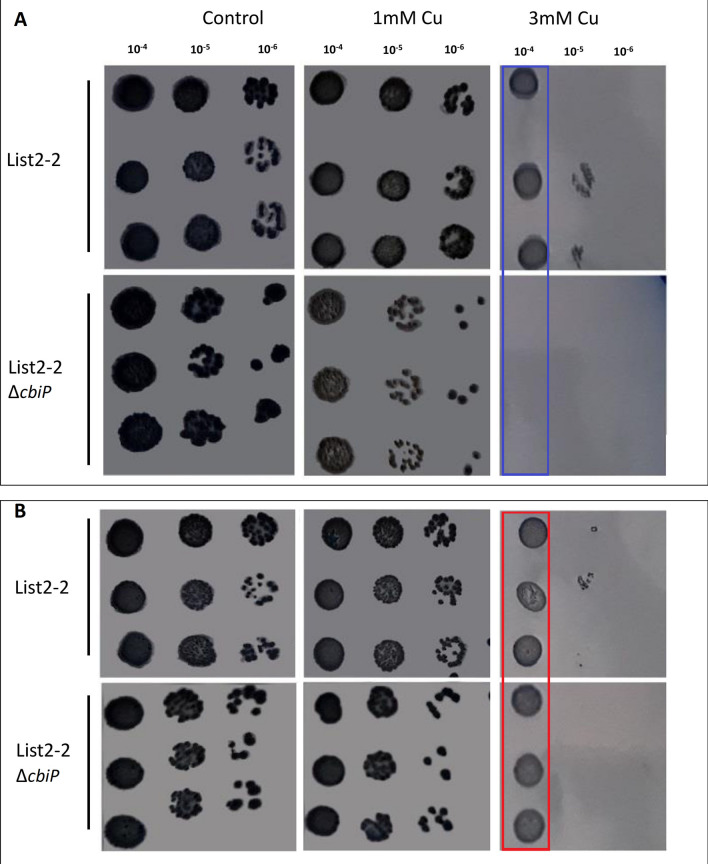
By analyzing the KEGG pathway database, twenty-two genes were involved in the cobalamin biosynthesis pathway in L. monocytogenes List2-2. The expression of genes cbiP, cbiB, and cysG, and eutV increased 6 h after the exposure to low temperature + copper. The cobalamin cbiP mutant strain List2-2ΔcbiP showed less tolerance to low temperature + copper (3 mM) than the wild-type L. monocytogenes List2-2. The addition of cyanocobalamin (5 nM) to the medium reverted the phenotype observed in List2-2ΔcbiP.
These results indicate that cobalamin biosynthesis is necessary for L. monocytogenes growth under stress and that the cbiP gene may play a role in the survival and growth of L. monocytogenes List2-2 at low temperature + copper.
单核细胞增生李斯特菌是一种食源性病原体,可导致人类李斯特菌病。该病原体针对应激会激活多种调控机制,而钴胺素生物合成可能在细菌保护中发挥潜在作用。低温是食品工业中用于控制细菌增殖的一种策略;然而,单核细胞增生李斯特菌可以在低温下生长并克服不同的应激条件。在这项研究中,我们选择了对低温+铜的组合具有高耐受性的单核细胞增生李斯特菌 List2-2 菌株,以了解钴胺素生物合成途径是否是该应激条件下耐受机制的一部分。为此,我们对三个与钴胺素生物合成相关的基因(cbiP、cbiB 和 cysG)和 eutV 基因(编码参与乙醇胺代谢的转录调节因子的基因)的转录水平进行了表征,单核细胞增生李斯特菌 List2-2 菌株在两种环境应激因子(低温(8°C)+铜(0.5mM 的 CuSO₅·5H₂O))下同时生长。此外,通过同源重组删除了编码钴胺素途径中必需的 cobyrinic 酸合酶的基因 cbiP,以评估该基因缺失对单核细胞增生李斯特菌耐受低温(8°C)和不同铜浓度的影响。
通过分析 KEGG 通路数据库,发现 22 个基因参与了单核细胞增生李斯特菌 List2-2 的钴胺素生物合成途径。暴露于低温+铜 6 小时后,cbiP、cbiB 和 cysG 基因以及 eutV 的表达增加。与野生型单核细胞增生李斯特菌 List2-2 相比,缺失 cbiP 基因的钴胺素 cbiP 突变菌株 List2-2ΔcbiP 对低温+铜(3mM)的耐受性较低。向培养基中添加氰钴胺素(5nM)可使 List2-2ΔcbiP 中观察到的表型恢复。
这些结果表明,钴胺素生物合成对于单核细胞增生李斯特菌在应激下的生长是必要的,并且 cbiP 基因可能在单核细胞增生李斯特菌 List2-2 在低温+铜下的存活和生长中发挥作用。