
倒刺缝线与传统缝线在全膝关节置换术中的比较:一项系统评价和荟萃分析。
A comparison between barbed suture and conventional suture in total knee arthroplasty: a systematic review and meta-analysis.
作者信息
Li Erliang, Niu Wenjing, Lu Tingting, Li Xiaolin, Zhang Tong, Cai Jinchi, Wang Wenji
机构信息
The First Clinical Medical College of Lanzhou University, Lanzhou, 730000, China.
Department of Orthopedics, The First Hospital of Lanzhou University, Lanzhou, 730000, China.
出版信息
Arthroplasty. 2020 Mar 27;2(1):8. doi: 10.1186/s42836-020-00028-6.
OBJECTIVE
The aim of this systematic review and meta-analysis was to evaluate the efficacy of barbed versus conventional sutures in total knee arthroplasty.
METHODS
Two investigators independently performed data extraction and assessed study quality using the keywords "barbed suture, wound suture, total knee arthroplasty" in two search trials, individual trials, and trials from Systematic Reviews or Meta-analyses in PubMed, Cochrane Library, Web of Science, and EMBASE databases.
RESULT
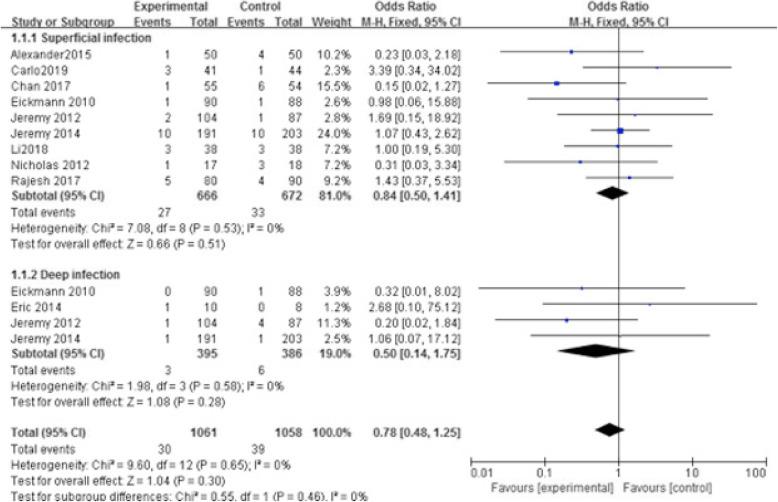
A total of 11 articles (involving 1546 total knee arthroplasties) were included in this study. Comparison was made between barbed and conventional sutures in terms of various measures. No significant differences were identified in superficial infection and deep infection (p > 0.51; odds ratio 0.84 [95% confidence interval, 0.50, 1.4] and p > 0.28; odds ratio 0.50 [95% confidence interval, 0.14, 1.75], respectively). There was no significant difference in time for capsular suture (p < 0.05; odds ratio - 4.05 [95% confidence interval, - 4.39, - 3.71]). There existed no significant differences in Hospital for Special Surgery Knee Score and Knee Society Score (p > 0.05; odds ratio - 1.20 [95% confidence interval, - 2.98, 0.58] and p > 0.05; odds ratio - 1.62 [95% confidence interval, - 4.06, 0.18], respectively). No significant differences were revealed in suture breakage and needle stick injury (p < 0.05; odds ratio 36.51 [95% confidence interval, 7.06, 188.72] and p < 0.05; odds ratio 0.16 [95% confidence interval, 0.04, 0.72], respectively). No significant difference was exhibited in dehiscence (p = 0.99; odds ratio 0.99 [95% confidence interval, 0.41, 2.38]).
CONCLUSION
In total knee arthroplasty, both barbed and conventional sutures yielded similar results in terms of superficial and deep infection, Hospital for Special Surgery Knee Score, Knee Society Score, and wound dehiscence. Barbed suture was associated with higher incidence of suture breakage, shorter suture time, and less needle stick injury.
目的
本系统评价和荟萃分析的目的是评估倒刺缝线与传统缝线在全膝关节置换术中的疗效。
方法
两名研究者在PubMed、Cochrane图书馆、科学网和EMBASE数据库的两次检索试验、单项试验以及系统评价或荟萃分析的试验中,使用关键词“倒刺缝线、伤口缝线、全膝关节置换术”独立进行数据提取并评估研究质量。
结果
本研究共纳入11篇文章(涉及1546例全膝关节置换术)。对倒刺缝线和传统缝线在各项指标上进行了比较。在浅表感染和深部感染方面未发现显著差异(p>0.51;优势比0.84[95%置信区间,0.50,1.4]和p>0.28;优势比0.50[95%置信区间,0.14,1.75])。在关节囊缝合时间上无显著差异(p<0.05;优势比 -4.05[95%置信区间,-4.39,-3.71])。在特种外科医院膝关节评分和膝关节协会评分方面无显著差异(p>0.05;优势比 -1.20[95%置信区间,-2.98,0.58]和p>0.05;优势比 -1.62[95%置信区间,-4.06,0.18])。在缝线断裂和针刺伤方面未发现显著差异(p<0.05;优势比36.51[95%置信区间,7.06,188.72]和p<0.05;优势比0.16[95%置信区间,0.04,0.72])。在伤口裂开方面无显著差异(p = 0.99;优势比0.99[95%置信区间,0.41,2.38])。
结论
在全膝关节置换术中,倒刺缝线和传统缝线在浅表和深部感染、特种外科医院膝关节评分、膝关节协会评分以及伤口裂开方面产生的结果相似。倒刺缝线与更高的缝线断裂发生率、更短的缝合时间以及更少的针刺伤相关。




 Zotero 插件