Department of Neurology, Affiliated ZhongDa Hospital, School of Medicine, Southeast University, Nanjing, Jiangsu, 210009, China.
Institute of Neuropsychiatry, Affiliated ZhongDa Hospital, Southeast University, Nanjing, Jiangsu, 210009, China.
Transl Psychiatry. 2022 Mar 2;12(1):89. doi: 10.1038/s41398-022-01829-w.
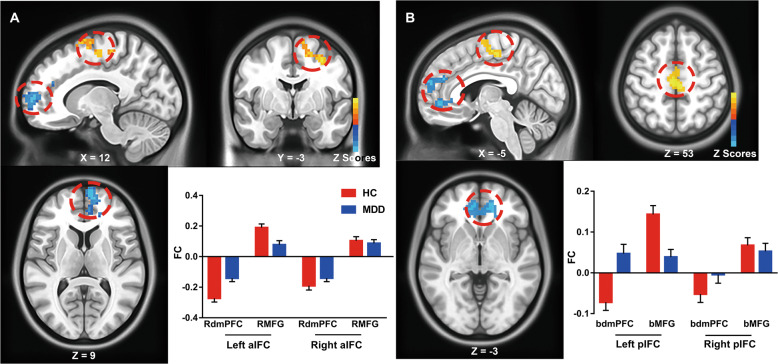
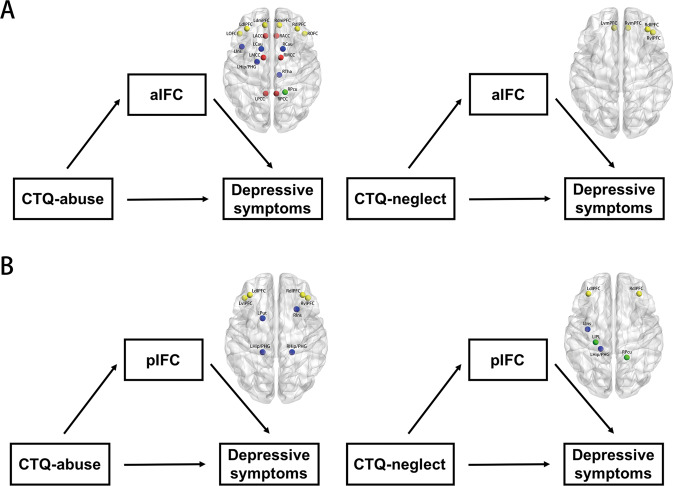
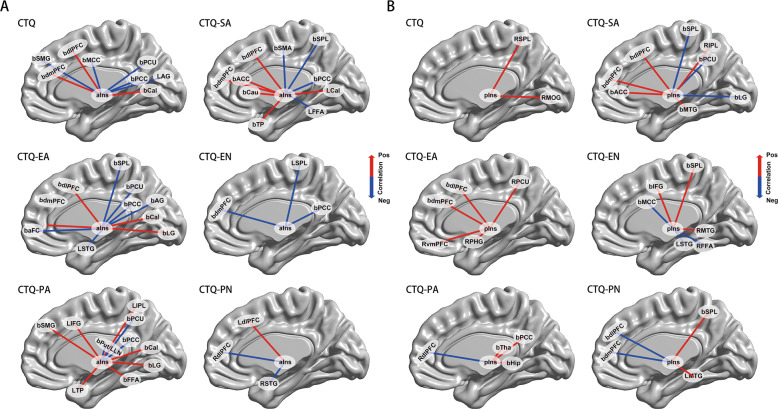
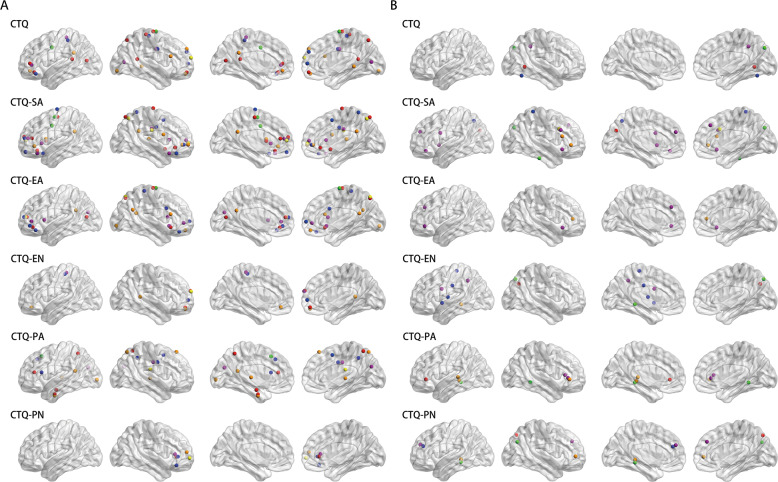
Childhood maltreatment (CM) is a major risk factor for developing the major depressive disorder (MDD), however, the neurobiological mechanism linking CM and MDD remains unclear. We recruited 34 healthy controls (HCs) and 44 MDD patients to complete the childhood maltreatment experience assessment with Childhood Trauma Questionnaire (CTQ) and resting-state fMRI scan. Multivariate linear regression analysis was employed to identify the main effects of CM and depressive symptoms total and subfactors scores on bilateral anterior and posterior insula functional connectivity (IFC) networks, respectively. Mediation analysis was performed to investigate whether IFC strength mediates the association between CM and depressive symptoms. MDD patients showed significantly decreased connectivity in the dorsal medial prefrontal cortex and increased connectivity in the medial frontal gyrus in the bipartite IFC networks, compared to HCs. The main effects of CM and depressive symptoms showed a large discrepancy on the anterior and posterior IFC networks, which primarily located in the frontal-limbic system. Further, conjunction analysis identified the overlapping regions linking CM and depressive symptoms were mainly implicated in self-regulation and cognitive processing circuits. More important, these IFC strengths could mediate the association between different types of CM, especially for childhood abuse and childhood neglect, and depressive symptoms in those overlapping regions. We demonstrated that early exposure to CM may increase the vulnerability to depression by influencing brain's self-regulating and cognitive processing circuitry. These findings provide new insight into the understanding of pathological mechanism underlying CM-induced depressive symptoms.
童年期虐待(CM)是发展为重度抑郁症(MDD)的主要危险因素,但将 CM 与 MDD 联系起来的神经生物学机制仍不清楚。我们招募了 34 名健康对照(HCs)和 44 名 MDD 患者,使用童年创伤问卷(CTQ)和静息态 fMRI 扫描完成童年期虐待经历评估。采用多元线性回归分析,分别识别 CM 和抑郁症状总分及各因子评分对双侧前、后岛叶功能连接(IFC)网络的主要影响。进行中介分析以探讨 IFC 强度是否介导 CM 和抑郁症状之间的关联。与 HCs 相比,MDD 患者在二分 IFC 网络中背内侧前额叶皮质的连接明显降低,而内侧额回的连接增加。CM 和抑郁症状的主要影响在前后 IFC 网络中存在很大差异,主要位于额叶-边缘系统。此外,联合分析确定了将 CM 和抑郁症状联系起来的重叠区域主要涉及自我调节和认知处理回路。更重要的是,这些 IFC 强度可以介导不同类型 CM 与重叠区域中抑郁症状之间的关联,尤其是儿童期虐待和忽视。我们表明,早期暴露于 CM 可能通过影响大脑的自我调节和认知处理回路增加对抑郁的易感性。这些发现为理解 CM 引起的抑郁症状的病理机制提供了新的见解。