Chen Min, Peng Li, Gong Ping, Zheng Xiaoli, Sun Tao, Zhang Xiaoqiao, Huo Jiangtao
Department of Geriatrics, Taihe Hospital, Hubei University of Medicine, Hubei, China.
Department of Surgery, Traditional Chinese Medicine Hospital, Guizhou, China.
Front Neurol. 2022 Feb 14;12:646817. doi: 10.3389/fneur.2021.646817. eCollection 2021.
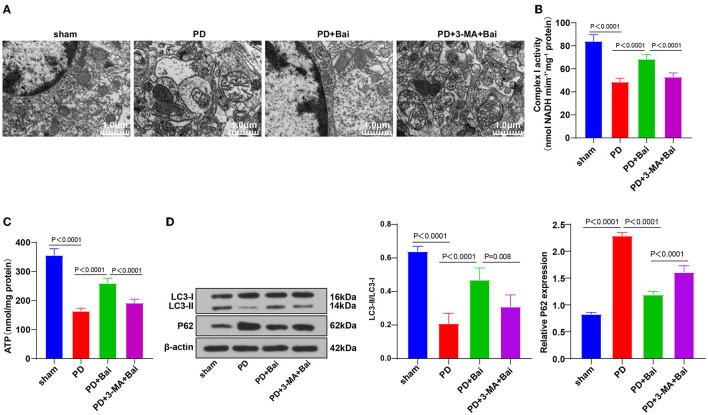
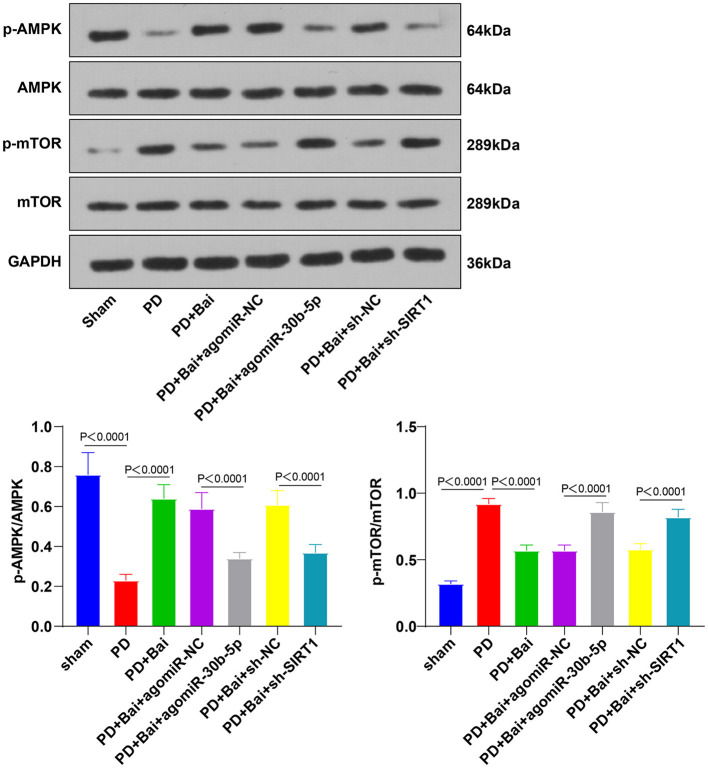
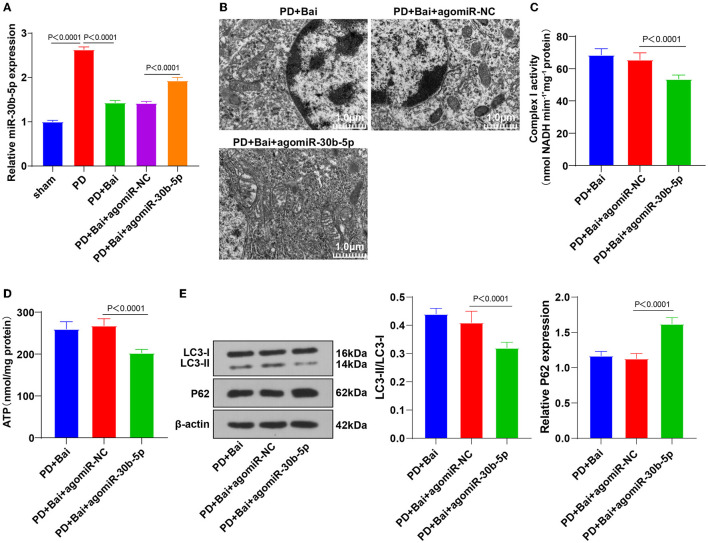
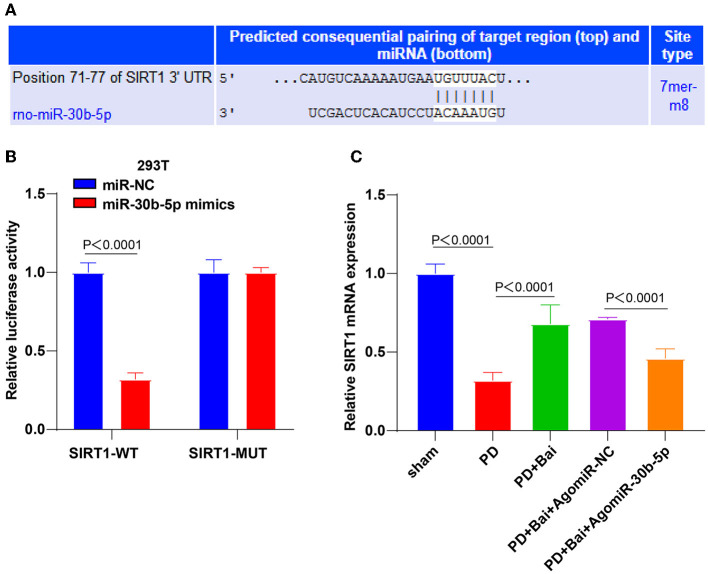
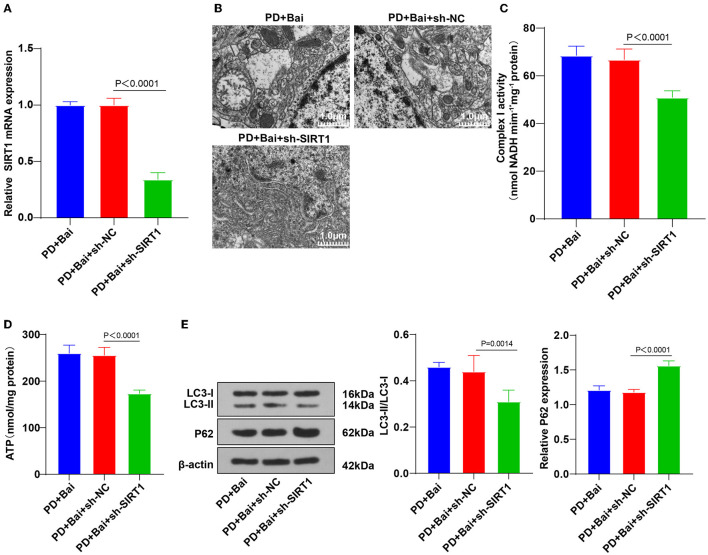
Parkinson's disease (PD) is a prevailing neurodegenerative disorder. Baicalein has neuroprotective effects on PD animals, but its mechanism is not clarified. We explored baicalein effects on PD rats. PD rat models were established by injecting 6-hydroxydopamine into the striatum of substantia nigra on the left side of the rat brain and treated with baicalein. Dopamine (DA) content, neuronal apoptosis, neuronal injury, neuronal mitochondria, and autophagy were assessed. Baicalein-treated PD rats were treated with autophagy inhibitor 3-methyladenine to identify the role of autophagy in PD. PD rats were injected with AgomiR-30b-5p or sh-SIRT1 plasmids and treated with baicalein. PD rats elicited decreased neurological score and DA secretion of the striatum, increased neuronal apoptosis, and injury, and reduced number of mitochondria and autophagy, whereas baicalein alleviated neuronal injury and partly recovered mitochondrial dysfunction, 3-methyladenine inhibited the protection of baicalein. miR-30b-5p was elevated and SIRT1 was diminished in PD rats and inhibited by baicalein. miR-30b-5p targeted SIRT1. miR-30b-5p overexpression or SIRT1 silencing annulled the protection of baicalein. The phosphorylation level of AMPK in the substantia nigra of PD rats was decreased and mTOR was increased, whereas baicalein annulled these trends. Briefly, baicalein activated mitochondrial autophagy miR-30b-5p and the SIRT1/AMPK/mTOR pathway, thus protecting PD rats.
帕金森病(PD)是一种常见的神经退行性疾病。黄芩苷对帕金森病动物具有神经保护作用,但其作用机制尚不清楚。我们探讨了黄芩苷对帕金森病大鼠的影响。通过向大鼠脑左侧黑质纹状体注射6-羟基多巴胺建立帕金森病大鼠模型,并给予黄芩苷治疗。评估多巴胺(DA)含量、神经元凋亡、神经元损伤、神经元线粒体和自噬情况。用自噬抑制剂3-甲基腺嘌呤处理黄芩苷治疗的帕金森病大鼠,以确定自噬在帕金森病中的作用。给帕金森病大鼠注射AgomiR-30b-5p或sh-SIRT1质粒,并给予黄芩苷治疗。帕金森病大鼠神经评分降低,纹状体多巴胺分泌减少,神经元凋亡和损伤增加,线粒体数量和自噬减少,而黄芩苷减轻了神经元损伤,部分恢复了线粒体功能障碍,3-甲基腺嘌呤抑制了黄芩苷的保护作用。帕金森病大鼠中miR-30b-5p升高,SIRT1降低,黄芩苷可抑制这种变化。miR-30b-5p靶向SIRT1。miR-30b-5p过表达或SIRT1沉默消除了黄芩苷的保护作用。帕金森病大鼠黑质中AMPK的磷酸化水平降低,mTOR升高,而黄芩苷消除了这些变化趋势。简而言之,黄芩苷激活了线粒体自噬、miR-30b-5p以及SIRT1/AMPK/mTOR通路,从而保护帕金森病大鼠。