UAB Center for Exercise Medicine, University of Alabama at Birmingham, Birmingham, Alabama.
Department of Cell, Developmental, and Integrative Biology, University of Alabama at Birmingham, Birmingham, Alabama.
J Appl Physiol (1985). 2022 Apr 1;132(4):984-994. doi: 10.1152/japplphysiol.00428.2021. Epub 2022 Mar 3.
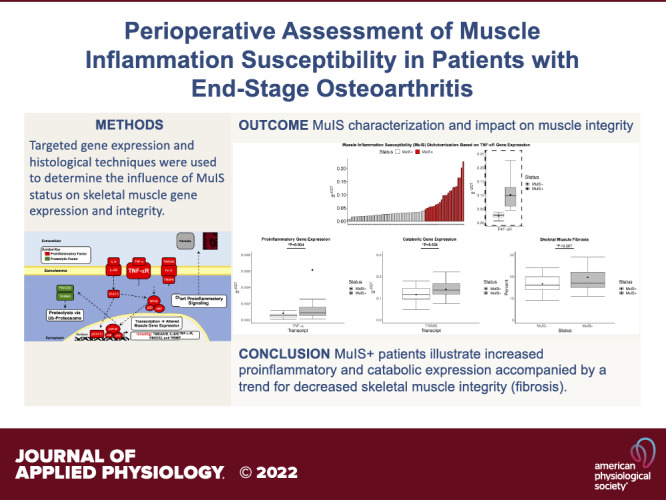
Many individuals with end-stage osteoarthritis (OA) undergo elective total hip/knee arthroplasty (THA/TKA) to relieve pain, improve mobility and quality of life. However, ∼30% suffer long-term mobility impairment following surgery. This may be in part due to muscle inflammation susceptibility (MuIS+), an overt proinflammatory pathology localized to skeletal muscle surrounding the diseased joint, present in some patients with TKA/THA. We interrogated the hypothesis that MuIS+ status results in a perturbed perioperative gene expression profile and decreases skeletal muscle integrity in patients with end-stage OA. Samples were leveraged from the two-site, randomized, controlled trial R01HD084124, NCT02628795. Participants were dichotomized based on surgical (SX) muscle gene expression of TNFRSF1A (TNF-αR). MuIS+/- samples were probed for gene expression and fibrosis. Paired and independent two-tailed tests were used to determine differences between contralateral (CTRL) and surgical (SX) limbs and between-subject comparisons, respectively. Significance was declared at < 0.05. Seventy participants (26M/44F; mean age 62.41 ± 8.86 yr; mean body mass index 31.10 ± 4.91 kg/m) undergoing THA/TKA were clustered as MuIS+ ( = 24) or MuIS- ( = 46). Lower skeletal muscle integrity (greater fibrosis) exists on the SX versus CTRL limb ( < 0.001). Furthermore, MuIS+ versus MuIS- muscle exhibited higher proinflammatory (IL-6R and TNF-α) and catabolic (TRIM63) gene expression ( < 0.001, = 0.004, and 0.024 respectively), with a trend for greater fibrosis ( = 0.087). Patients with MuIS+ exhibit more inflammation and catabolic gene expression in skeletal muscle of the SX limb, accompanied by decreased skeletal muscle integrity (Trend). This highlights the impact of MuIS+ status emphasizing the potential value of perioperative MuIS assessment to inform optimal postsurgical care. This study assessed the skeletal muscle molecular characteristics associated with end-stage osteoarthritis and refined an important phenotype, in some patients, termed muscle inflammation susceptibility (MuIS+) that may be an important consideration following surgery. Furthermore, we provide evidence of differential inflammatory and catabolic gene expression between the contralateral and surgical limbs along with differences between the skeletal muscle surrounding the diseased hip versus knee joints.
许多患有终末期骨关节炎(OA)的患者接受择期全髋关节/膝关节置换术(THA/TKA)以缓解疼痛、提高活动能力和生活质量。然而,约 30%的患者在手术后长期存在活动能力障碍。这可能部分归因于肌肉炎症易感性(MuIS+),这是一种明显的局部炎症病理学,存在于一些接受 TKA/THA 的患者的患病关节周围骨骼肌中。我们检验了 MuIS+状态是否会导致围手术期基因表达谱发生改变,并降低终末期 OA 患者的骨骼肌完整性的假设。这些样本来自两项、随机、对照临床试验 R01HD084124,NCT02628795。参与者根据手术(SX)肌肉肿瘤坏死因子受体超家族 1A(TNF-αR)的基因表达进行了二分法。MuIS+/-样本被检测基因表达和纤维化。使用配对和独立的双侧 t 检验分别确定对侧(CTRL)和手术(SX)肢体之间以及受试者之间的差异。显著性定义为<0.05。70 名参与者(26M/44F;平均年龄 62.41±8.86 岁;平均体重指数 31.10±4.91kg/m)接受 THA/TKA 治疗,分为 MuIS+(n=24)或 MuIS-(n=46)。SX 与 CTRL 肢体相比,骨骼肌完整性较低(纤维化程度更高)(<0.001)。此外,与 MuIS-肌肉相比,MuIS+肌肉表现出更高的促炎(IL-6R 和 TNF-α)和分解代谢(TRIM63)基因表达(<0.001,=0.004 和 0.024 分别),并且纤维化程度更高(=0.087)。MuIS+患者的 SX 肢体骨骼肌中炎症和分解代谢基因表达增加,骨骼肌完整性降低(趋势)。这凸显了 MuIS+状态的影响,强调了围手术期 MuIS 评估的潜在价值,以告知术后最佳护理。本研究评估了与终末期骨关节炎相关的骨骼肌分子特征,并对某些患者的一种重要表型进行了细化,这种表型称为肌肉炎症易感性(MuIS+),这可能是手术后的一个重要考虑因素。此外,我们提供了疾病髋关节与膝关节周围骨骼肌之间对侧与手术肢体之间以及差异的炎症和分解代谢基因表达的差异。