Department of Minimally Invasive Surgical and Medical Oncology, Fukushima Medical University, Fukushima, Fukushima, Japan.
Department of Surgical Oncology, Southern Tohoku General Hospital, Southern Tohoku Research Institute for Neuroscience, Koriyama, Fukushima, Japan.
PLoS One. 2022 Mar 3;17(3):e0264652. doi: 10.1371/journal.pone.0264652. eCollection 2022.
There are a few established prognostic factors for stage IV colorectal cancer. Thus, this study aimed to evaluate the impact of histological subtypes on prognosis and metastatic patterns in patients with stage IV colorectal cancer.
This was a population-based, multicenter, cohort study. We included consecutive patients diagnosed with stage IV colorectal cancer between 2008 and 2015 at all designated cancer hospitals in Fukushima prefecture, Japan. Patients were classified into two groups according to histological subtypes as follows: poorly differentiated adenocarcinoma (Por), mucinous adenocarcinoma (Muc), or signet-ring cell carcinoma (Sig) and well (Wel) or moderately differentiated adenocarcinoma (Mod). We evaluated the relationship between these histological groups and survival time. After adjusting for other clinical factors, we calculated the hazard ratio for Por/Muc/Sig.
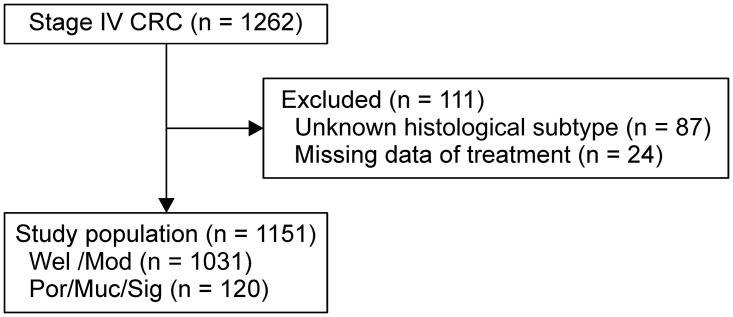
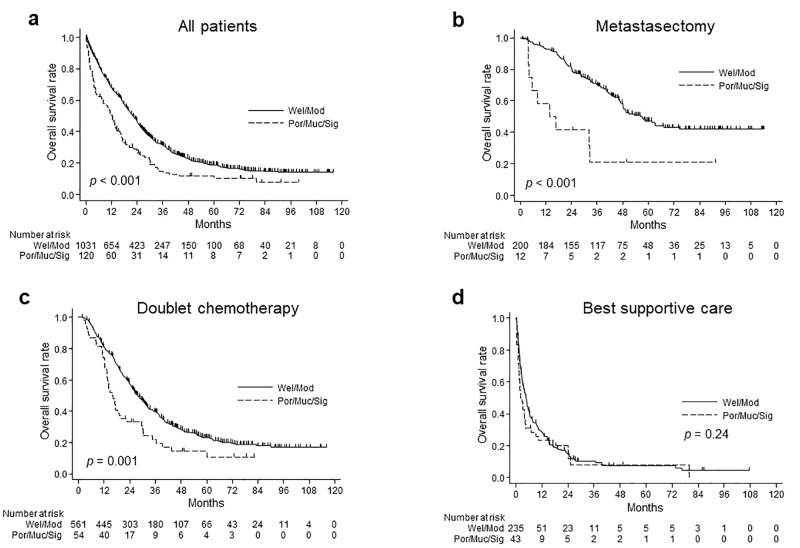
A total of 1,151 patients were enrolled, and 1,031 and 120 had Wel/Mod and Por/Muc/Sig, respectively. The median overall survival was 19.2 and 11.9 months for Wel/Mod and Por/Muc/Sig, respectively (p < 0.001). The adjusted hazard ratio for Por/Muc/Sig with regard to survival time was 1.42 (95% confidence interval: 1.13-1.77). Por/Muc/Sig had a lower incidence of liver and lung metastases and a higher incidence of peritoneal dissemination and metastasis to rare organs, such as the bone and brain.
The Por/Muc/Sig histological subtype was an independent prognostic factor for poor prognosis among patients with stage IV colorectal cancer. The histological subtype may be useful for predicting the prognosis of patients with stage IV colorectal cancer and designing the treatment strategy.
有一些已确立的 IV 期结直肠癌预后因素。因此,本研究旨在评估组织学亚型对 IV 期结直肠癌患者预后和转移模式的影响。
这是一项基于人群的多中心队列研究。我们纳入了 2008 年至 2015 年期间在日本福岛县所有指定癌症医院诊断为 IV 期结直肠癌的连续患者。根据组织学亚型将患者分为两组:低分化腺癌(Por)、黏液腺癌(Muc)或印戒细胞癌(Sig)和高分化腺癌(Wel)或中分化腺癌(Mod)。我们评估了这些组织学组与生存时间之间的关系。在调整其他临床因素后,我们计算了 Por/Muc/Sig 的危险比。
共纳入 1151 例患者,Wel/Mod 和 Por/Muc/Sig 分别为 1031 例和 120 例。Wel/Mod 和 Por/Muc/Sig 的中位总生存期分别为 19.2 个月和 11.9 个月(p<0.001)。Por/Muc/Sig 对生存时间的调整危险比为 1.42(95%置信区间:1.13-1.77)。Por/Muc/Sig 肝转移和肺转移发生率较低,腹膜播散和转移至罕见器官(如骨和脑)的发生率较高。
Por/Muc/Sig 组织学亚型是 IV 期结直肠癌患者预后不良的独立预后因素。组织学亚型可能有助于预测 IV 期结直肠癌患者的预后,并制定治疗策略。