Fundação Oswaldo Cruz, Instituto Oswaldo Cruz, Laboratório de Educação em Ambiente e Saúde, Rio de Janeiro, RJ, Brasil.
Universidade Federal do Ceará, Departamento de Análises Clínicas e Toxicológicas, Fortaleza, CE, Brasil.
Rev Soc Bras Med Trop. 2022 Feb 25;55:e0389. doi: 10.1590/0037-8682-0389-2021. eCollection 2022.
The World Health Organization recommends reliable point-of-care (POC) diagnostic testing to eliminate schistosomiasis. Lateral flow immunoassay that detects schistosome circulating cathodic antigen (CCA) in urine to establish prevalence thresholds for intervention in endemic areas is recommended. Stored urine may be useful if surveying at-risk populations is delayed or interrupted by unforeseen circumstances, such as the current COVID-19 pandemic. This study evaluated the manufacturer's claim that Schistosoma mansoni infection can be reliably diagnosed in urine samples stored at -20°C for one year.
Two-hundred-forty-two subjects from an endemic site in Brazil provided one urine sample each for testing with URINE CCA (SCHISTO) ECO TESTE® (POC-ECO) and one stool sample each for testing with Kato-Katz (KK) and Helmintex® (HTX) as a robust reference standard for infection status. At least 2 ml of urine from each participant was stored at -20°C; after one year, 76 samples were randomly selected for POC-ECO retesting.
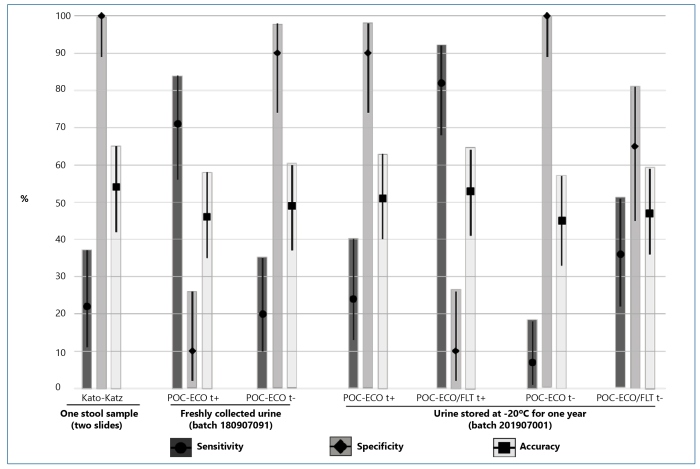
The POC-ECO agreement between freshly collected and stored urine was inadequate considering trace results as positive (Cohen's kappa coefficient κ = 0.08) and negative (κ = 0.36). POC-ECO accuracy was not significantly greater than that of routine KK (54%; 95% confidence interval: 42.1%-65.5%).
The precision and accuracy of POC-ECO have to be optimized in both freshly collected and stored urine before it can be recommended for use in control programs in Brazil.
世界卫生组织建议使用可靠的即时检测(POC)诊断测试来消除血吸虫病。推荐使用侧向流动免疫测定法检测尿液中的血吸虫循环阴极抗原(CCA),以确定在流行地区进行干预的患病率阈值。如果对高危人群的调查因不可预见的情况(如当前的 COVID-19 大流行)而延迟或中断,那么储存的尿液可能会很有用。本研究评估了制造商的说法,即在 -20°C 下储存一年的尿液样本中可以可靠地诊断曼氏血吸虫感染。
从巴西一个流行地区采集了 242 名参与者的一份尿液样本,用于检测 URINE CCA(SCHISTO)ECO TESTE®(POC-ECO),以及一份粪便样本,用于检测 Kato-Katz(KK)和 Helmintex®(HTX),作为感染状态的可靠参考标准。每个参与者至少采集 2 毫升尿液,储存在 -20°C 下;一年后,随机选择 76 个样本进行 POC-ECO 复测。
考虑到痕量结果为阳性(Cohen's kappa 系数κ=0.08)和阴性(κ=0.36),新鲜采集和储存尿液之间的 POC-ECO 一致性不足。POC-ECO 的准确性并不显著高于常规 KK(54%;95%置信区间:42.1%-65.5%)。
在推荐在巴西的控制项目中使用 POC-ECO 之前,必须优化其在新鲜采集和储存尿液中的精密度和准确性。