Sikonja Jaka, Brecelj Jernej, Zerjav Tansek Mojca, Repic Lampret Barbka, Drole Torkar Ana, Klemencic Simona, Lipovec Neza, Stefanova Kralj Valentina, Bertok Sara, Kovac Jernej, Faganel Kotnik Barbara, Tesarova Marketa, Remec Ziga Iztok, Debeljak Marusa, Battelino Tadej, Groselj Urh
Faculty of Medicine, University of Ljubljana, Ljubljana, Slovenia.
Department of Gastroenterology, Hepatology and Nutrition, University Children's Hospital, UMC Ljubljana, Ljubljana, Slovenia.
Mol Genet Metab Rep. 2021 Dec 16;30:100836. doi: 10.1016/j.ymgmr.2021.100836. eCollection 2022 Mar.
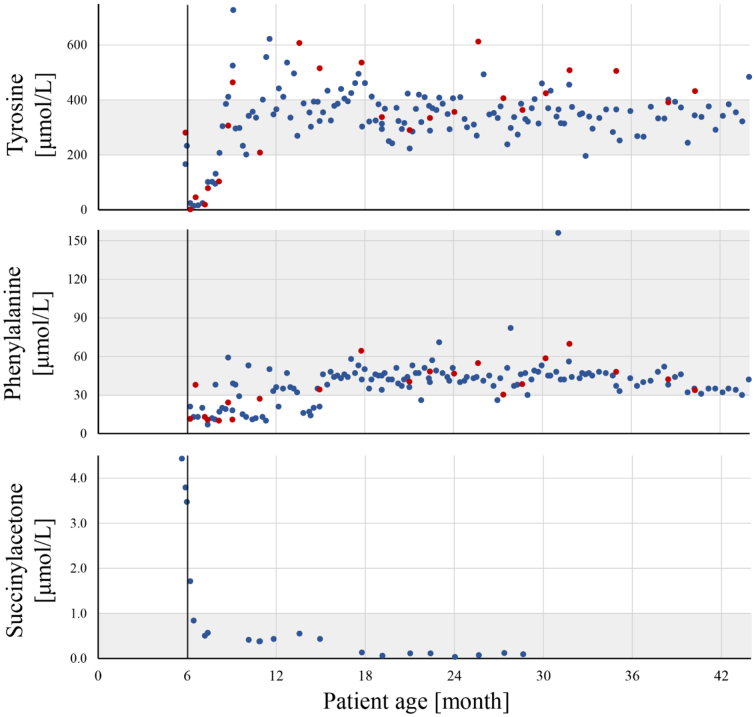
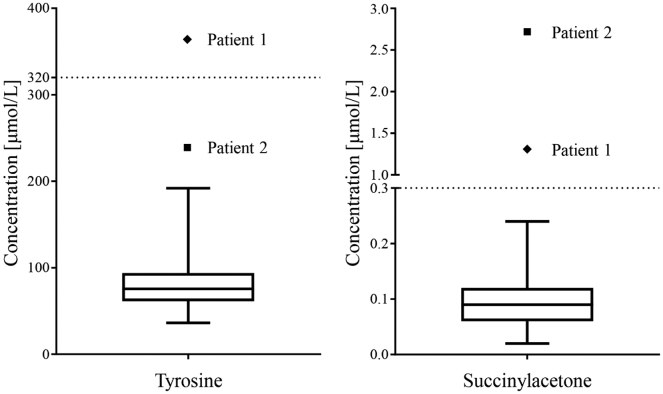
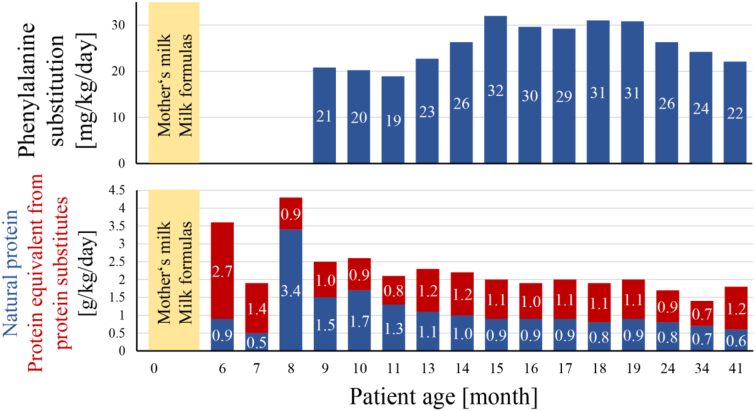
Tyrosinemia type 1 (HT1) is an inborn error of tyrosine catabolism that leads to severe liver, kidney, and neurological dysfunction. Newborn screening (NBS) can enable a timely diagnosis and early initiation of treatment. We presented the follow up of the only two Slovenian patients diagnosed with HT1. Metabolic control was monitored by measuring tyrosine, phenylalanine and succinylacetone from dried blood spots (DBSs). Retrograde screening of HT1 was performed from DBSs taken at birth using tandem mass spectrometry. First patient was diagnosed at the age of 6 months in the asymptomatic phase due to an abnormal liver echogenicity, the other presented at 2.5 months with an acute liver failure and needed a liver transplantation. The first was a compound heterozygote for a novel intronic variant c.607-21A>G and c.192G>T whereas the second was homozygous for c.192G>T. At the non-transplanted patient, 66% of tyrosine and 79% of phenylalanine measurements were in strict reference ranges of 200-400 μmol/L and >30 μmol/L, respectively, which resulted in a favorable cognitive outcome at 3.6 years. On retrograde screening, both patients had elevated SA levels; on the other hand, tyrosine was elevated only at one. We showed that non-coding regions should be analyzed when clinical and biochemical markers are characteristic of HT1. DBSs represent a convenient sample type for frequent amino acid monitoring. Retrograde diagnosis of HT1 was possible after more than three years of birth with SA as a primary marker, complemented by tyrosine.
1型酪氨酸血症(HT1)是一种酪氨酸分解代谢的先天性缺陷,可导致严重的肝脏、肾脏和神经功能障碍。新生儿筛查(NBS)能够实现及时诊断并尽早开始治疗。我们介绍了仅有的两名被诊断为HT1的斯洛文尼亚患者的随访情况。通过测量干血斑(DBS)中的酪氨酸、苯丙氨酸和琥珀酰丙酮来监测代谢控制情况。使用串联质谱法对出生时采集的DBS进行HT1的逆向筛查。首例患者在6个月无症状期因肝脏回声异常而被诊断,另一例在2.5个月时出现急性肝衰竭,需要进行肝移植。首例患者是一种新型内含子变异c.607-21A>G和c.192G>T的复合杂合子,而第二例是c.192G>T的纯合子。在未接受移植的患者中,66%的酪氨酸和79%的苯丙氨酸测量值分别严格处于200 - 400μmol/L和>30μmol/L的参考范围内,这使得该患者在3.6岁时获得了良好的认知结果。在逆向筛查中,两名患者的琥珀酰丙酮(SA)水平均升高;另一方面,只有一名患者的酪氨酸水平升高。我们表明,当临床和生化指标具有HT1的特征时,应分析非编码区。DBS是用于频繁氨基酸监测的便捷样本类型。以SA作为主要标志物,辅以酪氨酸,在出生三年多后对HT1进行逆向诊断是可行的。